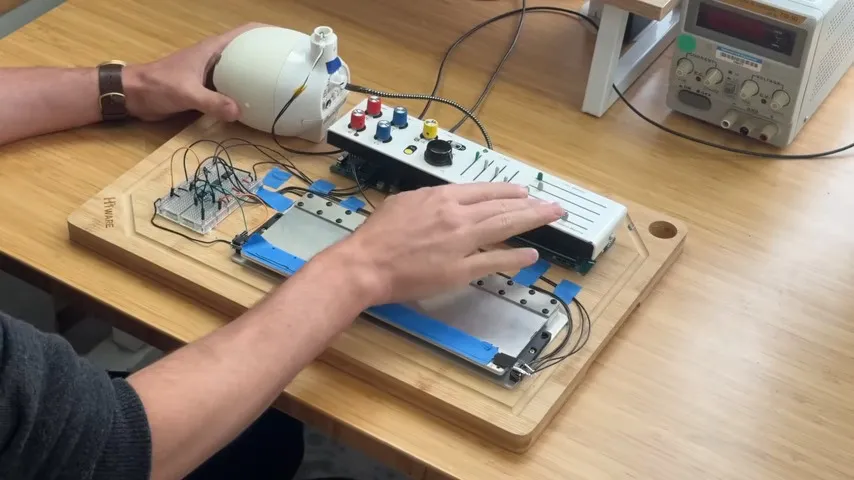
Analog synths are fun because they combine music, which all humans seem hard-wired to enjoy in one form or another, and electronics, which… uh, this is Hackaday. If you don’t like electronics, we’re not sure what to tell you. This hack from [Sound Workshop] takes the cheap, toy-like Otamatone and turns it into an older and more capable type of synthesizer: a Trautonium. The video below also includes a dive into the different types of early synthesizers, with examples of them playing, so it’s worth watching for that alone — if you know the history, skip the first five minutes or so.
For those of you more into the electronics than the music side of things, the Otamatone is kind of like an electronic slide whistle, but adorable. Shaped like an eighth note or a tadpole, you control pitch by sliding your fingers up and down the ‘tail’ and activate the voice by squeezing the ‘head’ to open the mouth. It is one of the newest electronic instruments on the market, having debuted as a Japanese toy in 2009.
The Trautonium is more than five times older, having been invented in 1930, and is a more capable instrument. It keeps the pitch slider, but adds some nice tactile bumps so you can actually hit specific notes– but more importantly, it adds tactile volume control. The pitch slider on the Trautonium is horizontal rather than vertical, and it doubles as a volume control: the harder you push, the louder it gets. That means everything musical is done with one hand, leaving the other hand free to twist knobs or work patch cables to max out the analog electronic fun.
The build itself starts at about 6:55 into the video. In simplest terms — audio out from the Otamatone goes through a low-pass filter, whose volume slider has been replaced by a pair of hall-effect sensors tracking the vertical motion of a flexing plate of metal. The original touch sensor has been glued to that plate, giving the one-finger pitch-and-volume control of a Trautonium. The circuitry gluing it all together is made of a handful of op-amps and passives– there’s no Arduino here, this is analog country.
If this isn’t enough Trautonium for you, we did a deep dive on the instrument long, long ago. We’ve also seen analog synths shaped like everything from keyboards to hurdy-gurdies.