“Thrash,” like just about every shark thriller, has a grade-Z son-of-“Jaws” quality. (The one exception: the ingenious “Open Water.”) Everything in the movie, from the chomping shark attacks that splash up the waves with Hawaiian Punch foam to the way a humongous great white meets her fate at the end, takes an obvious page from Steven Spielberg’s gambits and techniques. But shark movies, because of that derivative quality (and because the directors are not Spielberg), often tend to be dreary and claustrophobic affairs. Whereas “Thrash” has a lively competence about it, a touch of fluid originality in the staging.
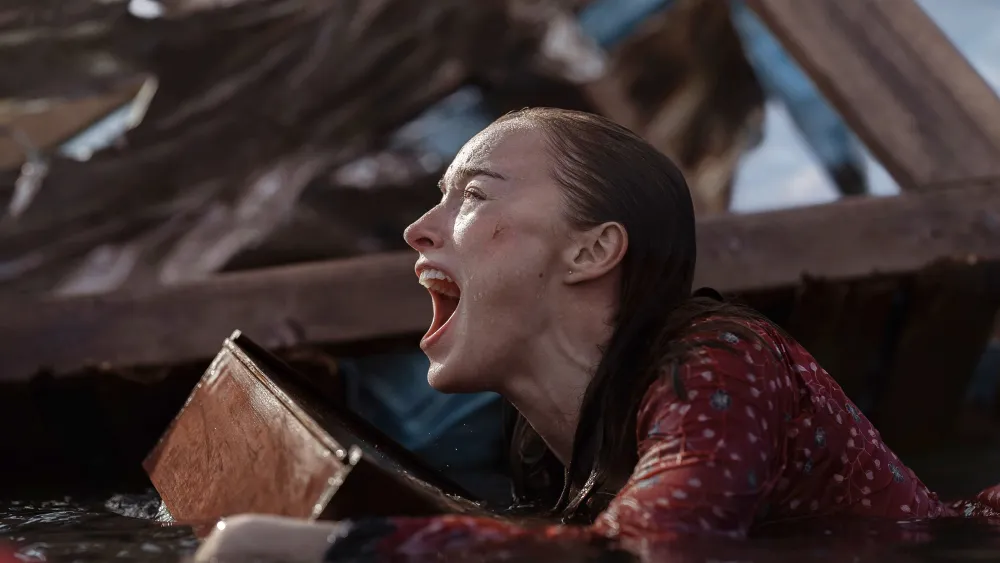
It’s set in the small town of Annieville, S.C., which in the first half hour gets subjected to a hurricane so intense it’s like a tsunami, bolstered by vintage stupido lines like, “If they ever considered creating a Category 6, this would be it. It’s a monster!” It’s all part of the film’s environmental message (the storm starts off as a Category 2 until it hits record-temperature warm waters off the coast). But once Hurricane Henry floods the town, the film’s writer-director, Tommy Wirkola, turns a submerged neighborhood block into a kind of water-world stage set, like a giant pond with the top halves of houses poking out the top. They’re places of refuge, only they keep shifting and collapsing.
The storm has brought with it a school of bull sharks, who are smaller and faster than great whites, but just as ravenous. The movie wastes no time delivering the gory goods, which are served up for our delectation like the killings in a slasher movie. If fear was once the pulse of a shark thriller, now it’s voyeurism — our chance to feast on what it looks like when a shark feasts. In this case, though, only the unappealing characters get eaten. That’s part of the lip-smacking quality of it all — the idea that certain movie characters deserve to have their limbs bitten off.
Of the ones in “Thrash” who don’t, the most original character is Lisa (played by Phoebe Dynevor, from “Fair Play”), not because there’s anything complex in how she’s drawn, but because she’s pregnant — as in not just about to have a baby, but she’s going to have it during the movie, as she struggles to wriggle away from the sharks. That sounds precarious, and is, but once her infant son has popped out, talk about providing someone with motivation to take on nature’s predators. She’s assisted by Dakota (Whitney Peak), the film’s other, younger heroine, who at one point makes her way over a floating rooftop and rickety branches, improvising the acrobatics of survival. Dakota, whose mother recently died, is being raised by her marine-biologist uncle, played by Djimon Hounsou as the film’s token scientist-philosopher of disaster.
Wirkola, who’s Norwegian, has written a bare-bones script, but he knows how to play with space. He stages an encounter in which Ron (Stacy Clausen), a teenage okie foster child, is swimming around in a basement, with that great white on his tail, and the sequence has a delectably flowing sense of danger.
Mostly, though, we’re watching the kills come right on cue. This is a Netflix and Chomp movie, just 80 minutes long (if you don’t count the closing credits), and the compact run time does more than keep “Thrash” from wearing out its welcome. It’s part of the film’s lean-and-mean structural unity — the way it treats an entire underwater street and its houses like the shark boat in the last act of “Jaws,” as a safety zone that’s rapidly disintegrating. Ron and his two siblings have been living with foster parents who are government-sponging creeps (they eat steak in the basement while tossing their meal-ticket kids packages of Wonder Bread), and when Bob (Josh McConville), the loathsome father, gets what’s coming to him, it’s not scary — it’s closer to mutilation porn. He’s the steak, there to sate our hunger.