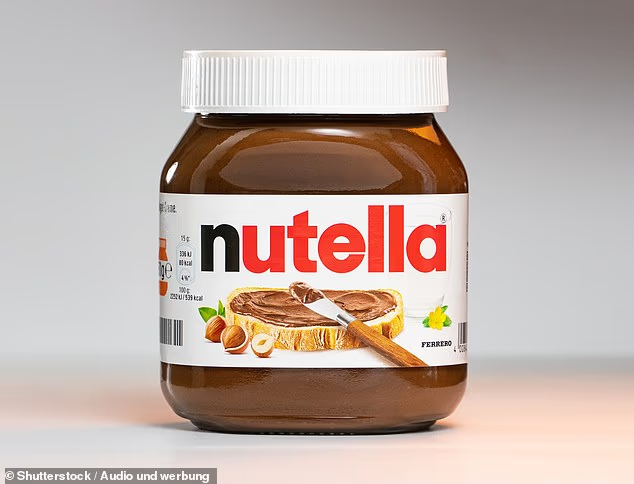
Nutella has become something of a national – or perhaps, now, interplanetary – obsession.
The chocolate and hazelnut spread, first launched by Italian confectionary maker Fererro in the 1960s – is now a staple in millions of kitchens, smeared on toast, spooned over pancakes and, for some, eaten straight from the jar.
Globally, more than 365,000 tonnes are sold annually across 160 countries – enough to fill nearly 150 Olympic-sized swimming pools.
And, as of this week, it has even made it into deep space: a jar of Nutella went viral after it was seen floating around the Orion spacecraft during a livestream of NASA‘s Artemis II mission, moments before astronauts set a record for the furthest distance humans have travelled from Earth.
But behind its wholesome ‘hazlenut spread’ image, and the thousands of Nutella-contaning recipes shared on social media, lies a more complicated nutritional picture.
With more than half its contents made up of sugar, and a significant proportion of fat coming from palm oil, experts say it sits closer to a confectionery than a health food.
Yet nutrition scientists says it can still have a place in a balanced diet – in the right context.
So what is the truth about Nutella – what does it really deliver nutritionally, how does it compare to its rivals, and how can you enjoy it without derailing your diet? We asked Gunter Kuhlne, Professor of Nutrition and Food Science at the University of Reading, to reveal all…
Nutella suggests 15g – roughly a heaped teaspoon – as a portion. This contains around 80 calories, 4.6g of fat and 8.4g of sugar

A jar of Nutella went viral after it was seen floating around the Orion spacecraft during a livestream of NASA’s Artemis II mission

Globally, more than 365,000 tonnes of Nutella are sold annually across 160 countries – enough to fill nearly 150 Olympic-sized swimming pools
What is Nutella made of?
Considering it’s billed as a chocolate and hazelnut spread, it may come as a surprise to learn that the main ingredient in Nutella is sugar – the spread contains 56g per 100g – followed by palm oil.
Palm oil – also found in some peanut butters – has a creamy, semi-solid consistency at room temperature, giving Nutella its smooth, spreadable texture. Ferrero does not disclose the exact amount used, but with 30.9g of fat per 100g, it is likely to make up the bulk of this.
The rest is made up of skimmed milk powder (8.7 per cent), fat-reduced cocoa (7.4 per cent), emulsifiers and flavouring.
So, despite the nuts on the packaging, nutritionally speaking it is closer to a bar of Dairy Milk than something like peanut butter, which is typically around 90 per cent nuts.
How much sugar is there in a serving of Nutella?
Nutella suggests 15g – roughly a heaped teaspoon – as a portion. This contains around 80 calories, 4.6g of fat and 8.4g of sugar.
By comparison, a Krispy Kreme Original Glazed doughnut contains around 10g of sugar – so a single spoonful of Nutella is not far off.

The chocolate and hazelnut spread, first launched by Italian confectionary maker Fererro in the 1960s – is now a staple in millions of kitchens. Pictured, a German Nutella advert circa 1970
Adults are advised to consume no more than 30g of free sugars a day – that is, added sugar as well as sugar in syrups and fruit juices. Just two spoonfuls of Nutella would take you well over half that limit.
For context, Nutella contains roughly the same amount of sugar per 100g as most commercial jams – around 50–60g – although jam is almost fat-free.
It may be more useful to compare it to chocolate: most milk chocolate bars contain around 55g of sugar per 100g, putting Nutella in a very similar range.
Professor Kühne said: ‘The problem with foods that contain this much sugar is that it’s very easy to exceed the recommended 30g per day. High amounts of free sugar are known to have adverse effects on dental health and contribute to heart disease risk and obesity.’
Will eating Nutella make you fat?
Foods containing more than 17.5g of fat per 100g are classed as high in fat, while those with more than 22g of sugar per 100g are considered high in sugar. Nutella exceeds both thresholds.
As a result, it is also highly calorie-dense – providing around 5.3 calories per gram. Any food above 4 calories per gram is considered energy-dense. For comparison, chocolate sits at roughly the same level, while pure fat contains around 9 calories per gram.
Regularly consuming foods that are high in fat, high in sugar and energy-dense is linked to weight gain, as they deliver a large number of calories in relatively small portions.
However, Prof Kühne said: ‘Nutella can be part of a healthy diet, as long as it is combined with other foods that contribute fibre, protein and complex carbohydrates. As long as you don’t eat too much of it and otherwise eat foods low in sugar, it shouldn’t be a problem.’
The issue, he suggests, is that foods like Nutella – which derive much of their energy from sugar and contain little fibre – are not very filling.
This means you may feel hungry again sooner, making it easier to eat more over the course of the day and exceed daily calorie recommendations, which are around 2,000 calories for women and 2,500 for men.
How much Nutella is it okay to eat?
Historically, Nutella packaging suggested a serving size of two tablespoons – around 37g.
Around 2016, Ferrero successfully campaigned to have it reclassified by US regulators, the Food and Drug Administration, as a ‘spread’ rather than a ‘dessert topping’, placing it alongside products such as peanut butter rather than hot fudge sauce.
As a result, the serving size was reduced to the 15g portion listed on packaging today – sometimes referred to in marketing as a ‘happy portion’ – which the company defines as a heaped teaspoon.
Ferrero argued this better reflected how people consume the product. Nutella is also sold in single-serve 15g packs.
However, studies suggest consumers often struggle with, or ignore, recommended portion sizes, frequently pouring or scooping more than intended.
‘From own experience, I think it would be very difficult to spread 15g satisfactorily on a slice of bread,’ said Professor Kühne, adding that one spoon can easily turn into three – ‘and this would take you to just below the entire daily recommended sugar limit for adults.’
Was Nutella banned in some countries?
Nutella has never been officially banned in any country.
However, in 2016, following a European Food Safety Authority (EFSA) report highlighting potential carcinogens formed during the high-temperature refining of palm oil, some media outlets suggested the spread could ’cause cancer’.
At the same time, a number of Italian supermarkets temporarily removed own-brand hazelnut spreads containing palm oil from shelves.
In response, Ferrero launched a TV advertising campaign in Italy defending its product, stating: ‘Like all quality vegetable oils, our palm oil is safe.’ A company spokesperson described the backlash as a ‘smear campaign’.
Despite no formal ban ever being introduced, the claim that Nutella was ‘banned’ has persisted on social media.

Nutritionally there is little difference: The plant-based version contains slightly less sugar – around 45g per 100g compared to 56g – but similar levels of fat and calories
More recently, in 2024, the EU did ban a separate product dubbed ‘Algerian Nutella’ after it failed to meet dairy import standards – further fuelling confusion.
Is Nutella worse for you than chocolate?
Whether Nutella is worse for you than chocolate depends on what type of chocolate you are comparing it to – and how much you eat.
Nutella is broadly similar to milk chocolate in terms of sugar content – both contain around 50–55g per 100g. For example, Dairy Milk contains around 56g of sugar per 100g, roughly the same as Nutella.
Dark chocolate, however, is typically lower in sugar – often closer to 30–40g per 100g – and contains compounds linked to heart health.
The key difference is how it is consumed. While people may eat a few squares of chocolate, spreads like Nutella are easy to over-serve, making it harder to keep portions in check.
Is Nutella healthier than peanut butter?
Peanut butter, in most cases, comes out on top.

Despite containing some hazelnuts, Professor Kühne said this does not offset the sugar and fat content: ‘Sugar is the main ingredient in Nutella’. Pictured, a UK Nutella advert, circa 2000
Many peanut butters are more than 90 per cent peanuts. A 15g serving of a typical brand contains around 96 calories, nearly 8g of fat, and very little sugar – often less than 0.5g.
This is because peanuts are naturally high in fat – but most of it is unsaturated. Replacing saturated fat with unsaturated fat has been linked to lower LDL cholesterol and reduced heart disease risk.
Some peanut butters do contain palm oil for texture, but generally in smaller amounts than Nutella.
Peanut butter is more energy-dense – around 6–7 calories per gram – but this primarily comes from whole nuts. It also contains protein and fibre, both of which are largely lacking in Nutella.
As a result, explains dietitian Sophie Medlin, founder of CityDietitians: ‘Eating peanut butter will help you feel fuller for longer – making you less likely to overeat.’
This may help protect against weight gain. One large cohort study, published in BMJ Nutrition, Prevention & Health, found that people who regularly ate nuts gained less weight over more than 20 years.
There is no equivalent evidence for Nutella. Despite containing some hazelnuts, Professor Kühne said this does not offset the sugar and fat content: ‘Sugar is the main ingredient in Nutella.’
Nutella vs Biscoff – which is worse?
Despite its indulgent reputation, Lotus Biscoff spread contains around 36.8g of sugar per 100g – significantly less than the 56g found in Nutella.
Biscoff spread is made largely from crushed biscuits (around 58 per cent), meaning a fair bit of its carbohydrate content comes from refined wheat flour.
However, it remains a high-sugar, energy-dense food that, if eaten regularly, can contribute to weight gain.
Does Nutella contain palm oil?
Yes, Nutella contains a significant amount of palm oil. As the second ingredient after sugar, it is likely to make up a large proportion of the spread’s fat content.
Palm oil is high in saturated fat. Nutella contains 10.6g of saturated fat per 100g – or around 1.6g per 15g serving. Foods with more than 5g per 100g are considered high in saturated fat.
Adults are advised to consume no more than 30g of saturated fat per day to help manage cholesterol and reduce the risk of heart disease.
Professor Kühne said: ‘One could consume more than 10 portions of Nutella and still remain below the recommended upper limit. But as with sugar, it depends a lot on other aspects of the diet.’

Despite its indulgent reputation, Lotus Biscoff spread contains around 36.8g of sugar per 100g – significantly less than the 56g found in Nutella
There have also been concerns about palm oil when refined at very high temperatures, as this process can produce potentially harmful compounds. However, these are regulated and considered safe at typical levels of consumption.
Is vegan Nutella any healthier than the regular kind?
Ferrero launched Nutella Plant-Based in 2024, using chickpeas and rice syrup in place of milk powder.
The company said the product was developed to meet growing demand for plant-based foods while maintaining the ‘unmistakable Nutella experience’.
Nutritionally, however, there is little difference. The plant-based version contains slightly less sugar – around 45g per 100g compared to 56g – but similar levels of fat and calories.
In practical terms, it is not significantly healthier – just suitable for those avoiding dairy.
Are there some people who shouldn’t eat Nutella?
Yes – while most people can enjoy it occasionally, there are some groups who should limit it or be more cautious.
Because Nutella is high in sugar and low in fibre or protein, eating it on its own can cause a rapid spike in blood glucose. Pairing it with foods such as wholemeal bread or yoghurt may help slow this effect, but it can still make blood sugar harder to manage for people with diabetes or poor glucose control.
Those trying to lose weight may also want to limit it, as it is calorie-dense and easy to overeat. Similarly, people with high cholesterol or at risk of heart disease may need to be mindful, as it contains relatively high levels of saturated fat. Diets high in both sugar and saturated fat have been linked to poorer heart health.
Experts also advise caution when offering it regularly to children. Foods that are high in sugar but low in nutrients that support fullness and stable energy may reinforce a preference for sweet tastes and make it easier to consume excess calories over time.
And, of course, Nutella contains hazelnuts and is not suitable for anyone with a nut allergy.
Which chocolate spread is a healthier alternative to Nutella?
The biggest differences between spreads come down to three things: sugar content, nut content and fibre.
Products with higher nut content – Pin & Nut Cocolate Hazelnut Spread, for instance, is 60 per cent nuts – tend to have more protein and fibre, and lower sugar levels. These are likely to be more filling and have a less dramatic impact on blood sugar.
By contrast, most mainstream chocolate spreads – including supermarket own brands – are nutritionally very similar to Nutella, typically containing around 50g of sugar per 100g.
‘Healthier’ options marketed as low-sugar often replace sugar with sweeteners, which can reduce sugar intake but may have other effects, such as digestive discomfort, if eaten to excess.
Ultimately, experts agree that chocolate spreads are best treated as occasional foods rather than everyday staples.