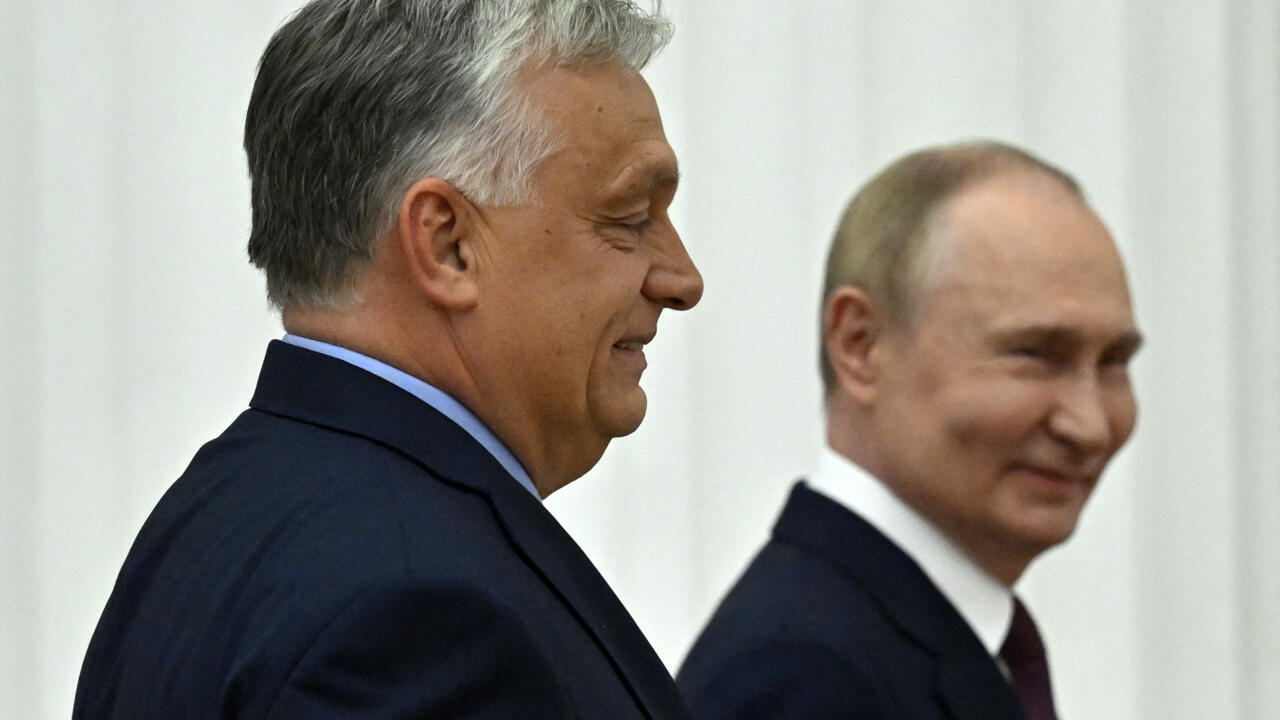
After 16 years in power doing Russia’s bidding in Brussels, Hungarian Prime Minister Viktor Orban’s Fidesz party is at risk of losing power in Sunday’s parliamentary elections, with challenger Peter Magyar significantly ahead in polls.
The Kremlin appears to have pulled out all the stops to boost its man in Budapest. An internal intelligence report for Russia’s SVR intelligence service revealed in March outlined a strategy dubbed “the Gamechanger”, which included staging an assassination attempt against Orban to “fundamentally alter the entire paradigm of the election campaign”.
The Hungarian campaign has seen a major escalation in interference, including “documented influence operations, disinformation campaigns and reports of intelligence-linked activities”, says Edit Zgut-Przybylska, a research affiliate at the Democracy Institute of the Central European University in Budapest and a specialist on democratic backsliding.
Moscow has also been accused of dispatching a team of election “specialists” – linked to the GRU, Russian military intelligence – to Budapest to closely monitor these interference operations.
At this point, “what we are seeing is not interference but the collusion between the Hungarian government and Russia”, says Anton Shekhovtsov, director of the Center for Democratic Integrity in Austria and an expert on the links between Moscow and Europe’s far-right parties.
Shekhovtsov noted that US Vice President JD Vance’s joint appearance with Orban in Budapest earlier this week was another attempt by “foreign interests” to influence the vote. Rightwing US President Donald Trump has even promised to boost Hungary’s economy if Orban wins re-election.
Read more’Ready to govern’ Hungary: Former ally Magyar challenges Orban with Europe gun
Putin’s translator and Moscow’s ‘Trojan Horse’
The appointment of Daria Boyarskaya, a former interpreter for Russian President Vladimir Putin, to the observer team overseeing the vote for the Organization for Security and Cooperation in Europe (OSCE) has come under fire from Hungarian rights groups as well as European lawmakers. An open letter signed by 56 members of the European Parliament last week called for Boyarskaya to be removed from the role, citing her ties to Moscow.
“Russia has a clear interest in keeping Orban in power, because Hungary has consistently acted as a Trojan Horse of the Kremlin who worked against EU decisions on Ukraine and sanctions against Russia,” says Zgut-Przybylska.
Putin would lose his “most loyal and reliable” partner within the European Union, she says – a position only underscored by the leak last week of a conversation in which Orban said he was ready to help Putin in any way he can.
“I am at your service,” he told the Russian president.
Russia has also tried to help Orban leverage the war in neighbouring Ukraine to “reframe the election as an existential choice between ‘Peace and stability’ under Fidesz and ‘Chaos and war’ under Tisza”, Zgut-Przybylska says.
But Moscow’s attempts to sow fear do not appear to have convinced an electorate of disgruntled voters who want the government to do more to help them in their daily lives, including in areas like public education and health care. Opposition challenger Magyar, a former member of Orban’s Fidesz who advocates a more pro-European policy, is leading by some 10 points in the polls.
Read moreWhy Hungary’s Viktor Orban is vilifying Ukraine before crucial elections
Incremental change
Even a win for Tisza would not guarantee that it is able to successfully govern Hungary, observes Shekhovtsov, noting that after 16 years in power, Orban’s party and his allies have made deep inroads into Hungarian political institutions. The current prime minister has done everything he can to ensure his allies, political institutions and friendly media outlets outlive him.
But a Magyar win could mean that Hungary “would begin distancing itself from Russia, though Russian influence would not disappear overnight”, Zgut-Przybylska says. Moscow’s influence could even ramp up, as the Kremlin might actively “work to weaken” a new Hungarian government that was looking to normalise relations with the EU.
“Of course there will be huge attempts by the Russians to undermine Magyar,” Shekhovtsov agrees, adding that Moscow can also expect continued support from Orban from within Hungary.
And Russia still has allies in Europe beyond Hungary – notably in rightwing Prime Minister Robert Fico’s Slovakia – that could continue to undermine pro-Ukraine and pro-European Union policies.
Slovakia would, however, be a weaker replacement as a Russian partner since it is more integrated into the European system and thus has less room for manoeuvre. “Slovakia is part of the eurozone, [so] Fico has more constraints within the EU decision-making system and is less isolated than Hungary,” Zgut-Przybylska says.
‘Vladimir Putin absolutely nervous’ about Hungary’s election, expert says
One of your browser extensions seems to be blocking the video player from loading. To watch this content, you may need to disable it on this site.
Russia might still be able to rely on Hungarian help even if Magyar wins. While he has promised a more Russo-sceptical approach, he is unlikely to make a complete break with Moscow.
“It’s not good for Russia, but it’s not a complete catastrophe for them either,” says Michael Toomey, a specialist in populism in Central Europe at the University of Glasgow, of a possible Magyar win.
Slovakia and Hungary have insisted on retaining access to cheap Russian oil and gas, arguing against or even blocking sanctions on Moscow.
Magyar reportedly also wants to ensure access to Russian energy resources.
“There are a lot of structural reasons for Hungary to want to continue to push for access to Russian oil and gas,” Toomey notes. So while Magyar is more likely than Orban to be supportive of Ukraine – and will be “less of a thorn in the side for the EU” – that does not necessarily mean he will always fall into line.
While the EU has called for all member states to end their reliance on Russian energy by 2027, Magyar has already made clear that Hungary would not be able to do this before 2035.
Read moreHow Orban benefits from Hungary’s tailor-made election system
No one expects Budapest to cut ties with Moscow, says Shekhovtsov. What is expected, he says, is for Hungary “to be a responsible member of the European Union and follow the line of the European Union on Russia”.
And any real break from Russia can only happen if Tisza secures a comfortable majority in Sunday’s vote, which would allow it to avoid making significant ideological compromises just to form a government.
If Magyar wins but doesn’t secure such a majority, Shekhovtsov says, “he will have a huge uphill battle to fight”.
This article has been translated from the original in French.