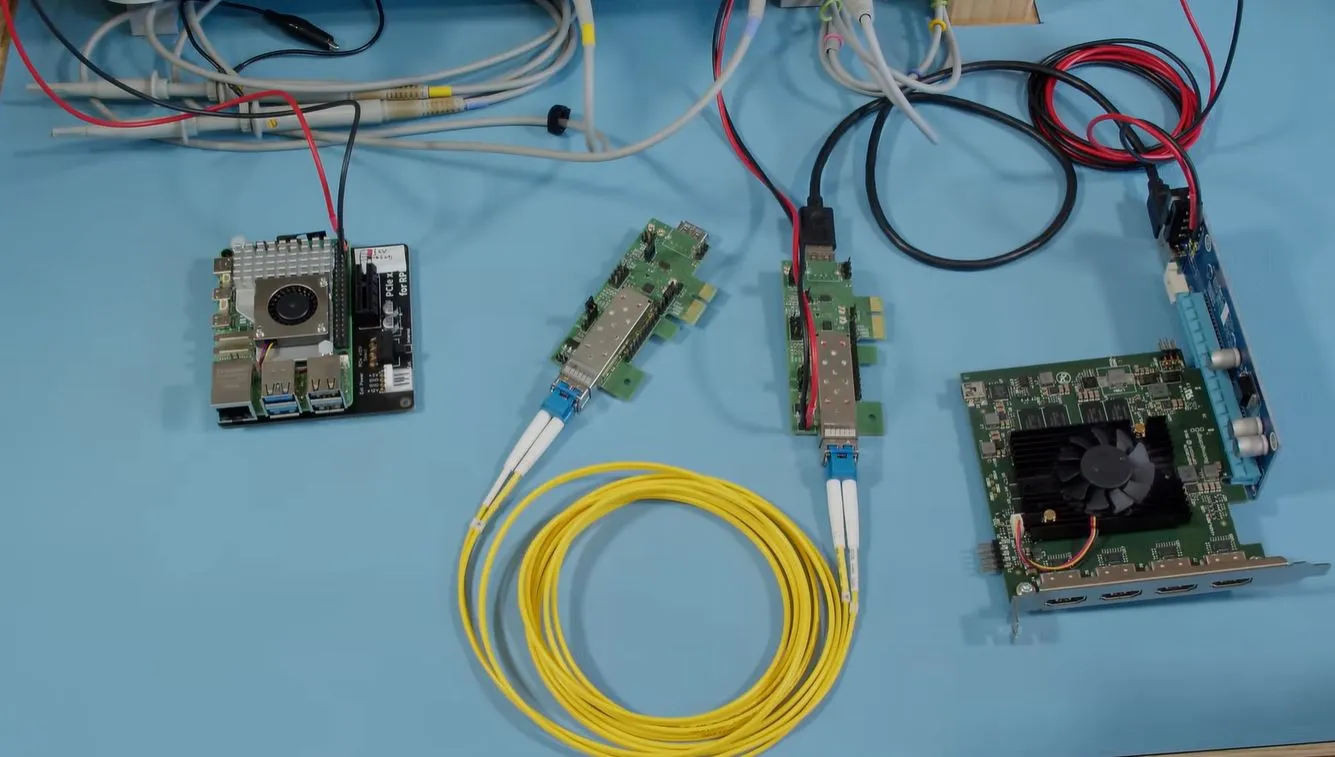
Although we can already buy commercial transceiver solutions that allow us to use PCIe devices like GPUs outside of a PC, these use an encapsulating protocol like Thunderbolt rather than straight PCIe. The appeal of [Sylvain Munaut]’s project is thus that it dodges all that and tries to use plain PCIe with off-the-shelf QSFP transceivers.
As explained in the intro, this doesn’t come without a host of compatibility issues, least of all PCIe device detection, side-channel clocking and for PCIe Gen 3 its equalization training feature that falls flat if you try to send it over an SFP link. Fortunately [Eli Billauer] had done much of the leg work already back in 2016, making Gen 2 PCIe work over SFP+.
The test setup involves a Raspberry Pi 5 on a PCIe breakout board and a PCIe card connected to the whole QSFP intermediate link with custom SFP module PCBs for muxing between PCIe edge connector or USB 3.0 connectors to use those cheap crypto miner adapter boards. The fiber is just simple single-mode fiber. Using this a Gen 2 x1 link can be created without too much fuss, demonstrating the basic principle.
Moving this up to Gen 3 will be challenging and will be featured in future videos, involving more custom PCBs. With Gen 5 now becoming standard on mainboards, it would be great to see this project work for Gen 3 – 5 at link sizes of x4 and even x16 so that it might be able to run external GPUs at full bandwidth unlike Thunderbolt.
Thanks to [zoobab] for the tip.