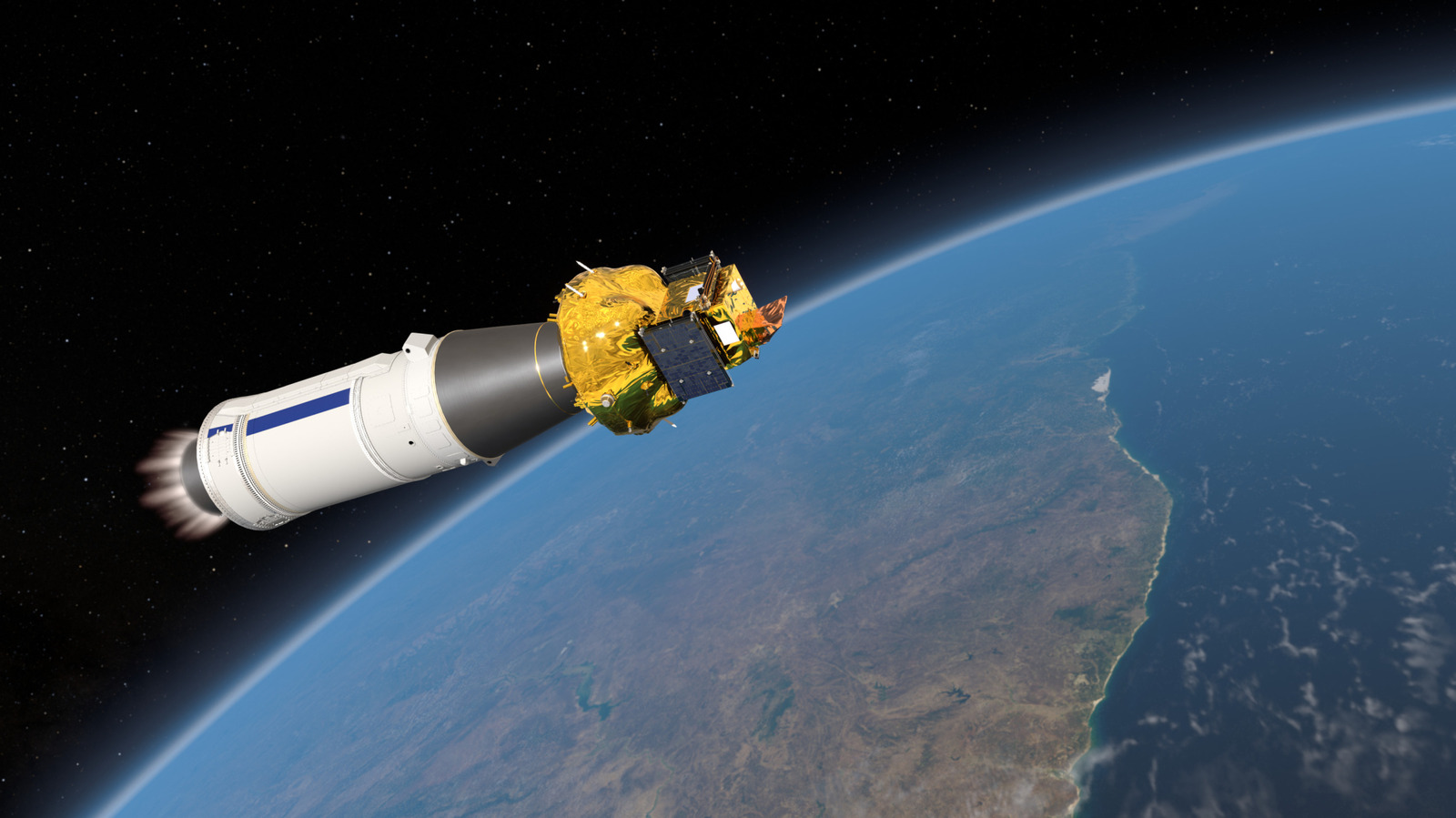
There are now thousands of satellites orbiting Earth, but there’s still a surprisingly basic thing we haven’t yet targeted well. The Earth is often bombarded with solar storms, but so far, we’ve yet to observe the planet’s magnetic field respond to them in real time. Now, a spacecraft built jointly by China and Europe is on the verge of doing just that. The spacecraft is launching as part of SMILE, which stands for Solar wind Magnetosphere Ionosphere Link Explorer.
The venture is the first comprehensive, mission-level space science partnership between the Chinese Academy of Sciences and the European Space Agency. That includes designing, building, and operating the whole thing. The collaboration actually traces back to 2015. That’s when ESA and CAS put out a joint call for mission ideas. SMILE was picked from 13 proposals and entered its study phase a decade ago, in early 2016.
Once SMILE launches, it will head for an unusually elliptical orbit that will swing from just 5,000 kilometers over the South Pole to a whopping 121,000 kilometers above the North Pole. The point of the wider arc is to give the instruments a better vantage point for watching how solar wind slams into Earth’s magnetosphere. That’s important because when that interaction is strong enough, it can trigger geomagnetic storms, which can sometimes be dangerous. Moreover, solar storms can even be a problem for satellites in low-Earth orbit.
Scientists currently have a decent understanding of how the interaction takes place. But the picture is incomplete. There are existing missions like the NASA MMS and the ESA-NASA SOHO spacecraft built for similar purposes. But they’re designed for individual events affecting localized areas, rather than a broad global perspective.
What SMILE aims to learn
Since none of the existing solutions can show the full picture at once, SMILE is designed to fill in this gap. It features a soft X-ray imager, which will map the boundaries of the magnetosphere globally for the first time. The goal is to watch how Earth’s magnetic shield changes shape when solar eruptions pass by.
Better observations could also help predict geomagnetic storms before they hit. Some of these storms are powerful enough to disrupt satellite navigation and radio communications around the world. The last notable one, which hit in May 2024, did just that. Then there was the much worse one from back in 1989, which actually knocked out Quebec’s entire power grid for nine hours, leaving millions without electricity. It’s a reminder of why solar storms affect power grids in the first place. Problems like these can be prevented with better forecasting, as they would give operators time to shut down vulnerable systems in advance.
That said, as is often the case with ambitious space missions, SMILE has run into some snags. It was supposed to lift off on April 9 from Europe’s spaceport in French Guiana. However, ESA announced that the launch had been postponed due to a technical issue on a subsystem component production line. As of writing, we don’t have a new launch date yet.