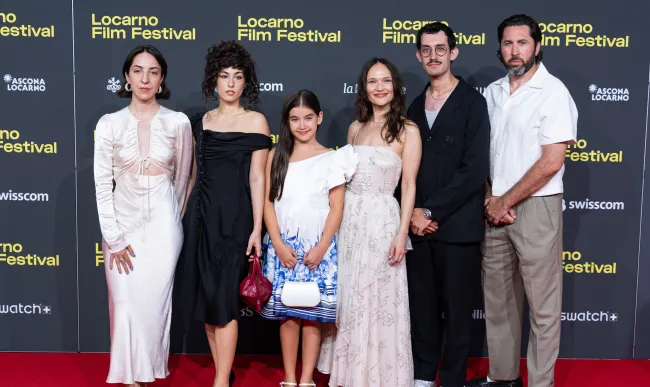
The brief history of cinema is filled with filmmakers obsessed with memory, both in their storytelling and as a cinematic device. How to make a movie feel or look like a memory is something we often hear directors talk about when discussing their formal choices.
But for Canadian-Hungarian director Sophy Romvari, the role of memory in her work is something far more personal and fundamental. “I use filmmaking as an aid to memory, something that I feel like can help justify or validate something I have been through,” said Romvari in an upcoming episode of IndieWire’s Filmmaker Toolkit podcast.
The imperfection of memory and the exploration and processing of what is not entirely knowable are themes that run through Romvari’s shorts, now streaming on the Criterion Channel, which the filmmaker jokingly described as “lonely girls on laptops.”

“That’s the repeated theme, just a woman on a computer looking at images from the past,” said Romvari of her shorts. “There is a fascination with trying to access something that is inaccessible.”
Her master’s thesis film, “Still Processing,” features Romvari digitizing and looking at her father’s old photographs and videos, and discovering footage of her deceased brother in the process. The second half is a fictional recreation of the making of the film itself — the meta aspect of Romvari’s work is underlined by the director also being the film’s subject.
Her shorts are hybrid documentaries, and were Romvari’s attempt at “figuring out what modes I want to work in.” Her new film, “Blue Heron,” is different, not only because it is Romvari’s first scripted narrative feature, but because each decision, both in terms of its structure and the filmmaking behind it, was wholly intentional.
If those shorts were early sketches, “Blue Heron” is the masterful painting resulting from the more informal explorations. Romvari’s aim with her first feature was as simple as it was complex: “I really wanted to show someone trying to unravel their own life.”
While the protagonist’s name is Sascha, not Sophy, “Blue Heron” is autobiographical. The film is split into two distinct halves, separated by 20 years and united by Romvari’s own journey to better understand her late brother and reconcile her memories of him.

In the first half of the film, Sascha (Eylul Guven) is eight years old. It’s the summer of 1998, and her Hungarian immigrant family has just moved to Vancouver Island. The family’s fresh start is interrupted by the increasingly dangerous behavior of Sascha’s older brother, Jeremy (Edik Beddoes). What is behind this behavior is a mystery to their parents, and they run through medical professionals, unable to diagnose or treat him. Romvari’s camera and direction make Jeremy equally unknowable to the audience and Sascha.
“The mystery of [Jeremy in the film] is important because I think it’s significant to anyone who has had a person like this in their family to address the fact that you can’t always know them,” said Romvari. “You can’t actually access who they are because sometimes people don’t want to be seen or understood. They don’t allow you in, and that’s part of what my experience was, just the frustration of never really having access and never really understanding.”
Romvari doesn’t remember if the things she knows about her brother were things she was told, or she overheard, or her actual memories of things she saw. The act of creating a scripted version gave her permission to take certain liberties in recreating it, but as Sascha is caught in the blast radius of Jeremy’s increasingly frightening behavior, Romvari doesn’t necessarily place us in the young protagonist’s perspective.
“I didn’t want to be dogmatic about point of view, because I think oftentimes films that are about children are through the eyes of the child, only what we see from the child,” said Romvari. “But if you’re dealing with memory, I think oftentimes you can remember things that you never saw. It’s like an implied memory.”
Inspired by her own father’s home movies and director Robert Altman, Romvari and cinematographer Maya Bankovic settled into longer takes, the camera on a tripod, and employing zooms to create a sense of movement. “Zooms [have] this very haunting point of view, a drifting feeling, and it really suited the form of the film,” said Romvari.
Combined with the long lens zooms, sound is used to evoke a sense of memory and what it felt like to be in that house as a young girl. “Sound is also tied to other senses. It almost feels like you can smell sound, it’s strange to say, but when you can hear people cutting grass or someone cooking in the kitchen, it starts to employ all of your senses at once, and can bring you back in time,” said Romvari. “We’re shooting these long zoom shots, there’s a lot that’s hidden from you that’s outside the frame, so we were doing a lot to imply things that are off-screen [with sound], especially with Jeremy.”
Romvari keeps the sound of her neighbors present as well. While the family feels isolated, they aren’t, and sound lends itself to the ominous sense people are watching and they are being judged.
The first half of the film comes to an end when Sascha’s parents are forced to face an impossible decision — if there is one thing that is concrete of Romvari’s exploration of her memories, it’s the empathic portrait she paints of her dedicated parents’ journey. The transition to the film’s second half, a 20-year time jump, is done simply with a phone call — ’90s landline to iPhone — between Sascha and her parents.

“I really wanted it to feel also like one of those conversations that you’ve had with your parents a thousand times,” said Romvari. “She asks, ‘What do you think is wrong with Jeremy? Why do you think he’s like this?’ And then, 20 years goes by, and they’re still having that same conversation.”
With Jeremy now gone, it’s a question adult Sascha has taken up with her work as a documentary filmmaker: hosting roundtables with medical professionals, interviewing one of her family’s social workers on Zoom (the lonely girl on a laptop returns), and finding people who knew Jeremy on social media. While Sascha’s documentary techniques are ones Romvari employed herself, it’s a recreated and more carefully crafted version, while leaning into the magic of movies (to say more would be a spoiler) to fold the film’s first half into the second.
Explained Romvari, “I really wanted the audience to feel like once you’re in Sascha’s world as an adult, you’re questioning the first half: Was that her memories, or was that the film that she’s making? Is that something we’re seeing now in retrospect? I really do fall into a trap, I love meta filmmaking.”
If it is a trap, it’s of a gifted and perceptive filmmaker using the medium to unravel their own life, a journey that lands in a familiar place for Romvari.
“I wanted to show that this character is given that access, and it still doesn’t change the outcome of the situation,” said Romvari. “And ultimately, the thesis of the film is having to accept that reality.”
Janus Films will release “Blue Heron” in New York City on Friday, April 17 and Friday, April 24 in LA, with a nationwide expansion in May.
To hear Romvari’s full interview, publishing later this week, subscribe to the Filmmaker Toolkit podcast on Apple, Spotify, or your favorite podcast platform.