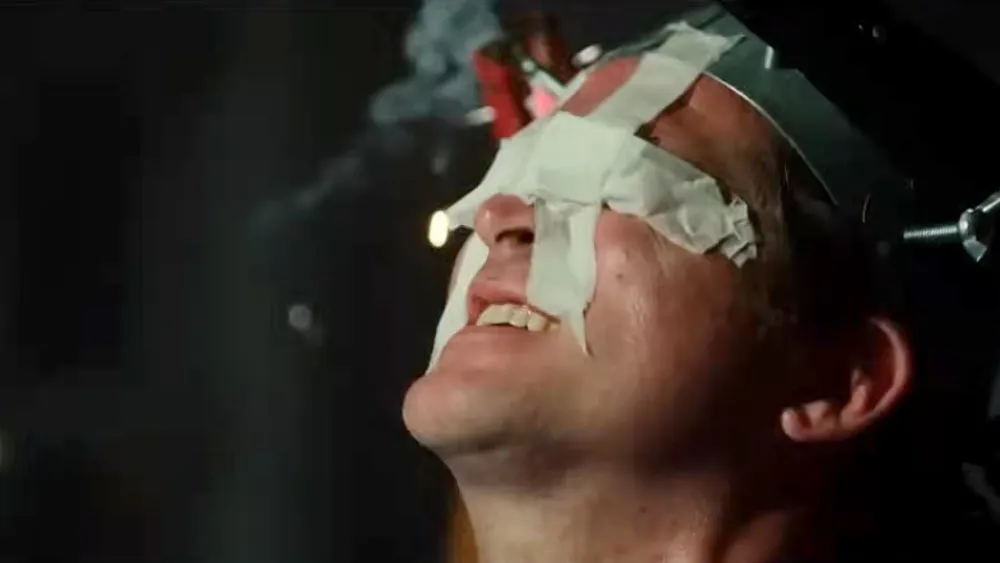
Isa Mazzei is a writer and filmmaker best known for Blumhouse’s hit “Cam” and Neon’s “How to Blow Up a Pipeline.” Her memoir “Camgirl” was named one of NPR’s “books we love.” She is co-writer and executive producer on the just-released “Faces of Death” from IFC Films. Here, Mazzei shares the essay “Tetris,” one she penned about millennials, the advent of digital violence and what it means to be a spectator to trauma. – Matt Donnelly
The man bleeds out slowly, a metal fence jutting through his ruptured abdomen. His mouth opens and closes like a fish, a small trickle of blood at the corner of his lip. I tab over to an open DM thread.
Hi, I’m a producer on a feature film. I’m licensing content to use in the movie and would like to ask if you are the owner of this video, and if you know the name of the victim — No, that isn’t right. I delete the word “victim” and replace it with “man.” I turn to my friend and production assistant Paris Peterson, who I’ve promoted to… snuff film curator? We haven’t decided on a title.
“Is this a man? Can you tell?”
It’s early 2023 and Daniel Goldhaber and I are adapting the film “Faces of Death,” a cult hit from 1978. Our adaptation centers on a content moderator who spends her days cleaning the internet of the worst of the worst content. I have been tasked with sourcing what that is.
People begin to associate me with snuff. Two years later, when Charlie Kirk is shot, multiple friends will send me the uncensored video. I receive the Charlie Kirk video the day after it happens — Sept. 11, 2025. It feels convenient, the latest viral death so closely juxtaposed with the anniversary of my first encounter with it. Like many millennials, my relationship with digital death began at ten years old as I watched people plunge from the World Trade Center. Inches from the television, I tried to make sense of what I was being told: each of those smudges was a human being.
Years later, in middle school, I watched my first beheading on LiveLeak. Videos like that were still shocking. My friends and I asked each other in hushed whispers: should we try to look it up in the library at lunch? We were scared of how excited we were to watch the painfully slow sawing of knife through bone. I always thought it would be easier to behead someone, we said, as if this were something we had thought about a lot. I grew up in Colorado during the Columbine school shooting, during the aftermath of 9/11. I grew up afraid. As we clustered around the old clunky desktops watching people die, it felt like a necessary ritual, a charm of self-protection. I remember looking for monsters in the dark corners of my room at night. If I can see it, it can’t hurt me.
“Faces of Death” co-writer Isa Mazzei.
LOGAN BIK
The original “Faces of Death,” which claimed to be a documentary, heralded the rise of the viral video. A white-coated narrator leads the viewer through a collection of snuff films. The VHS release was super popular, despite the “banned in several countries” warning (promise?) slapped on the cover. It was whispered about at sleepovers, the subject of numerous rumors, but when I first watched it, I thought it fell short of its reputation. Since I had seen so much real snuff, I could tell that most of the videos were staged, although — and this was confirmed to us by the film’s producers — at least one of the videos has an actual dead body.
In doing research for the film, Daniel and I listened to a podcast about people employed by social media sites to review content that has been flagged as explicit. The podcast investigated if viewing this content, day after day, week after week, could cause actual PTSD, despite the moderator remaining safely on the other side of the screen. The DSM says yes — but only when done for work. The DSM-5 criteria for PTSD explicitly states that a diagnosis of PTSD “does not apply to exposure through electronic media, television, movies, or pictures. Unless this exposure is work related.”1
In 2021, a year into writing our adaptation, I’m on my couch when my phone vibrates. Are you watching this? The texts come from many places at once. I open a Livestream from the parking lot of the King Soopers grocery store half a mile from my old high school. It is the grocery store where my first boyfriend bought me my first Cherry Garcia ice cream, the grocery store where I was once bitten by a tiny chihuahua. It is the grocery store where right now several of my friends’ parents and neighbors are going to die. Though I am only watching a witness’ livestream, I feel like I’m doing something wrong. I cannot look away. I think if I do, something worse will happen. It does not occur to me that nothing worse could happen.
“It’s kind of fucked up, if you think about it,” Daniel says, two years later on set in New Orleans. “To put real death in a feature film, we have to go through all these legal loopholes. But Instagram can just… show it? What is that?” He’s right. For a movie studio to make money off real violence they must first discuss it with a room full of lawyers, draw up contracts, releases. But social media companies make money off of ads and not videos directly. They can hide their culpability. In a lot of ways, I realize, this is what our “Faces of Death” is about.
I think about the most violent video I’ve seen online. Ronald Merle McNutt, a U.S. Army veteran, sits at his desk. He’s got a dark leather jacket, a long curly beard, and a rifle. His last words are pointed: “Hey guys, I guess that’s it.” He places the rifle against his chin and pulls the trigger. The technical definition of snuff is a death video made for profit — and this is not that. But that doesn’t change the fact that companies are making money off of it. Daniel and I decide it is important to confront people with the nature of online snuff by changing its context. We want to talk about the depersonalization that screens can cause. We want to create the sense of being complicit in something wrong. We want the audience to leave the theater feeling complicated and maybe a bit mad at us.
We need to find real dead people. I start on Twitter, on Instagram, on Reddit, on 4Chan. I find the video of the man with his mouth open like a fish. Paris barely glances over. “Is that the Russian impaling one? I already emailed them, the dude died though.” If the person was dead it was a lot harder to get a release. We’d have to hunt down next of kin. “I guess we can just blur his face.” I delete the part in my message about knowing the victim and simply ask if @username is the rightful owner of this video. I close my laptop. Sometimes I prefer not knowing if the person lived or died. I drive home through rainy New Orleans streets. In the murky twilight, everything looks like a corpse: a man electrocuted on the third rail, his dead body jerking with the current. A tiny child, tossed between the paws of a bear. A woman, face-down, blood mixing with mud.
I wonder if you can create a story about a monster using the monster. I’m watching these videos for work. I wonder if that means that the DSM-5 applies to me. In line at craft service the next day Paris tells me he has found a website called NewsFlare. Its collection includes videos of violent accidents. Because it is a news website, it is all available to license, legally. They have train crashes and car crashes and animal attacks and industrial accidents and fires and — I load my plate with scrambled eggs, hash browns, hot sauce. I don’t have trouble eating because I have become unfazed by death. I decide this isn’t a good thing but I don’t have time to think about it because I have a movie to finish and as long as everything is legal I can say I was just doing my best. Right?
Around the time I was hired to make “Faces of Death,” a study imaged the brains of combat veterans before and after playing Tetris. It found an increase in the volumes of the hippocampus, suggesting that playing Tetris might be an effective adjunct treatment for PTSD. It was based on an earlier study which found that playing Tetris in the emergency room immediately following a traumatic accident would decrease the amount of traumatic intrusive thoughts post-accident. The theory is that it works by disrupting the consolidation of sensory elements of trauma memory. The later study suggests it affects more than just the formation of traumatic memory – it can even potentially help treat it. It is the summer of 2025 and our film has wrapped production. I am visiting my hometown. My mother and I stop by the King Soopers grocery store — I have not been back since the mass shooting. When we walk through the doors we are blasted with icy air and that chemical smell of bread in plastic bags. It is busier inside than we expect: we shop in a rush. Back in the car, on my phone, I tab from Youtube to Instagram and scroll my stories. The sixth mass extinction is worse than previously predicted – and this time it’s entirely caused by humans! Scroll. A perfect night for beet gnocchi. Scroll. POV: you found your dream bikini. Scroll. Belarusian traveler attacks Iranian toddler at Moscow airport, leaving child in a coma. A blurry video shows a man bashing a child against a hard, shiny floor. As we pull out of the King Soopers’ parking lot, I realize that I forgot to have a profound experience.
In Feminist Tech, Neema Githere uses the term “data trauma” (first coined by Olivia Ross) to describe the effect of scrolling through a feed and encountering images of violence alongside memes and selfies. It is the glaring incongruity of watching a mass shooting underneath a YouTube banner ad for Dove Deodorant (now aluminum free!). I recall scrolling my Twitter feed a few years prior. Beneath a meme about eggs, I witnessed my favorite artist’s suicide note: “I’m away now, thanks.” Githere imagines a framework for recovery from this particular type of trauma and in this way, offers a glimpse of hope: There is a possibility where we do not normalize this.
I think about all the people I paid to license the videos they took of accidents, of dismemberments, of death. In the end we decided we wouldn’t show the faces of people who actually died and that we’d mostly show accidents where people lived. We’d argue for hours about the ethics of this too. After the mass shooting they closed the King Sooper for several months, balloons and flowers and stuffed bears lined the side of the road. When they renovated and re-opened, they framed it as resiliency and strength in the face of adversity. Don’t let fear win! Avocados on sale today only. There is a possibility where we do not normalize this. (Is there?)
Today, I watch the video of the assassination of Charlie Kirk. I wonder at the hundreds of images I have seen in the past few years – of famine, of genocide, of a brother carrying his dead sibling in a plastic bag. I have not been paid to see any of these videos — the distinction is absurd. I have seen death every day, and I have seen it decontextualized, ripped away from its source and placed in neat square boxes between advertisements and pictures of my friends. I watch the video of Charlie Kirk several times. I cannot look away, because watching it is a spell. I wonder what the monster is that I’m trying to protect myself from. I finally close my phone and open my laptop. I open my browser and I search for a game.I play Tetris, just in case.