Will Yellowstone erupt or are we blowing things out of proportion?
We may have underestimated Yellowstone’s potential to blow its stack in the future. Chinese scientists have made a disconcerting find regarding the mechanism behind the caldera’s eruption, sparking concerns that it could belch lava sooner than we’d hoped, per an explosive study in the journal Science.
Contrary to prior scholarship, which suggested that the magma originates in large deep chambers, the new study suggests that it could be lurking just below Earth’s surface.
The team, from the Institute of Geology and Geophysics of the Chinese Academy of Sciences (IGGCAS), had set out to study the engine behind supervolcanoes — volcanic expulsions that eject over 230 cubic miles of magma, rock and ash.
Ranking among the most cataclysmic geological events on Earth, these eruptions can have devastating effects on both the environment and human civilization alike.
The Yellowstone supervolcano Yellowstone supervolcano, which lies underneath a 30–by–45–mile crater Yellowstone Caldera, has produced three such supereruptions in the the past 2.1 million years, per the US Geological Survey (USGS).
If one were to occur today, it could create worldwide impacts, including massive pyroclastic flows, feet of toxic ash inundating the Midwest, and agricultural ruin with a projected $3 trillion in damages and millions of lives threatened.
To shed light on the mechanism behind magma generation in supervolcanoes, the team had devised a comprehensive three-dimensional model of western North America.
This facsimile simulated the present-day dynamics of both the lithosphere — the cold, outermost layer of the Earth — and asthenosphere, the hot and slow-flowing ductile mantle underneath that drives volcanic eruptions.
Prior scholarship suggested that supervolcanoes harbored large magma changes that will amass molten rock until the pressure grew to powerful and prompt an eruption. However, these reservoirs were conspicuously absent from the large supervolcanoes.
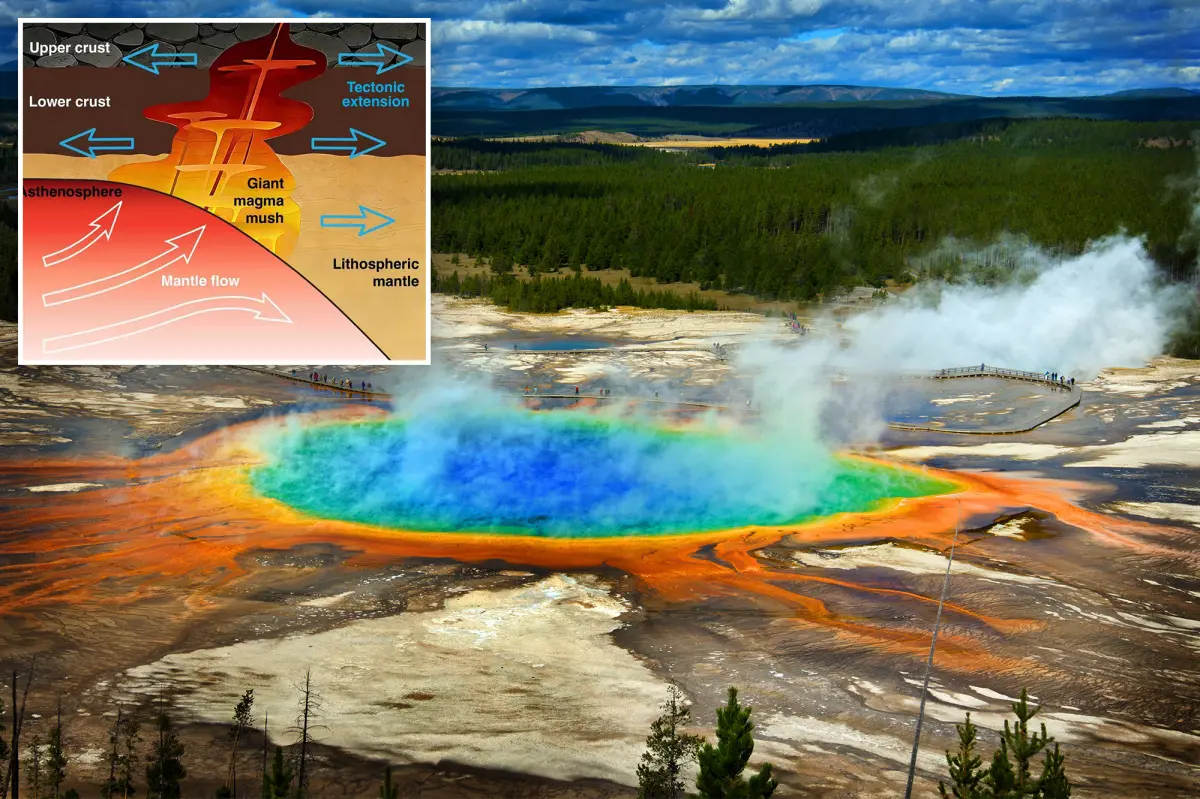
However, using this latest model, the team discovered that the eruption is generated via a much shallower source — large, sprawling zones of partially molten rock called “magma mush” systems that permeate much of the Earth’s lithosphere.
Magma originates in the upper asthenosphere and ascends into the outer layer, where it it mixes with surrounding solid rocks to form a viscous magma mush. However, the mechanism behind how it melts in the first place remains unclear.
All the while, a hot rock is steadily flowing eastward beneath the caldera, ripping apart the lithosphere’s hard rock, and forging a channel through which the molten rock can rise and fill the volcano’s mush reservoir with molten rock.
This means that a supervolcano can replenish its magma supply via tectonic activity alone sans the need for some deep lava chamber.
Thankfully, Yellowstone isn’t slated to blow its top anytime soon. Based on the prior three eruptions, there has been an average of around 725,000 between events, meaning we technically have 100,000 years to go before the next one.
And, as the USGS experts pointed out, “this is based on the average of just two time intervals between the eruptions, which is meaningless.”
Plus, even if the caldera does go off again, it might not even be large as the most “the most recent volcanic eruption at Yellowstone was a lava flow that occurred 70,000 years ago.”
“Yellowstone is not overdue for an eruption,” they declared. “Volcanoes do not work in predictable ways and their eruptions do not follow predictable schedules.”