Cris Sánchez believed he had left Cuba for good when he moved to London in 1994, but concerns for his ailing parents brought him back in 2018. Since then, the strain of life in Havana has caused him to turn to prescription drugs – “Just to take the edge off things,” he said.
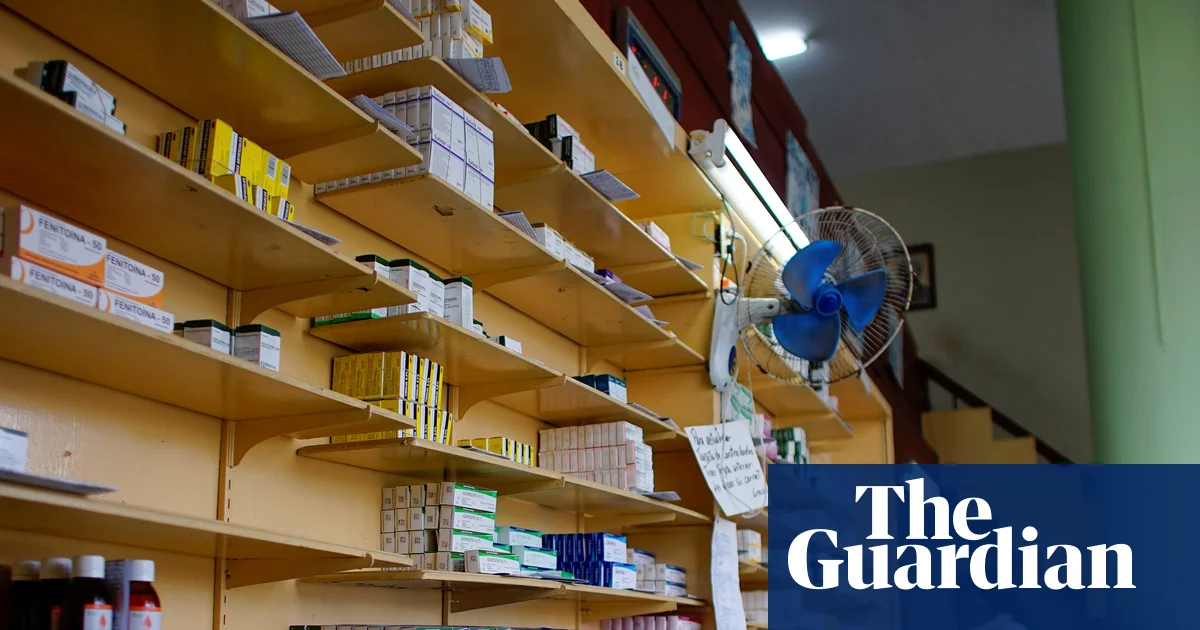
He is not alone. Currently under a US-imposed oil blockade, and following years of economic decline, Cubans are self-administering regulated drugs in growing numbers, as a mental health crisis envelopes the island.
There are few official statistics – the Cuban government has long been keen to emphasise its people’s “resilience” – but the Guardian spoke to healthcare professionals the length and breadth of the island, who reported that most families include at least one member turning to the black market to buy antidepressants, mood stabilisers or stimulants.
“My mother had a penchant for prescription drugs,” said Sánchez, who trained as a linguist and taught at University College London. “She decided that she needed them each day.” His mother suffers from Alzheimer’s, so he worked hard to help her break her habit – only to turn to antidepressants himself.
He is not an addict, but was keen to speak out and highlight how easy it is to slip into regular use. “I don’t regret coming back to look after my parents, but there’s very little I love about being in Cuba,” he said. “I liked my life in London and I don’t much like this one.”
A reliance on prescription medication is not new in Cuba, but recent events have led to a surge.
“We are experiencing an economic situation that has repercussions whether we like it or not,” said a professor of psychology in Cuba’s second city of Santiago, who asked to remain anonymous in order to speak freely.
“On a daily basis, someone might wake up without electricity, without the certainty of breakfast, or without knowing how they will get to work. This generates a great deal of stress, which is accompanied by numerous psychological manifestations: depression, intense anxiety and mental fatigue. As a result, mental health issues have increased tremendously.”
A senior aid worker in Havana said: “I’m witnessing this every day.”
Following the US government’s 3 January abduction of Venezuela’s president, Nicolás Maduro, Donald Trump signed an executive order imposing tariffs on any country supplying Cuba with fuel. As a result, blackouts that were already racking the island have grown worse. Petrol stations are shuttered and there is little transport. Most state offices, where 50% of the working population are employed, are closed, leaving people with little to focus on beyond surviving, and their uncertain future.
“We are in difficult times, but also a defining time, and here is a people who prefer to die standing than living on their knees,” said President Miguel Díaz-Canel last month to a visiting group of foreign supporters, including the former UK Labour leader Jeremy Corbyn.
But it seems that many Cubans are actually struggling to get out of bed. Meanwhile, even before the current crisis, Cuba’s GDP had contracted by 17% since 2019. The government is all but out of money, and so the state pharmacies are empty.
So, now people look for relief on the black market. “There has been an increase in the number of people consuming psychotropic medications without a prescription,” the psychology professor said. It only takes a phone call for the drugs, often in packages with Cyrillic, Indian or Chinese script, to be delivered by electric bikes, but at a cost.
Cubans’ reliance on psychotropic drugs goes back to the early 1990s when the communist government lost its sponsor, the Soviet Union, in what the then president, Fidel Castro, called the “Special period in the time of peace”.
On paper, it was a worse crisis than the current one, with the economy contracting by at least 35%. Most Cuban homes carry the marks of that time, in the photographs of healthy children surrounded by skeletal adults, the passionate conversations about food over lunch – and the reliance on prescription drugs.
At the time, doctors were quick to prescribe, and state pharmacies could provide. Another carer, who also asked to remain anonymous, said that during the special period the authorities went out of their way to fund the manufacture of psychoactive drugs. “They would have known that the country was overconsuming these types of medications, and the effect they have, but it suited them to keep people calm.”
When the situation eased – tourism was introduced, the US dollar became commonplace and a new ally was found in Hugo Chávez’s Venezuela – the use of these drugs receded. For a while, Cubans foresaw a better future, especially in 2016 when then US president Barack Obama arrived on the island to “bury the last vestiges of the cold war”.
But those hopes were extinguished. The Cuban government continued to drag its heels over economic reform, Donald Trump’s first administration returned to a policy of maximum pressure, and Covid arrived, along with hyper-inflation, beggaring anyone on a state salary or pension.
In July 2021, protests against the state surged across the island, to be put down with force. People, often the young, started leaving in large numbers, with up to 20% of the population fleeing abroad in the last five years. All of which has added to the psychological load on those who chose (or were forced) to remain.
“The stress is manifesting itself in a variety of ways,” said the psychology professor. “There are people losing their hair with no underlying physiological explanation. Or they struggle to concentrate – taking an hour over a task that previously would have taken 10 minutes.”
In the countryside, the problems are just as acute but the cost of black market prescription drugs means people are relying on more natural options. “People here make infusions from mint, chamomile, basil, lime and lemongrass,” said 28 year-old Rosangela Reyes in El Cobre, a town where people go to pray to Cuba’s patron saint, La Virgen de la Caridad del Cobre.
She was watching the body of a young cancer victim being unloaded and carried into the morgue, a death she said wasn’t associated with the economic situation, but that power cuts and a lack of medicines hadn’t helped.
In the cities, and especially among the young, there has been a concurrent swing towards illicit drugs, long anathema in Cuba, and traditionally subject to harsh prison sentences. “There is a segment of the population that we professionals cannot access very easily,” said the psychology professor. “And that is precisely where the consumption of hard drugs that are far more lethal and potent than psychotropic medications is taking place.”
The best known is “el químico”, a synthetic cannabinoid known elsewhere as spice. The Cuban government, with good reason, accuses the US – which generally berates Latin American countries for being the wellspring of drugs – of being the source.
Most users though, have turned to familiar crutches: benzodiazepines such as chlordiazepoxide and clonazepam, or else alprazolam (known as Xanax), or amitriptyline and sertraline.
These days, Cuba’s disparities in wealth are obvious to anyone walking a Havana street. The generation who built the revolution has seen their pensions reduced to less than $10 a month, while the owners of private businesses, permitted since the economy crashed in 2021, drive past in Mercedes.
Gabriel Menéndez, a teacher in Santa Clara, a town 200 miles from Havana, said that the special period was very tough for him: “After the birth of my second child, we didn’t have enough money to live.” Yet, he finds this crisis harder. “This time there is no idea to hold on to, only the need to accept the cruel reality of what is coming.”
Many of the elderly are not only hungry and disillusioned but also terribly alone, their children having left during the exodus, often with beloved grandchildren. “I see them moving around the neighbourhood,” said Sánchez. “They are so lonely. They are seeing the grandchildren grow up on a screen, often not speaking the same language.”
For the psychology professor in Santiago it is no surprise so many have returned to the prescription drugs they last used in the 1990s. “It is precisely the uncertainty – the not knowing how long this might last – that serves as an aggravating factor,” he said. “If you know a problem will last seven days, you might think, ‘I can handle it.’ But we are living through a situation where the end is unknown.”