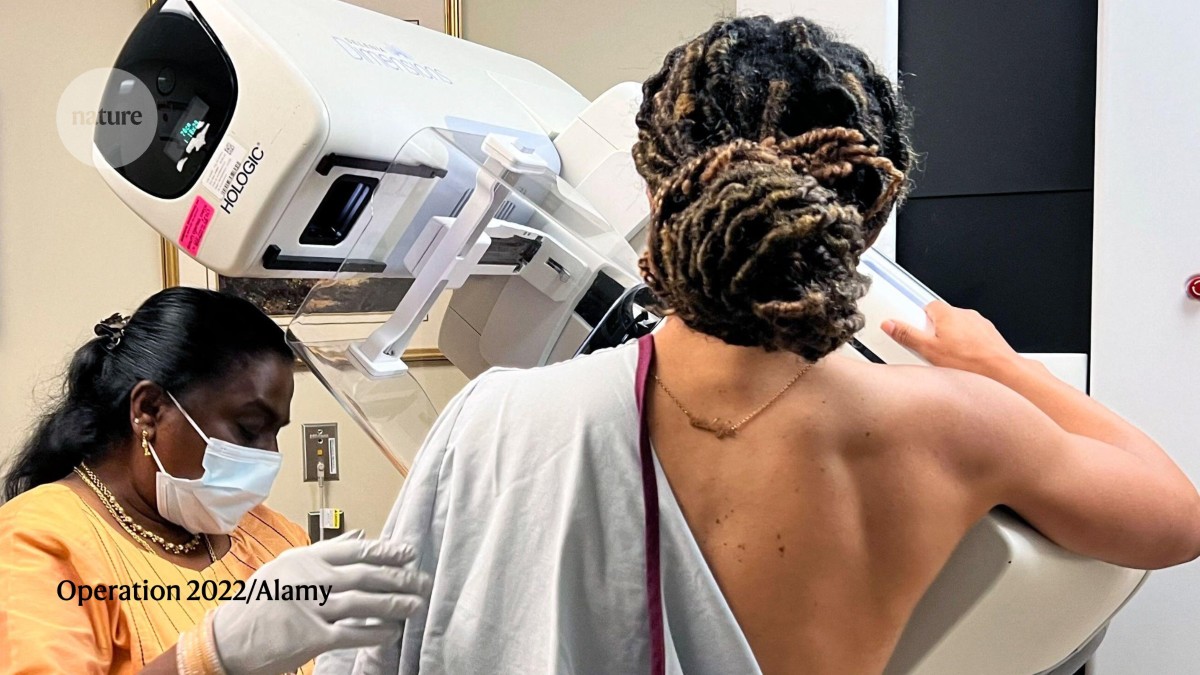
Some countries have lowered the recommended age for mammograms in response to rising rates of early-onset breast cancer.Credit: Operation 2022/Alamy
The question of what age cancer screening should start is getting louder, as increasing numbers of people under 50 are being diagnosed, often well before they are eligible for routine testing.
“There is clearly something going on,” says Yoanna Pumpalova, a medical oncologist who treats colorectal cancer at the Columbia University Irving Medical Center in New York. “I see it every day. I have way too many patients who are my age — I’m 37 — or even younger, and it’s horrible. It’s more than it was five years ago; there’s no question about it.”
In addition to colorectal cancer, there also seems to be an uptick in other types of malignancies, including those affecting the breasts, stomach, kidney and pancreas (see ‘Starting early’). A BMJ Oncology study1 published in 2023 estimated that the global incidence of cancer in people under 50 will increase by more than 30% between 2019 and 2030, the authors citing diet, alcohol consumption and tobacco use as potential risk factors.
Some countries have responded by lowering the screening age for certain cancers. In 2024, Australia lowered the recommended starting age for colorectal cancer screening from 50 to 45, and as of late last year, every province and territory in Canada, except Quebec, had lowered its minimum age for routine breast-cancer screening from 50 to 40 or 45. This year, South Korea launched its new national cancer control plan, which states that from 2028, anyone aged 45 will be eligible for a national colonoscopy screening.
In the United States, recommendations for lowering the screening age are also gaining traction. In 2024, the US Preventive Services Task Force (USPSTF) — an independent panel of medical experts — lowered its recommended starting age for routine mammograms from 50 to 402. The group cited data from the US National Cancer Institute that showed that breast cancer rates among women in their 40s had risen by an average of 2% per year between 2015 and 2019.
The decision to lower the age for routine screening programmes requires a complex assessment of risks, benefits and individual circumstances. The challenge, says Robert Smith, a cancer epidemiologist at the American Cancer Society, a non-profit cancer advocacy and research organization headquartered in Atlanta, Georgia, is weighing the potential gain in lives saved versus the potential harms. Not only is it “very expensive”, Smith says, but broadening eligibility would expose more people to the risks of physical injury and false-positive results. “There really does need to be a certain prevalence of cancer in the population to justify inviting asymptomatic individuals to undergo screening,” he says.
A delicate balance
It’s not clear why some cancers are becoming more prevalent in people under 50. Mark Ebell, a primary care epidemiologist at Michigan State University in East Lansing, suspects that a combination of improved screening technologies and expanded screening programmes is a major factor. “Detection of more cancers in younger persons may just be a consequence of more sensitive and widely used imaging rather than a real increase in incidence.”
Other researchers, including the authors of the BMJ Oncology study, argue that routine screening for under-50s remains too limited to fully explain the trend. Data from the Australian Institute of Health and Welfare show that in 2025, around 7.2% of colorectal cancers in the country were diagnosed in people aged under 40 — a group that would not have been routinely screened — up from 2.2% in 2000.
Nature Index 2026 Cancer
Regardless of what’s behind the increase in early-onset cancers, calls from patient advocacy and support groups to lower the screening ages for certain cancers are intensifying, and some researchers are concerned that it’s being done before the risks are fully understood. Ebell, who served on the USPSTF from 2012 to 2015, says the organization’s decision to lower the recommended screening age for some cancers is being “made in the absence of any new evidence regarding the benefits and harms of screening in younger persons”.
Barron Lerner, a physician and medical historian at the New York University School of Medicine in New York, agrees, and says the USPSTF should evaluate more data to decide whether the changes were really warranted. “It’s a teachable moment for the public about screening,” Lerner says. “While there is an assumption that screening should find every case of cancer at its earliest stage”, achieving this would require expanding testing in ways that would cause unacceptable levels of harm, he adds.
About 10% of mammograms performed in the United States between 2005 and 2017 produced false-positive results that led to additional imaging or biopsy3, for example, and although rare, bowel perforations — when a colonoscopy punctures the wall of the large intestine — can require emergency surgery. “The more you screen, the more people that have the procedure, the more they’re going to have those complications,” Pumpalova says.
There’s also the issue that young bodies can sometimes be less suited to the tests that are used in standardized screening programmes. Smith notes that it can be challenging to spot breast cancer in women in their 30s and early 40s, because they tend to have denser breast tissue, which is difficult for the radiological equipment to see through. After women undergo menopause in their mid-40s to mid-50s, that dense tissue is gradually replaced by fat tissue, which is easier to image, he says.
Rethinking the strategy
Some researchers want to see more personalized screening replace a ‘one-size-fits-all’ approach. Instead of recommending the same annual screening test for everyone above a certain age, clinicians could assess individual risk factors to determine how and when they are screened.
Research seems to support this idea: a randomized clinical trial involving more than 28,000 women in the United States4 found that when mammography frequency is tailored to an individual’s risk profile, it results in some women undergoing screening less often than they would under a routine annual schedule.

Some countries use low-dose computed tomography scans as part of their routine screening programmes for lung cancer.Credit: Kristian Thacker/The New York Times/Redux/eyevine
Sanjay Shete, a population health scientist at the MD Anderson Cancer Center in Houston, Texas, is investigating the use of genetic risk factors, rather than age, to inform patient screening routines. “Below a certain age group, I think we should start looking into more risk-based screening as opposed to simply age-based screening,” he says. “There are several calculators now coming up, which show that maybe one person is, say, 35, but their risk is the same as a 55-year-old because they have strong family history and they have some other risk factors.”
Some researchers are using what’s known as a polygenic risk score to estimate the combined effect of many gene variations in a given patient, and say it could be used to inform a more personalized approach to cancer screening. A study last year5 found that a polygenic risk score was better than the standard prostate-specific antigen blood test in identifying men who benefitted from prostate cancer screening using magnetic resonance imaging.
More comprehensive screening tests — such as a test that can detect multiple cancers at once — would be a game-changer, Pumpalova says, because it would not only expose people to fewer complications less often, but could potentially give them better coverage. Several multi-cancer detection tests now in development aim to spot abnormal DNA, proteins and other markers in the blood, with the potential to identify more cancers than the handful that most countries routinely screen for — namely breast, cervical, colorectal, prostate and, for smokers, lung cancer.
Expanding access
Such technologies are at a very early stage of development, and if they were to be rolled out at a population level sometime in the future, wealthy countries would undoubtedly be the first to do it.
Meanwhile, in low- and middle-income countries, which account for the majority of new cancer cases and deaths worldwide, resources for cancer screening are often extremely limited, even for the most at-risk patients. According to a study6 on the CanScreen5 project, a global cancer-screening data repository run by the International Agency for Research on Cancer, the World Health Organization’s cancer branch, there are major gaps in screening rates between countries.
According to the data set, which includes information on national screening programmes up to September 2022, the proportion of eligible people who received screening in Bangladesh for breast cancer was 1.7%, compared with 85.5% in England, for example. In Côte d’Ivoire, the screening coverage for cervical cancer was 2.1%, and in Sweden, 86.3%. And for colorectal cancer, coverage was 0.6% in Hungary, compared with 64.5% in the Netherlands. Countries with strong policy and funding commitment, either from the government or from health-insurance providers, were more likely to have good coverage, the authors conclude.