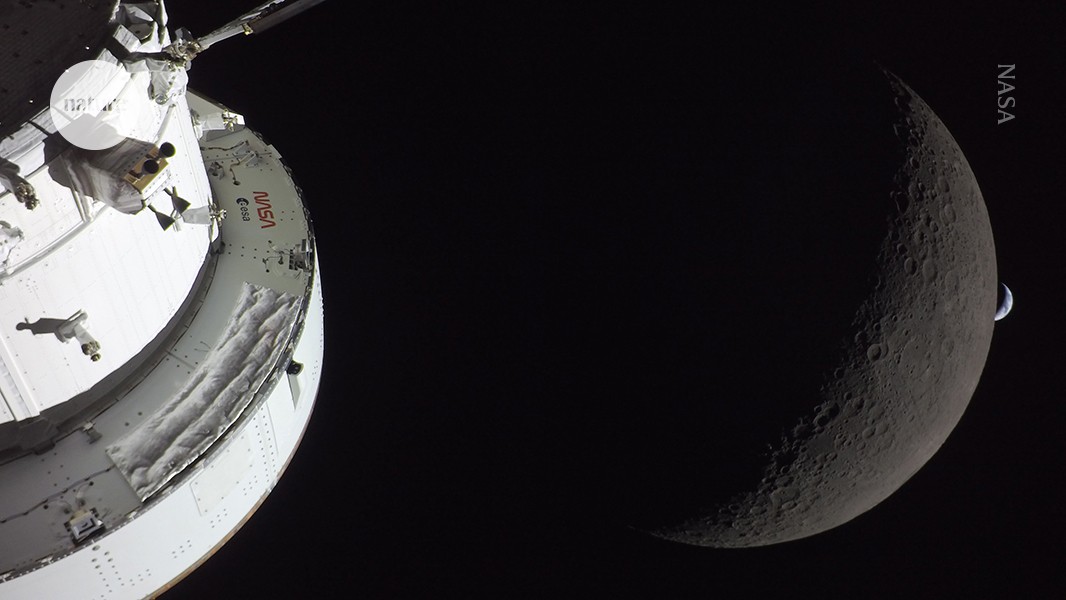
NASA’s Orion spacecraft captures the Moon and Earth in one frame.Credit: NASA
When NASA’s Artemis II mission came back down to Earth on 10 April, so, too, did the dreams of the millions who had followed its journey. Over a ten-day period, four astronauts flew to the Moon and back, becoming the first people to visit Earth’s satellite in more than half a century, and travelling farther than anyone has gone before.
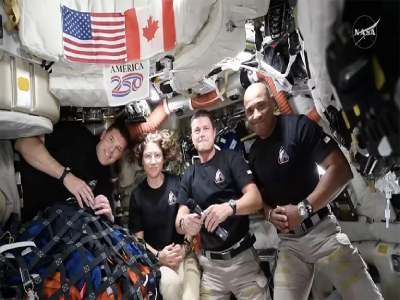
Historic Artemis II Moon fly-by: Nature’s live coverage as it happened
Judging by the breadth and depth of international media coverage, many have been inspired by the voyage. However, the mission has also encountered scepticism — and even cynicism — about its motivation, as well as the value of crewed space flight. Its occurrence at a time of acute geopolitical tension, fuelled by wars in Iran and Ukraine, has stoked an already polarized debate. Meanwhile, for many, a return to the Moon seems an expensive distraction from longer-term problems on Earth, such as climate change and environmental degradation.
But there is much to celebrate. The Artemis II mission showed the world what curiosity and collaboration can achieve. It was not, strictly speaking, a scientific flight, yet it demonstrated some of the best aspects of science. Despite the conflicts and other challenges that humanity is facing on Earth, Artemis II was a global project, driven by a shared spirit of discovery.
Although NASA was at the controls, Artemis II was a multinational endeavour. The European Space Agency’s service module provided the power and propulsion needed to keep NASA’s Orion capsule going. The Canadian Space Agency cheered the presence of its astronaut, Jeremy Hansen, on board. And the space agencies of South Africa, Australia and other nations contributed tracking and other data to help monitor the spacecraft during its flight.
Staying connected
Throughout the mission — and in contrast to overtly political statements made by NASA’s administrator, Jared Isaacman — the Artemis II astronauts emphasized that they were flying not for the United States or Canada, but for all of humanity. Crew member Christina Koch reiterated the message of human connectivity after the astronauts briefly lost contact with Earth as they traversed the far side of the Moon and began their voyage home. “We will always choose each other,” she said. It was a powerful message.
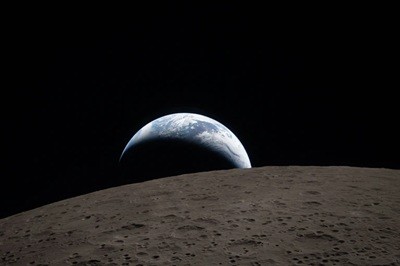
First photos from Artemis II: see stunning ‘Earthset’ and more
Human space flight has always been a polarizing issue, with some in favour and others opposed. Today, robots can accomplish many of the goals of space exploration, making it unnecessary to endanger human lives.
Human space flight also has political overtones. Countries that send astronauts into space do so to project both hard and soft power. And the programmes are expensive. According to the NASA inspector-general’s office, the Artemis II launch cost at least US$4 billion. There are many other ways in which that money might have been spent, on environmental-protection measures at home, for example.
At the same time, NASA’s scientific research must not be sacrificed in the interests of Artemis. While the astronauts were on their way to the Moon, the agency’s leadership proposed slashing support for its science programmes, including earth-science satellites and major observatories. On 3 April, the White House released a plan to cut more than one-fifth of the agency’s budget (to US$18.8 billion in 2027, down from $24.4 billion in 2026). This is unacceptable. Even as NASA pushes forwards with human space flight, it must also find the funds to support missions led by the scientific community across a range of research disciplines.

The Artemis II crew captured this image of a crescent Earth ‘setting’ on the Moon.Credit: NASA
All in all, the cost of Artemis II, which is a small fraction of US government spending, needs to be assessed alongside the mission’s benefits. Although not a science mission, the flight has the potential to change attitudes and inspire a generation of young scientists, as the Apollo missions did more than half a century ago.
Inspiring another generation
Those missions also took place at a time of great rivalry between world powers, armed conflicts and energy crises — as well as one of rising awareness of the environmental consequences of modern technologies. In the late 1960s, the first ‘Earthrise’ photo, taken by Apollo 8 astronaut William Anders while in lunar orbit, became an icon for the burgeoning environmental movement.
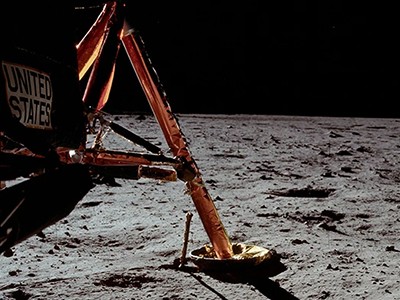
The Moon belongs to all of us — not just countries that can afford to reach it
We hope that the stunning views of Earth taken by the Artemis II astronauts will similarly inspire a generation of researchers, and that they will also continue to underscore the fragility of the planet that humanity calls home.
Space scientists need to lean further into global collaboration. Space agencies, including those of China, India, South Korea and Japan, have been successfully exploring the Moon using robotic orbiters and landers in recent years. Researchers should continue to collaborate on scientific discovery missions and on analysing the lunar samples being brought back to Earth by various programmes.
This is also the time to demonstrate good stewardship of the Moon. As aerospace engineer Moriba Jah writes in a World view column, the governments and companies involved in lunar exploration must, at a minimum, accept that the Moon’s surface belongs to all of humanity (M. Jah Nature 652, 275; 2026). NASA and its international partners need to strengthen their commitment to the general principles laid out in the Artemis Accords, a non-binding set of principles, signed by 61 nations, for safe and sustainable lunar exploration.
Artemis II must not be the starting gun on a new ‘space race’. Instead, space agencies and research teams should accelerate their work across borders to advance humanity’s understanding of the Moon, Mars — and beyond.