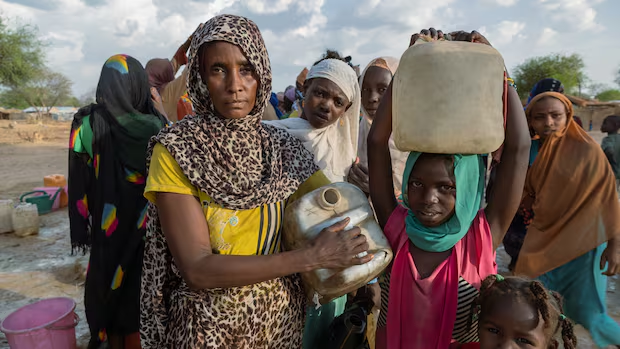
Under a tarpaulin tent, roasting in the midday heat, Nahma Mohammed describes her merciless eight-day journey from Nyala, in Sudan’s Darfur region, to reach safety in Birao, Central African Republic.
“The journey was extremely difficult … there were thieves, armed men and weapons everywhere,” she said, bouncing her youngest child on her knee. “It was like walking a path between life and death.”
She’s one of the dozens of new arrivals waiting in the dust hoping to have their photos taken and fingerprints scanned, joining more than 22,000 living in the Korsi Refugee camp and the 4.4 million Sudanese who’ve been displaced across the country’s borders.
Three years on from the outbreak of war in Sudan in April 2023, the country is in the grip of what the United Nations now calls the world’s worst displacement crisis, with more than 11 million people forced from their homes.
What started as a confrontation between two military leaders — the Sudanese army chief Gen. Abdel Fattah al-Burhan and the RSF leader Mohamed Hamdan Dagalo — has since fractured into a complex conflict.
Now, the army (SAF) controls much of the east and centre of the country, while RSF forces dominate large parts of the west, like Darfur. The targeting of civilian infrastructure such as hospitals, and the growing use of drone warfare, has created a deadly environment for civilians.
According to the IFRC, an estimated 33 million people are in need of assistance, while humanitarian and development budgets have been slashed worldwide. UN estimates put the death toll at 40,000, though many believe this is conservative and could be up to 10 times higher.
Influx of refugees
Birao’s population has surged as refugees cross the border. Reaching the camp from the border point at Am Dafok is a 65-kilometre journey through a region that remains unstable due to the presence of RSF and local armed militia.

When refugees arrive in this isolated region, little awaits them. The Central African Republic is one of the poorest countries in the world — World Bank estimates suggest nearly seven out of 10 people live on less than $2.15 US per day.
Hikmah Hussain was among the first refugees to arrive in 2023. Three years later, she still remembers the moment that forced her to flee Nyala: the death of her sister.
“Shrapnel hit her right in the heart, on the left side … she died right there,” Hussain said, recalling the moment her sister was killed during an aerial bombardment.
“This was what scared us and made us leave … we said to ourselves, ‘If we stay, these kinds of bombs will get us.'”
Before fleeing, Hussain worked with the Sudanese Red Crescent in Darfur. She remembers the chaos of the first weeks of fighting.

“The planes would come early in the morning and start bombing,” she said. “We would gather the bodies and take them to hospital.”
On one occasion, she recalls, RSF fighters seized their vehicle, forcing them to take shelter inside a hospital alongside those injured in airstrikes.
“There was chaos, we had to escape … everyone was running for their lives.”
International funding cuts
At a water point in the camp, long lines of women gather with jerry cans, waiting their turn to fill up for their families. Several say there isn’t enough potable water. Weaving through the erected tents in the Sahara, refugees stop to ask for food, water, soap and clothing — items they say have become scarce.
According to dozens of refugees, assistance was more readily available in the early stages of the war.
NGO Oxfam says U.S. funding for the refugee response nearly halved between 2024 and 2025, while inside Sudan, less than 40 per cent of the $4.2 billion US Humanitarian Response Plan was funded in 2025, down from 70 per cent the year before.
Meanwhile, needs are rising — 21.2 million people face acute food insecurity.

Multiple civil society organizations, including Human Rights Watch and Amnesty International, have also reported widespread abuses, including sexual violence, gang rape and beheadings in Sudan.
But in Birao, UNFPA-run safe spaces and services supporting survivors of gender-based violence have had to close due to aid cuts, leaving aid workers concerned about the war’s lasting psychological impact.
“It was a 35 per cent budget cut that left thousands of people without access to clean water, to housing, to protection services, but also to basic services like health,” said Gloria Ramazani from UNHCR’s office in the Central African Republic.
She describes how funding shortfalls are reshaping daily life in the camp, as reduced food assistance increases hunger, limited water gives rise to disease and a lack of shelter heightens the risk of sexual violence for women and girls.
“Birao is one of the most remote areas of the Central African Republic, where there is a lack of services [and] physical access. So that makes our response more difficult, but also costly,” said Ramazani.

Sheldon Yett, the UNICEF Representative in Sudan, says the two-and-a-half-year civil war there has led to the highest levels of displacement for children in the world, with 17.3 million in dire need of aid.
Only 11 per cent of the $55-million US response plan is funded for CAR this year.
“As human beings, this is just not acceptable and we need to step up. We need to do more so refugees keep their dignity, to enable them to live like us, because they haven’t chosen to be refugees. They were forced to flee their country,” said Ramazani.
War carries on
Hussain has become a community leader among women in the camp in Birao. It’s part of a broader pattern across the Sudanese displacement crisis, where refugees have organized themselves — including groups like the Emergency Response Rooms — to fill gaps left by overstretched and limited international aid.
But informal networks that have proven critical are also under threat, due to funding cuts across the humanitarian and development sector. New Islamic Relief research estimates 42 per cent of community kitchens, which have been a lifeline in the war, have shuttered in the past few months due to lack of international funding.
“After three years of conflict, diaspora communities are struggling to sustain the level of financial support required,” the Islamic Relief report notes.
As financial support wanes, the war itself shows little sign of resolution.

Sudan is one of Africa’s top gold producers, but most of it is being smuggled out of the country and sold to finance the country’s civil war. CBC’s Ashley Fraser breaks down how gold became central to the conflict and the human toll it has on the people mining it.
Marie-Helene Verney, the UNHCR representative for Sudan, describes a mixed picture in Sudan, as fighting continues across Darfur, Blue Nile and the Kordofan states, while some areas, like the capital, Khartoum, have come under government control again.
“We have seen in recent weeks, unfortunately, an increase in the use of aerial bombardments and drone attacks, but also indiscriminate bombardment … in the sense that civilian structures are also being attacked,” Verney told CBC from Khartoum.
The increasing use of drone warfare has intensified the conflict’s reach and lethality, with more than 1,000 documented drone strikes since 2023.
External actors, such as the United Arab Emirates, are accused of backing and arming rival sides, deepening the war’s regional dimensions as they introduce more lethal weaponry.
“There’s a lot of fighting that results in continuing displacement. Many people have been displaced more than once,” Verney said.
‘If God clears the path for us’
Inside the only hospital in Birao, Taiba Ahmat Kamiss cradles her newborn child.
Kamiss, who is only 17 herself and fled Nyala in 2024, says her life in Sudan is becoming increasingly distant.
“We were a normal family, we had money. But then everything changed,” she said.

Kamiss looks at her baby, who is just a few hours old and still unnamed, unsure of the family’s future.
“We can only go back to Sudan when things get back to normal. Otherwise, we don’t have a choice,” she said, rocking her child.
“It’s only if God clears the path for us.”