Across the United States, servicepeople and scientists alike are working hard every day to ensure that the nation can maintain its reputation as one of the most militarily advanced on the planet. To do so requires the use of training and research facilities where the most intriguing new weapons, vehicles, and technology can be developed, tested, and refined.
It’s just as plain why military officials would want to ensure that civilians and any potential intruders can be kept as far away from such facilities as possible. There’s the immediate danger to said intruders’ own safety, as well as that of anybody at the facility in question. There’s also the ever-present risk of information leaks resulting from potential spies gaining access. OPSEC concerns are generally taken very seriously across all branches of the military, and that’s one reason why the U.S. Air Force has banned its troops from using certain popular tech. There’s one particular facility in the U.S., though, that poses a very real and rather distinct threat to would-be trespassers: the U.S. Army Yuma Proving Ground in Arizona.
Here, a huge array of weapons and pieces of equipment are tested, the better to determine how they’d function in such an environment. One major concern is that, among all of this equipment are elaborate military-grade lasers, which can pose an enormous danger to those who may stumble upon them while they’re active. A press release from Mark Schauer, shared by DVIDS, warns of “the risk of causing serious eye injuries to unwitting persons traipsing in areas that they do not belong.” Let’s take a look at this enigmatic facility and how servicepeople attempt to keep the public away.
Activities at the U.S. Army Yuma Proving Ground
The U.S. Army Yuma Proving Ground is a hotbed of weapons testing activity. For this reason, it’s signposted as restricted territory. Under the U.S. Army Test and Evaluation Command and named as such in 1963, it is set in an unforgiving section of the Sonoran Desert. It boasts one of the United States’ longest artillery ranges, according to the U.S. Army, as well as “over 200 miles of improved road courses for testing tracked and wheeled military vehicles” and “the most modern mine and demolitions test facility in the western hemisphere.” It also has the scope to host large-scale training exercises for troops.
The iconic likes of the M-1 Abrams tank were tested at the facilities here. One thing that civilians aren’t so familiar with, though, is the military’s roster of laser weapons. The U.S. Navy, for instance, has a formidable military laser that is capable of shooting drones out of the sky. In order to develop such technology, though, it’s vital that protracted periods of testing in controlled conditions such as those at Yuma are conducted. With the power of military lasers in mind, the protection of operatives is paramount, and operational safety measures need to be taken into account. Those who aren’t supposed to be on the site and could even be undetected, then, are in a danger that they may never have anticipated. The laser may be a bit more of an unusual threat, but on these ranges, there are a wide range of other dangers to worry about beyond them.
How authorities protect the Yuma training ground from trespassers
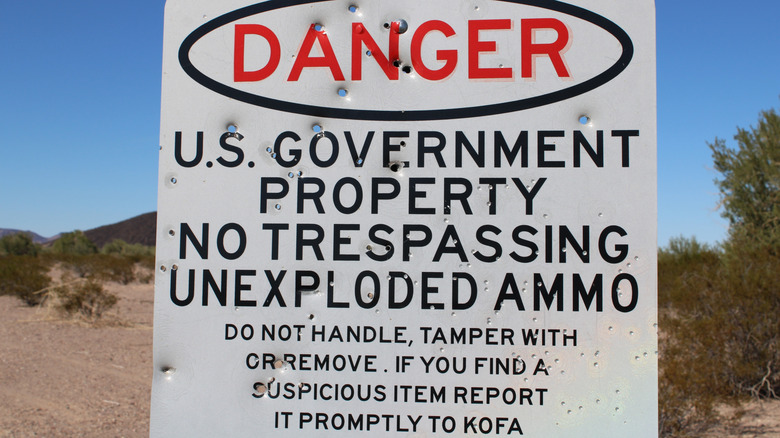
YPG Conservation Law Enforcement Officer Sergeant Gregory Harper states, in the DVIDS press release, that the team’s approach is “to educate and issue a warning the first time unless there is a more serious offense connected to the trespassing.” According to Harper, those who find their way into the region of the proving ground often aren’t aware that they’re breaking the law or that they’ve entered such a potentially dangerous area at all. It is, after all, a vast complex on what may appear to be empty land in places.
“They are cooperative and their intent isn’t bad, but that won’t protect them from the hazards on our ranges,” Harper said of those unannounced visitors who may, say, have simply been traveling in the area and unaware of the complex they’ve happened upon. There’s no doubt, though, that those hazards are many and varied. Laser weapons testing, such as that of the Stryker-based Short-Range Air Defense system prototypes that were put through their paces at Yuma in early 2023, is just one unique threat.
Some rather more conventional dangers lie on a potentially active artillery testing ground, as you can imagine. It’s not just about those weapons that were in active use, but some far harder to detect too: those buried in the ground. The facility had been in use for a very long time, and so many different types of munitions have been expended there that the risk of unexploded buried shells is very real. The landscape itself is also perilous in the region. It’s home to numerous disused mines that can be potentially deadly temptations to explore, quite apart from hosting endangered Sonoran species such as bats that should not be disturbed.