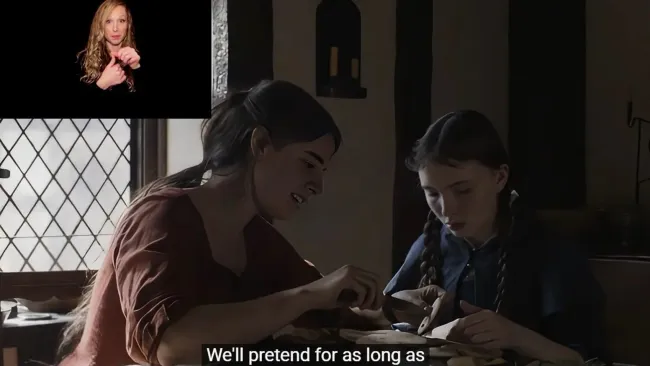
Ahead of this year’s Oscars, all 10 Best Picture nominees will have American Sign Language interpretation for the first time in history.
It’s part of The Oscars Project, the latest pursuit of SignUp Media, an accessibility and entertainment company that has independently produced and distributed ASL, BSL (British Sign Language), and ISL (Irish Sign Language) interpretations for more than 250 streaming TV and movie titles. On March 2, the company will debut picture-in-picture ASL overlays for eight of the 2026 nominees — “Bugonia,” “F1,” “Frankenstein,” “Hamnet,” “Marty Supreme,” “Sentimental Value,” “The Secret Agent,” and “Train Dreams” — through their free-of-charge Google Chrome extension, joining the existing BASL (Black American Sign Language) version of “Sinners” and ASL version of “One Battle After Another” from HBO Max.

“We saw an opportunity to do something that’s never been done before — making all of the Best Picture nominees available in ASL so Deaf audiences could experience the films the same way everyone else does: fully, in their native language, before the biggest night in Hollywood,” said Harriett Seitler, SignUp Media co-CEO and former marketing executive for MTV, ESPN, and Harpo Productions. “It’s a huge audience segment, and we believe Hollywood, producers, and the Oscars all win by treating this as a global event.”
Work on the project began shortly after the nominations announcement in late January, allowing “ample time for the team to properly digest each film and plan for optimal accessibility,” said Angie McSwain, SignUp Media’s interpreter operations manager. Those weeks also ensured everyone, including interpreters, was ready for the project’s demands, as “many of these films feature longer runtimes and more mature themes than SignUp has previously addressed.”
The entire company, comprised of hearing and Deaf people (including those from multigenerational Deaf families), was involved, from “our accessibility tech team ensuring seamless delivery across streaming platforms to our interpreter operations team, which handled the casting and creative collaboration that makes each project distinctive,” said Seitler. Casting is a particularly signifigant aspect of SignUp Media’s work, with the company’s ASL interpreters selected with both cultural representation and their “background work, interpreting, and performance experience” in mind, said McSwain. With “The Secret Agent,” she notes, “since the protagonist is Brazilian, this necessitated a specific casting call, which immediately garnered several responses.”
Deaf Brazilian interpreter João Gabriel Ferreira was ultimately tapped, along with five others: Everett Glenn (“Marty Supreme,” “F1”), JoAnn Benfield (“Sentimental Value”), Rach Burton (“Bugonia”), Rosina Mae (“Hamnet”), and Scott Keller (“Train Dreams,” “Frankenstein”). Mae filmed in an at-home studio, complete with her own high-def webcam, studio lighting, a foot-pedal teleprompter that “allows me to stay in the flow without using my hands to scroll,” and various backdrops “to ensure perfect visual contrast for ASL.”
For years, the Maryland-based Deaf performer often watched the telecast for the fashion while noting films she’d want to see. But engaging more directly with the Oscars’ real-time events often meant relying on online award show updates. The introduction of the Oscars’ YouTube ASL stream in 2022 has made the show “much more vibrant and accessible,” with The Oscars Project now expanding that access more directly to the films. It has allowed Mae to watch more with her own family and “share those moments [like the Oscars] together.”
“ASL accessibility gives Deaf people the same experience that millions of hearing people have. It’s about the buzz, the excitement, and the ‘oohs and ahhs’ — bringing all the sparkles and gold of the film industry to everyone,” said the Certified Deaf Interpreter. “Captions let you read the script; ASL lets you experience the performance. Bringing this level of access to the Oscars isn’t just about inclusion. It’s about setting a new standard for how we view accessibility in entertainment.”
The Oscars Project is part of a new, larger strategy to eventize cultural moments in the community and at the company, launched in 2021 by co-CEO Mariella Satow. After her school went remote during COVID, the current Stanford University undergrad, who has Deaf family members, enrolled in ASL courses. “I started talking to members of the Deaf community, and it became clear that closed captions weren’t the gold standard of accessibility that I thought they were. The community needed Sign Language access, whether that’s for Deaf kids who haven’t learned how to read yet or can’t keep up with captions, or Deaf adults who want to watch something in their native language,” she said.
Among the company’s recent efforts were its nearly day-and-date releases for Netflix’s “Stranger Things” final season, with interpretations turned around in under 24 hours. They have also started working directly with studios, including Moonbug Entertainment on CoComelon’s live-action “The Melon Patch,” and the YouTube animated series “Paris & Pups,” from Paris Hilton’s 11:11 Media, 9 Story Media Group, and HappyNest Entertainment.

These join other wider industry ASL picture-in-picture efforts from PBS Kids and JAM Media, as well as the day-and-date releases for HBO Max’s “The Last of Us” Season 2 and “It: Welcome to Derry.” The demand is already visible, with the “Paris & Pups” Halloween episode’s ASL version overindexing with the show’s core audience according to publicly available data, earning 112,000 or 11% of total views when combined with the 905,000 views of the non-ASL version.
A 2021 American Community Survey found that around 11 million Americans — or 3-4% of the U.S. population — identify as Deaf or having serious hearing difficulty. ASL usage is not tracked by the American Census, as it’s not currently classified by the federal survey as a spoken language. But according to 2022 research from Gallaudet University, around 6 million people total use it, including about 1 million Deaf and hard of hearing adults. That makes ASL the third-most-used language in the U.S., behind English and Spanish.
Under the ADA, theaters are not presently required to provide picture-in-picture ASL, but they must provide auxiliary aids and live ASL interpreters when requested. As a result, few distributors produce and release ASL or even open caption versions for theatrical screening — which their critics consider distracting, obstructive, or visually unappealing — forcing deaf audiences to rely on devices that may be limited in number or fail.
Besides the truly handful of interpretations that have started to arrive once popular films hit streaming (HBO Max’s “Minecraft: The Movie,” “Beetlejuice Beetlejuice,” and “Superman,” and Disney+’s “Ant-Man”), Hollywood has largely ignored the potential of “a bigger, more engaged audience” for whom ASL is their primary language, said Seitler.
“We’re seeing more producers and studios selectively choosing to support the ASL community, but in our opinion, the Deaf community is vital, it’s big,” she continued. “[They] represent 5 to 6 percent of the world’s population. That’s hundreds of millions of people who have historically been underserved by mainstream entertainment.”
The Deaf community’s fight for equal access to entertainment has been a long one, and alongside what the community itself, social platforms, and even Deaf content creators can currently do, closed captioning has remained one of the most significant access tools. Developed back in the 1970s, major legal and legislative wins tied to captioning have driven much of its early success and adoption — from the 1990 Television Decoder Circuitry Act requiring all new TVs include the technology, to the National Association of the Deaf’s 2011 lawsuit, which required Netflix and other streaming platforms to caption their libraries.

In the decade or so since, growth around captions has also been accelerated not just by Deaf people, but also by hearing people. They are now a constant presence on platforms like TikTok, and a 2023 YouGov poll found 63 percent of 18-to-29-year-olds use subtitles in their primary language, whether for improved comprehension or to address issues like noise pollution. Media attention over CBS’s “speaking in non-English” caption backlash at the 2023 Grammys and the 2023 Sundance Film Festival jury walkout has also shifted an industry that has historically treated access as a burden or afterthought.
As a result, captions now include details like atmospheric descriptions for sound effects and music. But their presence and execution remain inconsistent across platforms and content. Live, open, or closed, they can still contain critical errors, whether delivered by humans or AI, and may fail to capture the full scope and context of a scene or dialogue. Especially for Deaf audiences for whom ASL is their first language, overlaid interpretation remains rare but can offer more nuance in context, emotion, and tone, address language deprivation, increase comprehension, and reduce cognitive overload and lags in information delivery.
According to Satow, picture-in-picture ASL interpretation “follows the cost of closed captioning and audio description,” with Mae adding that “you don’t need a massive commercial space to achieve professional results. With the right gear, such as tripods and editing software, high-quality accessibility is something any studio can and should easily invest in.”
SignUp already knows there’s an audience willing to pay for it. The company’s research team partnered with Open Inclusion in the U.K. and U.S., as well as PhD candidates in India, to design studies that reflect the experiences and needs of Deaf viewers. In the U.S. and U.K., respondents indicated they’d pay between $5 and $6 a month, while in India, the equivalent was about $2 a month. The team has also already met with “heads of accessibility at all the major streaming platforms,” said Satow, with conversations generally positive. “But there’s presently no urgency,” she told IndieWire. “It’s seen as a nice-to-have, not a need-to-have.”
Still, Satow and Seitler believe ASL interpretation is on the cusp of a turning point. “Similar to closed captioning being treated as optional, with advocacy and litigation pushing it into the mainstream, I think something similar is going to happen with ASL interpretation,” Satow said. “Other countries are further along than the U.S., and I think the U.S. will eventually have to catch up. The U.K. just had a bill [the New Media Act 2024] which mandates that 5% of content has to be in Sign Language.”
“There is always the question of, ‘Why aren’t closed captions enough?’ [ASL’s] a different language. There’s different syntax, there’s a different culture around it. It’s not the same as an English word-for-word translation,” said Seitler. “The core argument is almost disarmingly simple: platforms already translate their content into dozens of spoken languages, from Italian to Icelandic. ASL is a language. It should be treated like one.”