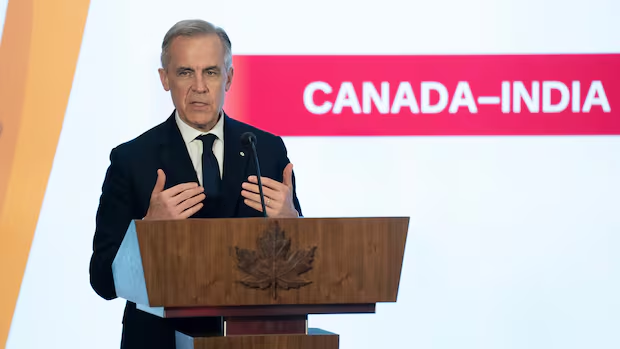
Prime Minister Mark Carney’s Indian charm offensive continued over the weekend as he set aside any notion of bilateral bad blood and hailed the South Asian country as a “natural partner.”
In a speech to a largely business crowd at the glitzy and historic Taj Mahal Hotel in Mumbai late Saturday evening, Carney said the two countries are on pace to broker a comprehensive economic partnership by year’s end — setting up a possible signing date for the G20 summit in Miami in mid-December.
In the past, Canadian trade negotiators worked to secure sectoral deals with India — favourable trade terms for certain products and industries.
But Carney and his Indian counterpart, Narendra Modi, are gunning for something much more ambitious this time — a full free trade deal — as they both stare down the seismic effects of U.S. President Donald Trump’s trade war.
The two will meet in Delhi on Monday where officials say they will sign a series of memorandums of understanding — including a possible deal for Canada to supply huge quantities of uranium for India’s nuclear sector — and formally kickstart the final leg of the free trade negotiations.
A senior government official said Carney is going into that Modi one-on-one with a preset list of priorities he hopes to finalize. However, like at the recent meeting with China’s Xi Jinping, Carney is also prepared for other impromptu agreements to emerge at the leaders’ table.
As the U.S. and others prompt a “more volatile era” with a “rupture” in trade and traditional alliances, Carney said Canada and India need each other more than previously thought.
While the two countries have been on shaky ground since former prime minister Justin Trudeau alleged Indian agents were involved in the killing of a Canadian Sikh, and the RCMP flagged Indian involvement in a series of violent events, Carney said his visit to India “marks the end of a challenging period, and more importantly, the beginning of a new, more ambitious partnership between two confident and complementary nations.”
“Canada and India are natural partners,” he told about 100 attendees gathered for a sit-down dinner at the Canada-India Growth and Investment Forum.
“The reality is, on the economic side, that level of activity is nowhere near our potential, especially as Canada and India both embark on ambitious transformations. We should aim much higher,” Carney said.
A government official said Carney’s business meetings in Mumbai have been overwhelmingly positive, a sign the business community in particular is ready to move on from the Trudeau era, marked as it was by hostilities, including both sides expelling diplomats after foreign interference allegations erupted.
While in Mumbai, Carney had a sitdown with the chairman of Tata Sons, India’s largest conglomerate which controls a sprawling operation with holdings in autos, steel, tea and power generation among dozens of other businesses, including some in Canada.
Carney is trying to lure Tata and others to invest more domestically as the government prioritizes foreign direct investment, which is already producing some results. According to data released last week, more foreign money poured into Canada last year than at any time since 2007.
On Saturday, Canada also helped facilitate an agreement between Universities Canada, the association representing higher education, and 13 Indian schools for closer collaboration on research, student exchanges and hybrid campuses.
Speaking to media travelling with Carney, Gabriel Miller, the president and CEO of Universities Canada, said a number of Indian students have had a bad experience in Canada over the last number of years after the floodgates were opened and a huge influx of Indians attended some questionable institutions.
Miller said that has attracted bad press in the Indian media so it’s not just the diplomatic relationship that needs a reset.
“The first thing is Canada’s focus on international education needs to be on quality, not quantity. There’s no question that the country lost its way there for a couple of years. We were too focused on volume and people were allowed to abuse our system,” Miller said.

Prime Minister Mark Carney touches down in India as his government seeks progress on a free trade deal, but a senior official’s comments about the end of Indian interference continue to cause controversy in Canada. Former national security adviser to the prime minister Jody Thomas and former director of CSIS Ward Elcock evaluate whether the threat could have subsided, and Thomas argues that the official misspoke. Plus, Helen Hayes with the Centre for Media, Technology and Democracy explains the regulatory reforms she’s calling for after revelations about the Tumbler Ridge, B.C., shooter’s ChatGPT accounts.
This new education agreement aims to establish a more “balanced relationship,” ensuring it’s not solely based on Indian students coming to Canada but also on Canadians gaining something from India, Miller said, like faculty exchanges and research partnerships on tech and AI.
Miller, who did business with India before, during and now after the bilateral fracas, said he feels optimistic about the state of relations.
“I didn’t know what I was going to find when I came here. I think if we stay on the road we’re on, we’ll be able to turn the page and the opportunities here are extraordinary,” he said.
As Carney and others push for a new outlook on India, major issues remain, especially concerning allegations that Indian agents have carried out violent acts and targeted Sikh activists in Canada.
Some leaders from that community say Carney’s visit, amid questions about Indian involvement in the killing of Hardeep Singh Nijjar (which the Indian government denies), is a form of “appeasement.”
And Carney’s speech came as his government faced increasing pressure to clarify whether it believes India is still engaged in foreign interference.

Foreign Affairs Minister Anita Anand refused to answer that question Saturday, even as reporters repeatedly pressed her to say yes or no.
Ahead of Carney’s trip, a federal official said Carney would not be making this trip if Canada still believed agents of the Indian government were involved in extortion or threats of violence in Canada.
“Foreign interference, transnational repression is taken extremely seriously by our government and it will continue to be taken seriously because no country has a pass when it comes to domestic public safety,” Anand said.
Anand said she will continue to raise concerns by the Sikh community with her counterparts in India.
“In order to make progress, you need to be at the table,” she said.