The 18th-century philosopher Johann Gottfried Herder is credited in Germany with coining the maxim: “Talk is silver, but silence is golden.” The saying has come to define Germany’s political culture. Olaf Scholz was economical with words and drew mockery for his wooden, monosyllabic replies as the “Scholzomat” or even the “coma chancellor”. Scholz was not entirely different from his predecessor. Angela Merkel grew up in East Germany’s communist dictatorship and learned early that words could be dangerous. She spoke cautiously, almost clinically, in the monotone of a central banker. Every word served a purpose. That was precisely why everyone listened closely.
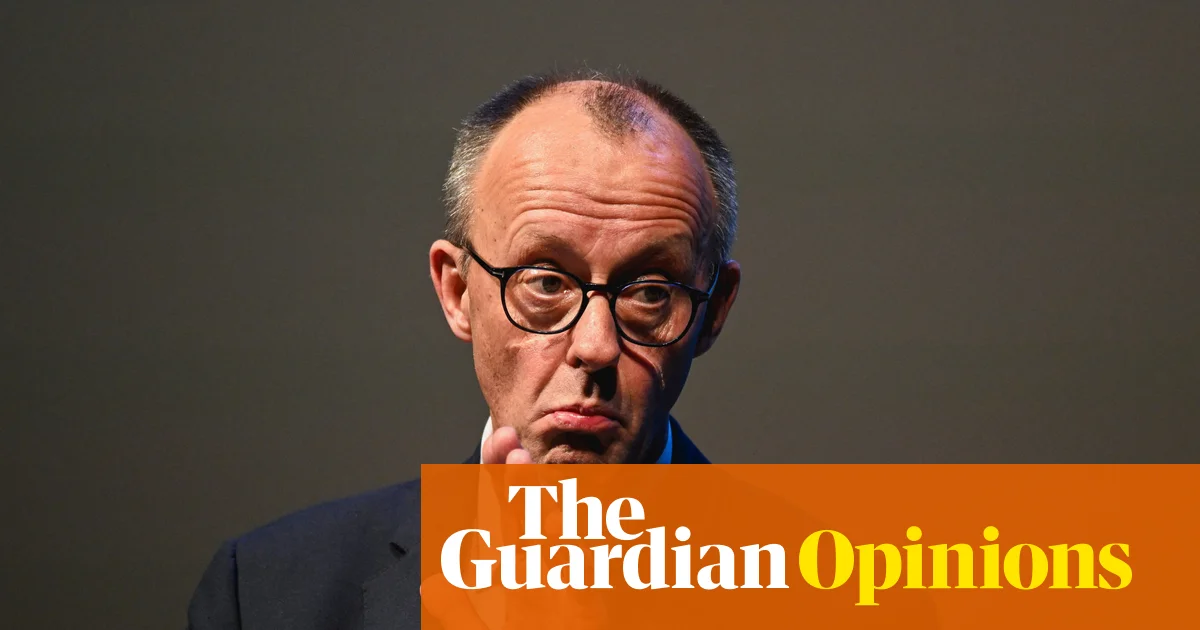
Friedrich Merz, by contrast, is anything but a soporific speaker. The trained lawyer has a sharp tongue and visibly enjoys the sound of his own voice. In this, the conservative chancellor resembles the French president, Emmanuel Macron – another beau parleur. And like Macron, Merz is a know-all. He rarely misses a chance to show his audience how clever he is.
In this, the 70-year-old chancellor is not endearing himself to German voters, who traditionally like their politicians to be affable but not overly slick. Worse, Merz’s overconfidence has a tendency to backfire. He sometimes loses his audience in explanatory detours and his command of the facts is less sure-footed than his delivery suggests. In a recent wide-ranging interview on one of Germany’s leading political podcasts, Machtwechsel, Merz delivered a flurry of inaccurate or contradictory-sounding statements. Listeners could not help but experience a sense of “Fremdschämen” – a German word that might best be expressed as cringe.
Despite his past experience as a finance executive (he worked for the asset management firm BlackRock), Merz claimed that Germany was “the only country in all of Europe with a triple-A rating” for its sovereign debt. In fact, within the EU alone, Denmark, the Netherlands, Sweden and Luxembourg also hold top ratings.
Boundless self-assurance combined with a tendency to offer unsolicited commentary on subjects he has only partially mastered may not be a problem unique to Merz, or to men of his generation. But Merzsplaining could explain why the chancellor’s approval ratings, particularly among women, remain so dismal.
Being the German chancellor is a tough job. Mistakes happen and Germany’s political journalists delight in pointing them out. The eye-rolling in Germany after the podcast was not mere pedantry; it was about a pattern. Merz often opens his mouth before fully working out his argument. In domestic policy, this may be embarrassing. In matters of defence, it can carry serious risk.
In the same podcast interview, Merz declared himself ready to reconsider Germany’s commitment to the Franco-German fighter jet programme, FCAS. Unlike France, he argued, Germany’s future jets will not require a nuclear capability. Yet minutes earlier he had insisted he wanted to explore a European nuclear deterrent with France – and suggested that German jets should be capable of carrying French nuclear weapons.
Belgium’s defence minister, Theo Francken, tagged Merz in a post on X: “Regarding nuclear deterrence, I really don’t understand why European leaders are so loose lipped. Not wise. Please keep your mouth shut.”
Francken has a point. A Kremlin analyst listening to Merz could indeed only reach one conclusion: Germany still lacks a coherent plan for lessening Europe’s defence dependence on the US, other than throwing a lot of money at its own defence industry.
Yet if Merz’s loquacity can seem like a liability at home, in Europe his self-confidence could be seen as an advantage. His willingness to take risks – in a 2024 interview he chose “courageous” when asked to describe himself in one word – and his recognition that politics in this volatile geopolitical era must surpass the managerial incrementalism of the Merkel era are pluses.
On the night of his election victory in February 2025, he called on Europe to establish its independence from the US. At the Munich security conference earlier this month, he urged the EU to operationalise its mutual defence clause. “Germany is at the centre of Europe,” he said. “If Europe is torn apart, we are torn apart.”
Such “big speeches” matter for Germany, given its political mood. The country’s pacifist reflexes run deep, and the anti-EU, pro-Russia far-right Alternative für Deutschland eagerly panders to them. To secure German political backing for a stronger European defence, Merz must lead public opinion rather than follow it.
The ultimate test of his chancellorship may lie beyond Germany however. The job of steering Germany is arguably the most important in Europe, and polls suggest that most Europeans agree with his assessment of the global threats.
In speeches studded with historical references and big-picture essays, Merz has articulated a vision of a Germany that no longer hides behind economic might and strategic ambiguity to build a more sovereign Europe.
Whether Merz’s geopolitical calculations hold firm in the wake of the US war on Iran remains to be seen. Merz travels to Washington this week: so far he has failed to condemn the joint US-Israel air strikes, saying that it was not the moment to “lecture” the US and its allies about international law. That may be true, but it still matters when a German chancellor appears to casually disregard international law as irrelevant. For Europe as a collection of small nations, international law is not an abstraction – it is the branch on which it sits.
A damning criticism often heard of Emmanuel Macron is that he is Europe’s “thinktanker-in-chief”: astute in diagnosis, expansive in ambition, but one who struggles to convert his fine rhetoric into actual change.
Merz has a chance to do something different, but if he fails to turn his words into a deliverable plan for the benefit of Europe, he risks the same fate. After all, if speech is silver, as Herder wrote, action is gold.