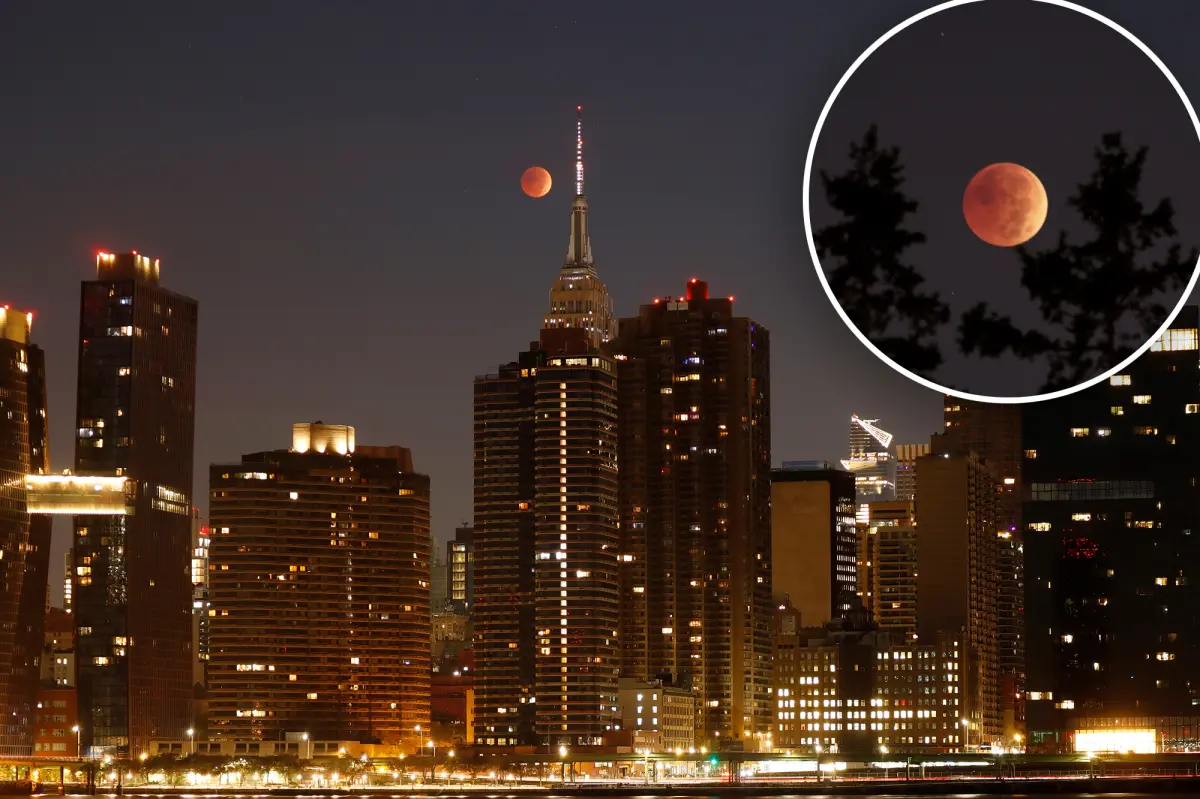
There will be blood (moon).
Earth’s last total lunar eclipse for two years will result in a spooky red “blood moon” that will be visible from New York on Tues. Mar. 3 — weather permitting, of course.
The totality, which is when the moon is fully immersed in Earth’s shadow, will be visible to Empire Staters during the early morning hours, according to NASA.
Astronomy pro Darryl Seligman was positively mooning over the prospect of the first proper lunar overlap of 2026 when reached by The Post at his offices at Michigan State University. .
“The blood moon happening in a few days is very exciting for amateur and professional astronomers,” the starseer explained.
What is a ‘blood moon’?
During the total lunar eclipse, which occurs when the Earth sits between the moon and the Sun, the moon will be sitting in the Earth’s shadow, Space.com reported.
As a result, it will take on an orange or red tinge as the sunlight that shines upon it is refracted through our planet’s atmosphere, like seeing our rocky satellite through celestial rose-tinted glasses.
According to the wonks at NASA, “it’s as if all of the world’s sunrises and sunsets are projected onto the Moon.”
Seligman said that the “interaction of sunlight” with our planet makes the moon look blood red, hence its spooky moniker. He said that the special phenomenon required a “perfect alignment between the earth moon and sun” adding that it “only happens a few times a year if that.”
Seeing red
This particular totality will be visible to billions of people along the path of the eclipse. According to NASA, it can be viewed in the evening from eastern Asia and Australia, all in the Pacific, and in wee hours of the morning in North and Central America, as well as the far west South America.
The rest of South America and central Asia will glimpse a partial totality while it won’t be visible in Africa or Europe.
Unfortunately for Big Apple residents, the best vistas in North America will be from West Coast. There, residents will get to see the maximum eclipse — when the moon is almost completely overlapped with Earth’s shadow — while New Yorkers will only get to see the beginning of the totality phase.
The eclipse starts very early on Tuesday, March 3, lasting about 5.5 hours, from 3:44 a.m. to 9:23 a.m. EST, but the totality will last around an hour from 6:04am to 7:02 am EST.
Visibility, meanwhile, depends on having a clear view, which can be a gamble given the oft-tumultuous weather during March.
Clear skies permitting, the lunar eclipse should provide an excellent opportunity for astrophotography, otherwise known as taking snaps of celestial objects.
For optimal results, Seligman advised grabbing a camera and/or binoculars and positioning oneself up “in a high vantage spot away from city lights.”
However, unlike a solar eclipse, which needs to be viewed with special eyewear, its lunar counterpart can be gazed upon with the naked eye.
All you need is an uninterrupted view of the Moon.