There’s a famous scene in “The Lion King” in which feline prince Simba, still learning of the responsibilities he will take on once he becomes ruler of the Pride Lands, listens as his wise father Mufasa describes the Circle of Life the animals of this paradise live by: the lions may eat the antelopes that roam the fields, but the lions’ bodies become the grass the antelopes eat. “In that way, we are all connected in the great circle of life,” Mufasa extolls, as the camera pans to a shot of the gorgeous savanna landscape.
“Hoppers,” Pixar‘s latest movie and its best new release in a solid decade, is also a film about the burdens of an animal king defending his subjects, one whose briefly alluded-to backstory (reclaiming the throne after his uncle usurped his father) bears a probably not coincidental resemblance to Simba’s arc. But this monarch — the dorky, sweetly optimistic, ’80s pop rock-loving beaver King George (voiced by Bobby Moynihan) — cuts a much less traditionally regal figure than Mufasa, and his domain, a small forest pond overpacked with too many animals for it to properly sustain itself, proves far more modest. George’s version of The Circle of Life, the “Pond Rules” he enforces upon his subjects, is a lot less poetic and a lot more practical: “If you gotta eat, eat.”


Another difference between the two movies: in “The Lion King,” Mufasa may have talked about eating the antelopes, but the audience never actually saw it. Like most animated features that humanize animals into fun, friendly characters, “The Lion King” perhaps didn’t want to sully the fantasy it offered with the reality that Simba would be more inclined to eat Timon and Pumba than befriend them.
In “Hoppers,” all the killing and violence inherent to the animal kingdom is right there in gloriously casual display. When protagonist Mabel (Piper Curda), a 19-year-old environmental activist who has “hopped” her way into the body of a realistic beaver robot, first infiltrates the ecosystem of this forest, she saves the lazy beaver Loaf (Eduardo Franco) from getting eaten by grizzly bear Ellen (Melissa Villaseñor), despite his protests that he was fine with it. As George takes Mabel on a tour of his kingdom, Ellen gobbles up a fish, while a friendly worm gets abruptly carried off by a bird that swoops in from the sky. At the midpoint of the film, there’s a display of mammal-on-insect violence so abrupt and visceral that it’s both a little horrifying and also maybe the single funniest scene Pixar has ever animated.

“Hoppers” comes to theaters as the once-mighty studio has lost its luster, with a run alternating between sequels that are mere shadows of their predecessors and original films like “Elio” or “Elemental” that felt constrained and formulaic, attempts to reverse engineer the type of heartfelt, high-concept experience people have come to expect from Pixar without taking any actual risks. The dimming prestige of the brand perhaps allowed “Hoppers” the freedom to be something much more modest, and also way more fun and satisfying — a hilarious, joke-a-second comedy that has its moments of sweetness and emotional resonance, but isn’t looking to force tears out of you.
Whereas much of the studio’s recent output feels like it could have been made by anybody, “Hoppers” is the first Pixar film since “Turning Red” in 2022 to have a strong, evident creative voice. Director Daniel Chong started making the film after the conclusion of his Cartoon Network series “We Bare Bears,” a sitcom about three wild bears in the Bay Area trying and mostly failing to integrate with human society. Much of that show’s DNA has carried over to Chong’s feature debut, a quirky, humorous look at the animal kingdom with a streak of cringe comedy that derives as much pleasure from how gross and dumb mammals can be — with their shrill, shrieking voices and body oils — as it does from how cute they are.
And they are very cute. Pixar’s animation style, which has veered toward the gorgeous but generic in recent years, gets a refresh here. There are still moments of showy technical prowess (including crowd scenes where thousands of butterflies fly across the screen at one time), but the film’s rounded and adorable character designs for its animals prove refreshingly simple. In one clever touch, the animals have more detailed designs when viewed from their perspective, and are given blank, beady black eyes when we see them from humanity’s perspective.
What drove many episodes of “We Bare Bears” was the relationship between the natural world and the drudgery of modern human living, and that’s also the tension that courses through “Hoppers,” a lovingly environmentalist tale that never gets overly preachy. The film opens as Mabel, (barely) attending the local university in her hometown Beaverton, stages a one-woman campaign against the construction of a high-speed rail ordered by smarmy mayor Jerry (Jon Hamm, perfect for this), as a bid to guarantee his reelection.
Her protest, disrupting builds and going door-to-door looking for petition signatures, focuses on its environmental impact but is intensely personal for her: the rail is set to cut through a now-abandoned glade near her deceased grandmother’s home, the place where she, as a misunderstood kid who spent her recesses trying to break the school tortoise out of class, first learned to stop, listen, and love nature. But in the present day, with the glade abandoned, the only hope for construction to stop is for Mabel to find a beaver — a keystone species — that can once again make the area inhabitable.
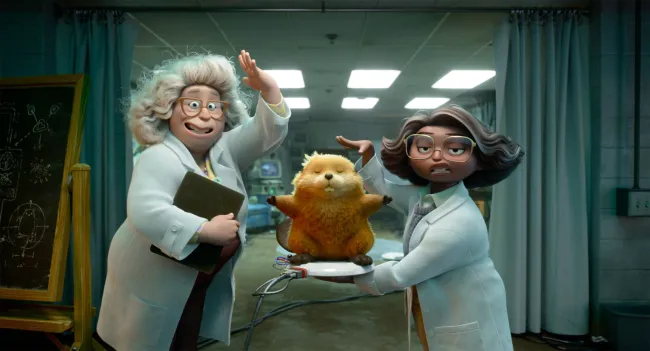
Which is where the titular Hoppers technology, an experiment designed by Mabel’s frazzled biology professor Dr. Sam (Kathy Najimy), comes in. Designed to perfect the art of studying animals incognito — there’s a great montage of all the… less high-tech predecessors to the invention — the machine puts the user in the body of an adorable orange-furred beaver and gives them the ability to talk with all animals, from the spiders on their webs to the fish in the sea. In a joke that’s very funny but also presumably meant to get ahead of snarky internet comments, Dr. Sam insists it’s “Nothing like ‘Avatar’” right before Mabel steals the tech to take her campaign to save the glades’ animals directly to the source.

If there’s a chief flaw to “Hoppers,” it’s that it has so much plot for its 100-minute running time that you wish it could settle down in one place for longer. After Mabel gets in her robot beaver body, the film barrels through its storyline so quickly that she goes from frazzled outsider to a Joan of Arc-style revolutionary figure to the animals in the space of a single scene. With a large ensemble of animals and humans alike and an entire second half dedicated to fighting a council intent on “squishing” humanity, there’s not enough time to deepen the sweet friendship between Mabel and George into something as powerful as, say, Merlin and Dory in “Finding Nemo.”
Still, what we do get is pretty uniformly delightful. The screenplay for “Hoppers” — credited to Jesse Andrews and based on a story by Chong — has pitch-perfect comic timing, from gags that achieve the Sideshow Bob rake effect of going just long enough they loop right back around to hilarious to little one-liners that absolutely complete a scene.
Importantly, the movie’s sense of humor is always grounded in the situation happening and the distinct crazy personalities surrounding Mabel’s stubborn straight woman. For example, a standout sequence in which Mabel’s attempts to communicate with Jerry via text-to-speech on her phone are derailed by George and the other animals hijacking it while discovering emojis is a riot, and only works because each of the characters is immediately understandable.
It helps that the voice cast proves uniformly strong, with Curda adding a real edge to Mabel that makes it easy to understand why some of her enemies refer to her as “shrill and unlikable,” even as you root for her. Meryl Streep makes an incredible cameo as a distinguished butterfly, Najimy is hilarious as the possibly slightly Doc Brown-inspired professor, and Moynihan — who previously voiced one of the main characters on “We Bare Bears” — is perfectly cast as the irrepressibly cheerful George. Hamm might be the standout, though, playing a slick and punchable politician who steadily unspools into a nervous wreck as the wildlife he’s attempting to displace start pursuing him.
In a film that nimbly walks the tightrope between lightheartedness and weightlessness, Jerry and Mabel’s antagonistic relationship ends up proving the unexpected core of the story. Their backstories are kept brief (Mabel’s origin story prologue is no “Up”) but “Hoppers” makes it clear that for all their issues with each other, they’re both decent people navigating their own problems, from Mabel’s grief and listlessness after losing her grandmother to Jerry’s career and family life. The moral it eventually draws from the human vs. nature debate the two exemplify, that what’s most important is coexistence and learning to listen and support one another, isn’t necessarily surprising, but it’s poignant all the same.
That’s the Circle of Life, “Hoppers”-style, and just because it’s not as elegant as it when Mufasa says it doesn’t mean it isn’t meaningful.
Grade: B+
Disney will release “Hoppers” in theaters on Friday, March 6.
Want to stay up to date on IndieWire’s film reviews and critical thoughts? Subscribe here to our newly launched newsletter, In Review by David Ehrlich, in which our Chief Film Critic and Head Reviews Editor rounds up the best new reviews and streaming picks along with some exclusive musings — all only available to subscribers.