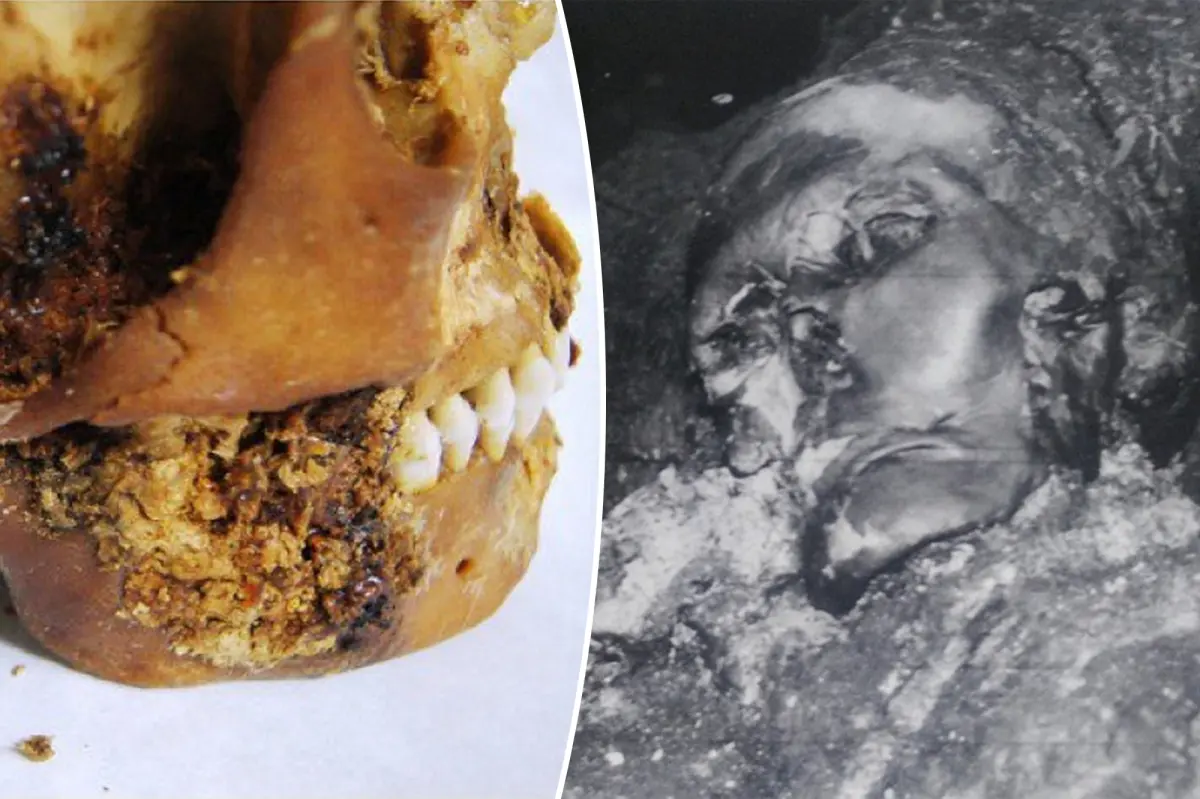
It was a jaw-dropping discovery.
A mouth prosthetic on a 2,500-year-old Siberian mummy could potentially be the earliest example of complex jaw surgery in history, per a groundbreaking study by researchers at Russia’s Novosibirsk State University (NSU).
“It is possible that we have discovered evidence of such a surgical procedure for the first time,” Dr. Andrey Letyagin, a Russian radiologist who helped conduct these fossil forensics, said in a translated statement.
The surgical saga dates back to 1994, when archaeologists with the Russian Academy of Sciences excavated a burial ground in the remote Ukok Plateau, uncovering the remains of the ancient patient in the permafrost, Livescience reported.
Estimated to be around 25 to 30 years old when she died, the woman was reportedly lying on a wooden bed and rocking a wig typical of the Pazyryk people — a nomadic horse-riding tribe that marauded about the Central Asian steppes between the sixth and third centuries BC.
However, with only a partial skull and no significant burial ornaments, researchers didn’t probe the case further.
“This mummified patch of skin on the buried woman’s skull made anthropological research impossible,” said Natalia Polosmak, an archaeologist at the Siberian Branch of the Russian Academy of Sciences.
However, by using a CT scanner, researchers were able to digitally remove the soft tissue — and made a gruesome discovery.
The woman had suffered a head injury that had destroyed her right jaw joint, torn ligaments and thrown her jaw out of alignment, preventing her from speaking or eating.
Potentially sustained during fall while riding — which tracked given the cavalry-based culture — this gruesome injury would’ve proved fatal due to malnutrition or infection had ancient medics not performed the aforementioned emergency op, ZME Science reported.
Astonishing photos show where two tiny, 1.5-millimeter canals had been drilled into the bones that comprised the injured joint, intersecting at a right angle.
Inside these grooves were elastic material, likely horsehair or animal tendon, that held it together like a form of surgical ligature.
“This primitive prosthetic held the articular surfaces together and allowed the patient to move her jaw,” explained Dr. Letyagin. “The joint functioned, but she still couldn’t chew food on the injured side due to severe pain.”
New bones grew around the holes, forming a circle of thick tissue that confirmed that the patient had been alive during this ancient surgery and that she had survived for months or even years post-op.
It was an impressive achievement that challenges conceptions of the Pazyryk as marauding barbarians.
In fact, prior scholarship shows that these pastoral peoples practiced cranial trepanation, the oldest-documented surgical procedure.
During this dubious mind-opening procedure, primitive surgeons bored holes in people’s skulls for purposes ranging from relieving migraines to releasing evil spirits like a demon vent.
Earlier this winter, UK researchers exhuming a Viking-era mass grave happened upon the dismembered remains of a 6ft5 man who had seemingly undergone this ancient brain surgery.
The reason for his primitive mind probe is unclear, but researchers speculated the surgery could’ve been attempt relieve pressure caused by a pituitary gland disorder that prompted his anomalous growth.