It gamed the system.
Here’s yet more proof that AI is playing 3D chess while we’re playing checkers. A gameplaying AI system has cracked a cryptic, Roman-era board game that has baffled scientists for a century, as detailed in a breakthrough study in the journal Antiquity.
The cutting-edge gamebot, named Ludii, “played the game against itself and identified a few variants that are enjoyable for humans to play,” the machine’s designer Dennis Soemers, a researcher in the Department of Advanced Computing Sciences at Maastricht University, in a statement.
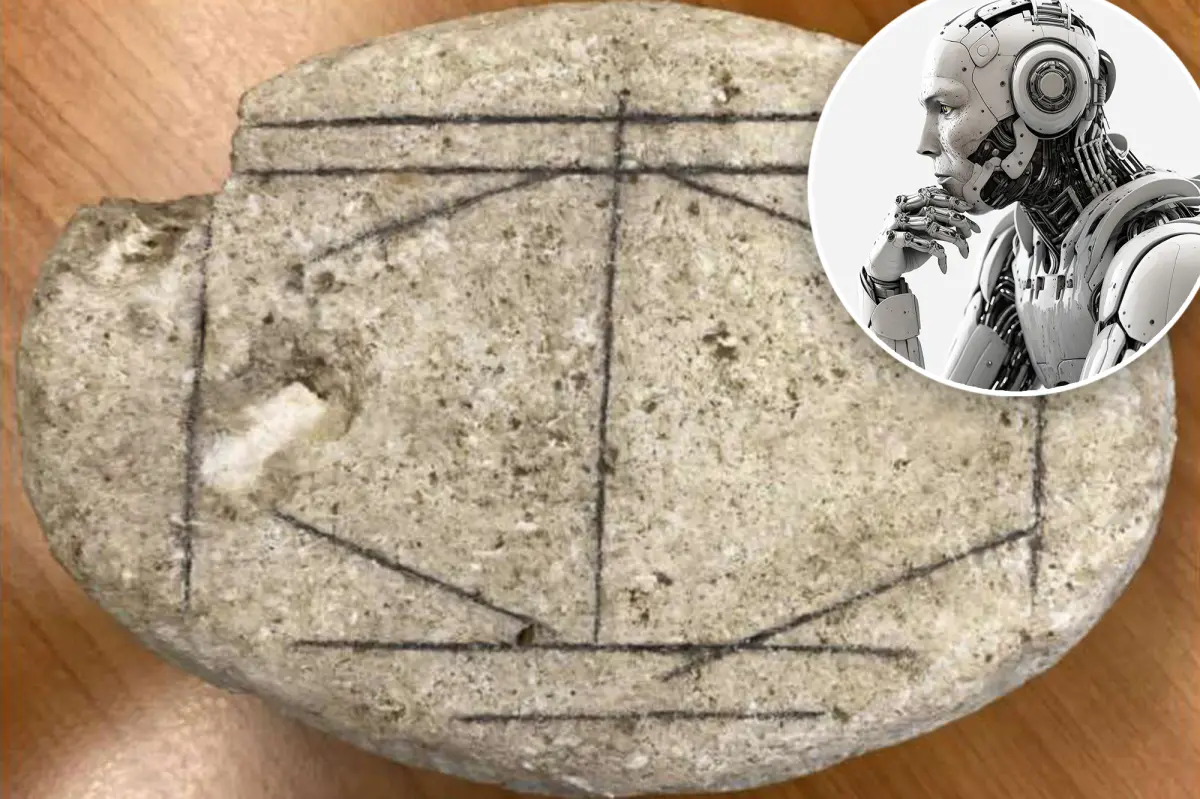
This marks the culmination of an archaeological caper that began around one hundred years ago, when this mysterious limestone stone etched with linear glyphs was excavated in Herleen in the Netherlands, which sits astride the former site of the Roman town of Coriovallum, Science News reported. The 20cm tablet was displayed at the local Het Romeins Museum, a cultural institution centered around the Roman Empire’s presence in the Netherlands, which began circa 19 BC.
Museum staffers called the rock a game despite no Roman records of said pastime.
By using 3D imaging, researchers discovered that some of the lines ran deeper than others, suggesting wear and tear from players moving pieces along them.
“We can see wear along the lines on the stone, exactly where you would slide a piece,” says Walter Crist, an archaeologist at Leiden University who specializes in games from antiquity. “The appearance of the stone, combined with this wear, strongly suggests it’s a game.”
To determine the rules, the Maastricht University programmed Ludii with the rules of “about a hundred medieval or older games from the same cultural area as the Roman stone.”
Like an ancient chess computer, the digital decoder produced dozens of rulesets and then played 1,000 rounds of each, allowing the machine to pinpoint possible iterations of this game of stones.
“We tried many different kinds of combinations: three versus two pieces, or four versus two, or two against two,” said Crist, Science News reported.
The researchers then cross-referenced the piece movement patterns under the potential rulesets with the visible wear and tear on the alleged game board, finding that they seemed to match up.
The movements were specifically part of a blocking game, a tic-tac-toe-style pursuit played by two people, the Scientific American reported.
The players moved pieces —likely made of glass, bone or earthenware—along the board’s lines with the goal of trapping their opponent’s figurines in the corner.
This discovery was significant as it was previously thought that blocking games of this variety didn’t come to fruition in Europe until the Middle Ages.
Much like Chess.com, online gamers can now play the pursuit, dubbed the “Coriovallum Game” on Ludii according to the rulesets devised by the researchers.
Despite the promising results, Soemers is reluctant to confirm that the scientists unlocked the game’s exact rules, given the AI bot’s somewhat results-based programming.
“If you present Ludii with a line pattern like the one on the stone, it will always find game rules,” he says in Maastricht’s statement. “Therefore, we cannot be sure that the Romans played it in precisely that way.”
Nonetheless, these findings could potentially pave the way for using AI to decipher more ancient games.
Archaeologist Véronique Dasen of Switzerland’s University of Fribourg, who wasn’t involved in the study called the discovery “groundbreaking, declaring, “the research results invite [archaeologists] to reconsider the identification of Roman period graffiti that could be actual boards for a similar game not present in texts.”