The Market Tries to Price the War’s Duration
On Tuesday morning, the markets woke up in something of a panic over the Iran war. The Dow initially fell by as much as 1,200 points, and Treasuries sold off, sending yields higher, as oil surged above $85 a barrel.
By midday, the Dow was down closer to 250 points, around a half-percentage point, while oil had slipped back toward the low $80s. The pattern was familiar from Monday, just more volatile: equities sold off, then retraced, leaving the day looking calmer than the opening minutes suggested.
That whiplash isn’t just traders being dramatic. It’s the market doing the only honest thing it can do in the fog of war: trying to price the duration of the conflict. The essential question isn’t whether oil can spike. It’s whether energy markets will be disrupted long enough for the climb not to be a spike—where prices rise and then fall—but an ascent to a high plateau.
For most Americans, the war will be experienced the way distant conflicts usually are: urgent headlines, furious debates on social media, and the nagging sense that something important is happening far away. But just because there’s not much most of us can do to alter the path of the war does not mean the war cannot alter the path of our economy.
The Straight and Narrow About Oil Prices
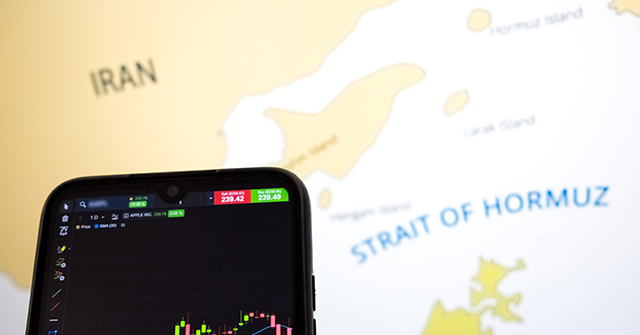
The Strait of Hormuz is where that path will be blazed. If the strait—where traffic has reportedly thinned as shippers weigh the risk—can be reopened quickly, this episode will probably look, in hindsight, like a nasty bout of volatility. If it is effectively closed for an extended stretch, it becomes something else: a genuine supply shock with the power to change the trajectory of inflation, growth, and Federal Reserve policy.
The economist James Hamilton worked out the mechanics after the 2007–2008 oil surge, and the analysis holds. The damage from a big oil move doesn’t come from the machinations of speculators or moral outrage over price gouging. It comes from the fact that people do not—and often cannot—adjust their own lifestyle quickly when energy prices rise. Workers still must commute. Deliveries still need to be made. Homes need to be heated. This means that oil demand is inelastic, so when supply is constrained, the market clears through price.
Hamilton’s precision is useful here because it draws a line between noise and danger. What matters most isn’t simply that oil is up this week. It’s whether oil pushes above a recent high—breaking into new territory rather than merely retracing old ground—and then stays there long enough to force the economy to adjust on the fly. That is when an oil move stops being a headline and starts becoming a mechanism. Right now, the best measure is probably the most recent three-year high, which is around $95 a barrel.
And the mechanism has a visible translation for voters in the form of gasoline prices. Crude doesn’t pass through to the pump one-for-one, but over time the relationship is tight enough to offer a rule of thumb: a ten percent increase in crude has tended to show up as something like a mid-single-digit percentage increase in retail gasoline. Roughly, a $10 dollar increase in the price of oil will push up gasoline prices by about a quarter. The exact timing varies, but the direction is reliable.
When energy prices jump and hold, the economy doesn’t absorb it gracefully. Households absorb it the way households always absorb a budget squeeze: they cut elsewhere. The damage shows up first in discretionary spending, especially big-ticket purchases that can be delayed, vacation travel, and even dining out. Any business with thin margins and heavy transport costs gets squeezed. The longer high prices persist, the wider that squeeze spreads.
The White House is now explicitly trying to prevent that “extended stretch” from happening. President Trump said Tuesday the Navy will escort tankers through Hormuz if necessary and directed the International Development Finance Corporation to provide war-risk insurance for Gulf shipping—an acknowledgment that supply can be choked off not only by firepower but by finance. If ships can’t get insured, the strait is effectively shut even if the waterway is physically navigable. If federal coverage and escorts restore traffic, the shock looks less like a structural supply loss and more like a temporary dislocation.
If this works and the Trump administration restores safe passage through Hormuz quickly, then the oil surge functions mostly as a war premium. Gasoline prices can rise and still leave only a small imprint if the move reverses before households have time to reorganize their spending. Inflation data get noisy, but the Fed is likely to look through it. Consumer confidence may wobble, although a quick resolution might boost sentiment. But the economy doesn’t have to rebalance around meaningfully higher energy costs.
If the fighting drags on and Iran manages to keep the strait effectively closed for weeks, the problem then isn’t simply that oil is expensive. It’s that oil is expensive long enough to force a rearrangement of spending across the economy. The growth hit will be sharpest in Europe and Japan, where energy import dependence is higher, but the U.S. won’t escape. Trouble abroad arrives here through weaker demand, tighter financial conditions, and shakier confidence. Our exports will suffer, likely worsening our trade balance.
That’s when the Fed’s situation gets uncomfortable. A central bank can look past a temporary energy spike if inflation expectations stay anchored and second-round effects don’t materialize. A prolonged supply shock puts the Fed in a vice: inflation pressure rises even as growth weakens. That’s the setup for hesitation and policy error, either tightening into a supply shock or refusing to ease as the real economy deteriorates.
None of this is unknown in the Trump White House. National Economics Director Kevin Hassett and the president’s economic team have every incentive to treat a prolonged oil shock as a political and economic threat, especially with midterm elections in November. You don’t need to love the administration’s military campaign to understand the constraint: a war that keeps oil high for weeks is a war that starts showing up in consumer budgets and Fed deliberations.
That likely implies the administration entered this conflict with a plan to exit swiftly. War, however, has a way of making a mockery of plans.