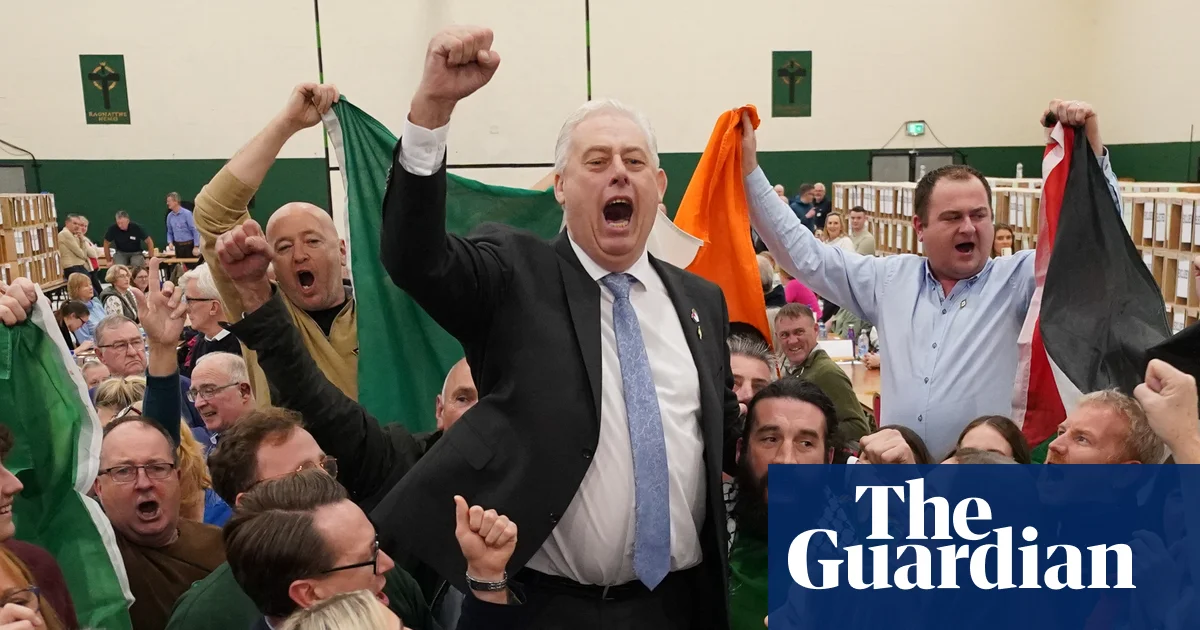
When the Irish politician Thomas Gould rose to speak in the Irish parliament recently, few expected a lesson in colonial linguistics.
Yet clips of his speech began circulating online last week, with some viewers saying he sounded unmistakably Jamaican. The reaction was animated, particularly among Jamaican heritage communities.
Responding to the Cork politician’s viral moment, one person wrote online: “The influence the Irish have on the Jamaican accent is uncanny.”
Gould, a Sinn Féin TD, said he had been overwhelmed by the response he received after the speech in January, particularly from Jamaica.
So, is there a deep linguistic link between Ireland and Jamaica – or is something else at play?
For Hubert Devonish, professor emeritus of linguistics at the University of the West Indies, the popular narrative needs careful correction. “There are four main sources of English from the British Isles that potentially affected Jamaican speech,” he says, pointing to the speech of indentured servants in St Kitts and Barbados in the period before the English captured Jamaica in 1655; that of indentured servants from south-west England and from Monmouthshire in the 17th century; and the later recruitment of Scots overseers.
He says: “There is no record of significant numbers of Irish coming to Jamaica in these formative periods that I know of.”
The linguistic evidence, he adds, “points to a concentration of regional features from Somersetshire, East Anglia and Monmouthshire, in that order”.
Even in Montserrat, historically referred to as an Irish-dominated colony, research by Prof John C Wells found “zero influence traceable to dialects of Irish English” on the local creole.
Many Irish indentured servants deported in the 17th century, he notes, spoke Irish Gaelic rather than English.
With that said, Devonish does not deny that similarities can be heard. “The features Jamaicans pick up as similar are vowels, notably that in ‘cake’, the vowel in ‘cut’ and sentence intonation, with sentence endings not having the falling pitch normal in other varieties of English,” he says.
The more intriguing question, he suggests, is why these comparisons resurface so powerfully. “One version of the Jamaican mythology is that of ‘out of many, one’, and a disproportionate desire to connect with the European part of their heritage,” he says.
In the popular imagination, Devonish says, “the Irish represent a prominent ‘non-standard’ identity from which one can hang the linguistic ‘peculiarities’ associated with being Jamaican, far more respectable than linking them with Africa”.
Strikingly, he adds, “it isn’t that the Irish have got excited but that it is Jamaicans who have got excited about the supposed similarity”. That excitement, amplified through social media, then becomes the focus of attention in Britain and Ireland.
Empire sits at the heart of this story. As the Guardian’s Cotton Capital explores, the transatlantic slave economy reshaped Britain and the Caribbean alike, entangling language, labour and identity across the Atlantic. Ireland was under British colonial rule until it became independent in 1922.
Jamaica was seized by England in 1655 and transformed into a plantation colony built on enslaved African labour. Barbados, colonised earlier in about 1627, became a staging ground for plantation capitalism, exporting settlers and systems to Jamaica.
Both Ireland and the English Caribbean were drawn into England’s colonial orbit, populated in part by migrants from south-west and western England. That shared demographic history may explain some of the overlap.
“Both Ireland and the English Caribbean were settled disproportionately by people of south-west and western England,” Devonish says, adding: “The similarities in vowels and intonation may be a result of that shared origin.”
Dr Taryn Hurley Hall, a PhD researcher examining language variation in Barbados, sees comparable patterns in discussions about Welsh and Bajan speech. “When it was settled in the 17th century, Barbados’ white population was largely from the south of England, but there were Irish and Welsh people too, so there’s definitely connection of some kind,” she says.
Welsh and Bajan accents, she notes, share similarities in the pronunciation of certain vowels, such as in “right” and “nice”, and in the shorter “a” sound in words such as “class” and “laugh”.
She points out that Jamaican and Irish English share some noticeable traits. “They both also pronounce the ‘th-’ in ‘three’ and ‘though’ in almost the same way as ‘tree’ and ‘dough’,” she says.
While she is cautious about overinterpreting rhythm, she notes that some varieties of Caribbean English – Trinidadian and Bajan English, for example – are frequently described as “sing-song”, potentially reflecting a wider pitch range than standard southern British English.
These point to a more complex imperial entanglement, in which regional English crossed the Atlantic alongside systems of indenture, deportation and enslavement. Jamaican speech emerged from that crucible, shaped most profoundly by the linguistic creativity of enslaved Africans and their descendants.
The fascination with Gould’s speech may therefore reveal less about hidden Celtic roots and more about how colonial histories continue to echo in sound – and how European strands of heritage can sometimes be privileged over African ones in popular imagination.
Accents carry power, myth and memory. In the social media age, so too does the urge to interpret them.