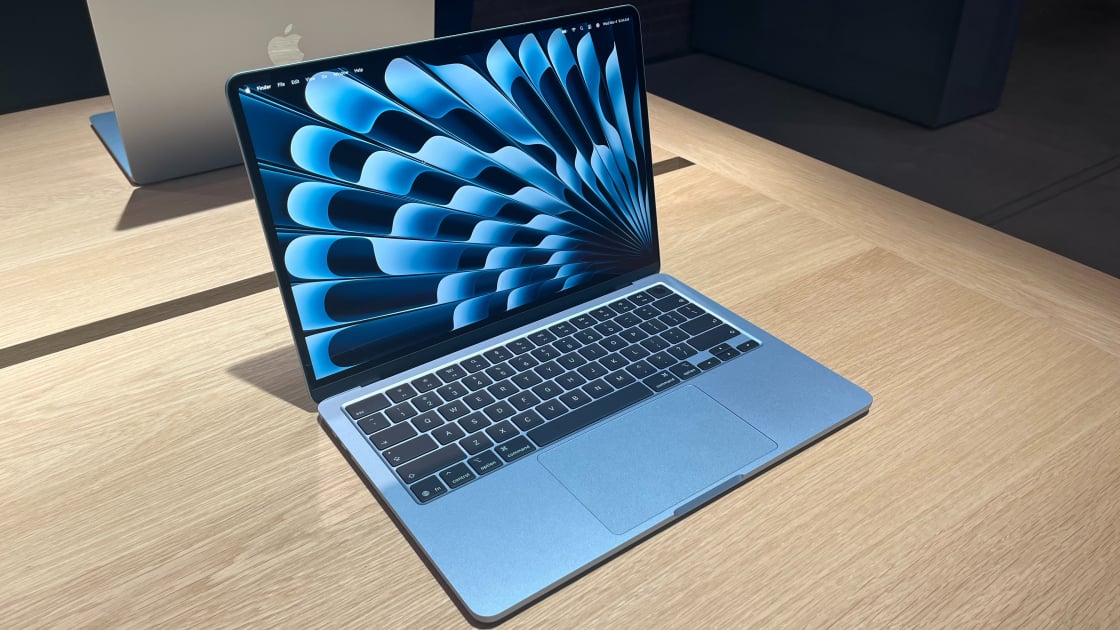
The MacBook Air is back, but this time in a new light. Apple used its March 2026 product event to bring M5 processing to the MacBook Air, along with a sizable storage upgrade and enhanced wireless connectivity, for a new starting price of $1,099. You’re not seeing things: After a year at just $999 for the basic 13-inch version (and often on sale at a decent discount), the MacBook Air now costs $100 more at both of its screen sizes, 13 inches and 15 inches.
Why the price increase? The easy answer is that the storage upgrade doubles both the capacity and the SSD speed, a tangible improvement overall. The more complicated answer is that Apple’s shiny new budget MacBook Neo (starting at $599) also, arguably, gave the company some wiggle room to bump up the price a bit. At least, with the storage upgrades, the company has tried to make good on the higher price.
Check Out the 2026 MacBook Air M5
I had the chance to play with the updated MacBook Air in both sizes during Apple’s big launch event. You’ll be either pleased or bummed (or maybe a bit of both?) to hear that it looks and feels just like last year’s model. The biggest changes are on the inside.
Design: It’s the Air You Know
Absolutely nothing has changed about the MacBook Air‘s design coming from the M4 generation. That may excite or disappoint you, depending on how you feel about the current MacBook Air design, which debuted years ago with the M2 models.

(Credit: Joe Osborne)
Regardless of how well-received the MacBook Air has been, five generations of any laptop with no redesign would start to feel stale. Apple’s iPhones and iPads, for example, have seen multiple design revisions within the same time frame.
Did Apple all but ace its redesign back in 2022? Arguably, yes. But Apple’s PC competition has leveled up its design game big-time in the years since. (And everyone knows how divisive Apple’s screen notch is.) From a sharper display with deeper contrast (but, ahem, not OLED) to quality-of-life improvements like more ports and a webcam privacy shutter, the MacBook Air has plenty of room for improvement despite its top-tier status.

(Credit: Joe Osborne)
With all that said, the 13-inch MacBook Air still weighs just 2.7 pounds and measures 0.44 inch thick. (The 15-incher’s dimensions also remain unchanged.) Both sizes still include two Thunderbolt 4 ports, a MagSafe power connection, and a headphone jack. Also, the Airs still come in four colors of recycled aluminum: silver, blue, black, and gold. In short, a new design is not why you’d consider this year’s MacBook Air. It’s the laptop equivalent of choosing Classic Coke.

(Credit: Joe Osborne)
Toying around with the laptops at Apple’s New York launch event today, I can confirm that the design hasn’t changed one bit, which isn’t a letdown considering how much I already appreciate the keyboard and trackpad. Both continue to be top-notch parts. While I think we’re about due for a design update, this year’s laptop has all of that familiar MacBook Air feeling, but with a much mightier punch inside.

Get Our Best Stories!
Love All Things Apple?

Thanks for signing up!
Your subscription has been confirmed. Keep an eye on your inbox!

(Credit: Joe Osborne)
Specs Check: What’s Changed Inside This Time?
Of course, the marquee upgrade—like with every generation since the Apple M1 in 2020—is that a new processor, here the 10-core Apple M5, has made it into the MacBook Air. First seen in last year’s 14-inch MacBook Pro, the M5 chip brings substantial gains in graphics performance with a new integrated graphics architecture that adds neural accelerator coprocessors to each of the M5 chip’s eight or 10 GPU cores. (Getting Apple’s 10-core GPU is a $100 upgrade in the Air.)
These neural accelerators are geared mainly toward boosting the GPU’s AI processing capabilities, but they also apply machine-learning techniques to graphics rendering (primarily around resolution upscaling and frame generation). Altogether, the MacBook Air will be much more prepared for content creation and gaming than the previous generation: Apple claims 2.7 times faster image processing from the M5 over the M1 in the Affinity app, and a 1.5 times increase over the M4.

(Credit: Joe Osborne)
We’ll have to wait for full testing to see for ourselves how the M5 elevates the MacBook Air in terms of performance. (We’ve only tested the M5 in the MacBook Pro, since that’s been its only appearance to date, until now.) I’m particularly excited to see how the enhanced M5 GPU improves gaming on the latest Air models.
Recommended by Our Editors
Otherwise, Apple has doubled the starting storage capacity for its 13-inch and 15-inch MacBook Air models from 256GB to 512GB, respectively, while increasing the SSDs’ overall data transfer bandwidth and upgrading the systems’ storage controller. (Apple claims these changes have doubled the SSDs’ read and write speeds.) These drives are now configurable up to 4TB, though that capacity costs an additional $1,200. (That extra cost also gains you the bump to the 10-core M5 GPU.)

(Credit: Joe Osborne)
Beyond this, nothing about the MacBook Air’s component mix has changed. It still starts with 16GB of Apple’s unified memory at either of its screen sizes, and nothing about the supporting components has changed year-on-year. You’ll still get the same display, webcam, keyboard, and touchpad as before when buying an M5 MacBook Air. And with the move to M5, Apple stays steady with its claim of up to 18 hours of battery life (measured via Apple TV playback).
Oh, I almost missed an upgrade: The M5 MacBook Air models now have Wi-Fi 7 and Bluetooth 6 support, thanks to Apple’s N1 wireless chip embedded in the package.

(Credit: Joe Osborne)
Early Takeaway: Speed Gains Should Be the Story
Despite the memory crunch forcing all laptop makers to make tough decisions on pricing and configurations this year, Apple might come out of it relatively unscathed for now. Losing the MacBook Air’s three-digit $999 starting price hurts a lot, but Apple offset that in the 2026 Airs with a legitimate storage upgrade and faster Wi-Fi, in addition to the new processor. The MacBook Air has proven itself faster with every generation, thanks to an impressive succession of Apple silicon from M1 to M5, but this time the SSD gets a boost, too: now twice as fast, Apple says, which is the kind of change you’ll notice if you spend lots of time transferring local files like photos and videos.
The 2026 move was a lateral one for the MacBook Air, repositioning it as Apple’s midrange laptop rather than its budget offering, and it just might work. You can preorder the new MacBook Air in either size and all colors right now, with the laptops hitting shelves on March 11.

About Our Expert

Joe Osborne
Deputy Managing Editor, Hardware
Experience
After starting my career at PCMag as an intern more than a decade ago, I’m back as one of its editors, focused on managing laptops, desktops, and components coverage. With 15 years of experience, I have been on staff and published in technology review publications, including PCMag (of course!), Laptop Magazine, Tom’s Guide, TechRadar, and IGN. Along the way, I’ve tested and reviewed hundreds of laptops and helped develop testing protocols. I have expertise in testing all forms of laptops and desktops using the latest tools. I’m also well-versed in video game hardware and software coverage.