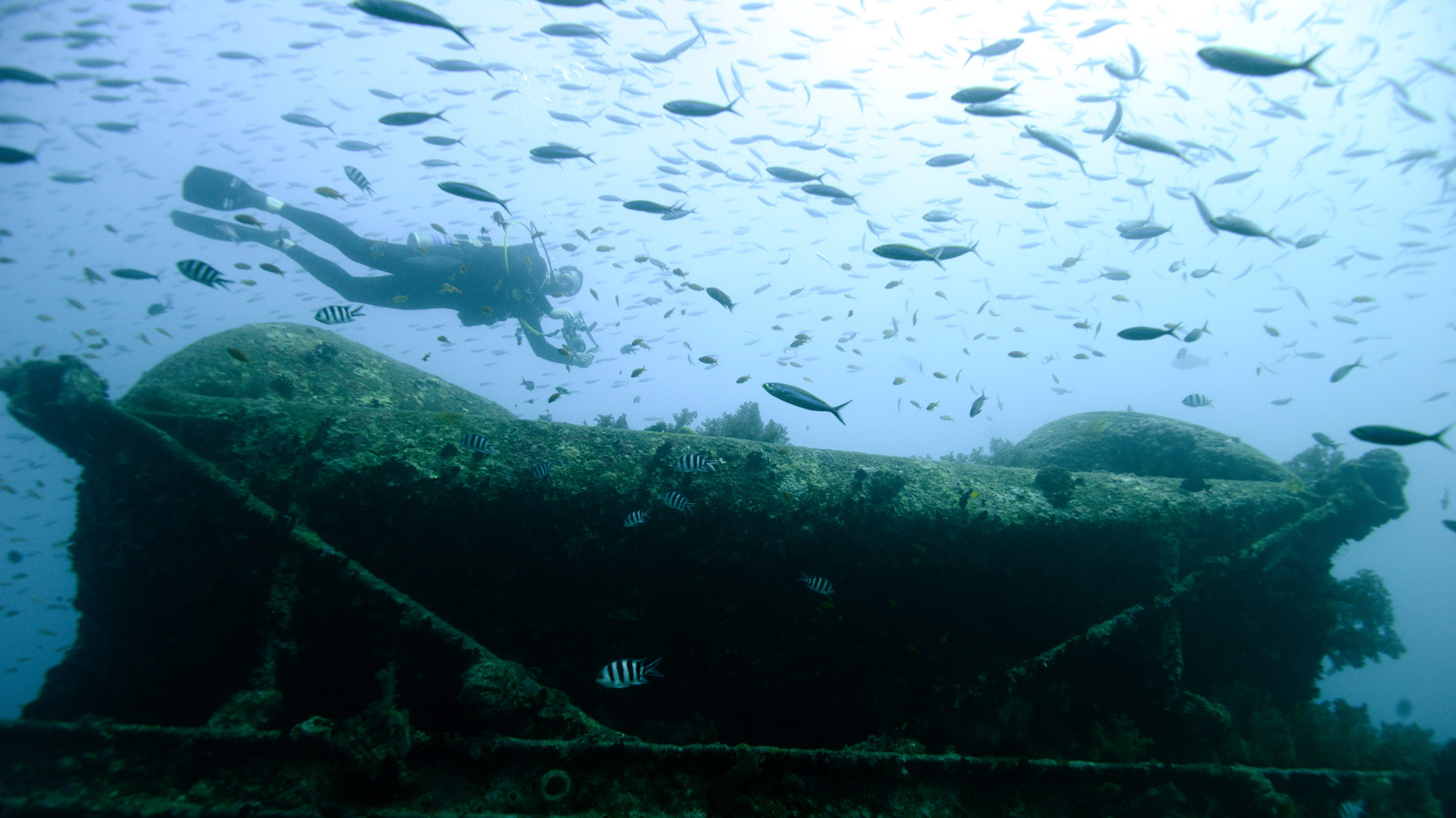
During the early morning hours of October 6, 1941, the SS Thistlegorm sat in the Straits of Gubal in the Northern Red Sea, near the Sinai Peninsula. It was in the wrong place at the wrong time: A pair of iconic Heinkel He 111 bombers was on the hunt for what the German Luftwaffe thought was an Allied troop transport, but they instead found the Thistlegorm. Officially, it was only carrying motor parts, but in reality, it was carrying all sorts of military equipment, including firearms, munitions, and vehicles – all bound for British troops in Northern Africa.
At approximately 1:30 a.m., one of the Heinkels dropped two bombs, which hit hold number four at the rear of the 415-foot ship. The munitions ignited, causing an explosion so powerful it cracked the hull in two and tossed two Stanier 8F locomotives (each weighing 73 tons) overboard. The ensuing firestorm was so bright it revealed the location of the nearby Rosalie Moller, which was destroyed two days later.
The Thistlegorm sank in a “V” shape; the stern came to rest on its port side at about 105 feet of water, while the bow landed upright at about 52 feet. Of the 42 men aboard, only nine died, five of whom were Royal Navy personnel — probably manning the 4.7-inch anti-aircraft gun and heavy caliber machine gun at the stern where the bombs first dropped. The area has since become a renowned dive site, where divers can see an array of sea creatures, including barracuda, stonefish, and sea turtles (among others).
Lion and crocodile and angel (fish), oh my!

The Thistlegorm’s wreck remained mostly forgotten until famed sea explorer Jacques-Yves Cousteau rediscovered it in 1955. However, its popularity as a dive destination didn’t truly explode until the 1990s. The now coral-covered structure has since become a refuge — a creepy underwater zoo, if you will — for an array of aquatic animals, including lionfish, batfish, moray eels, and angelfish. Perhaps the oddest of them all, though, is the crocodilefish, a reclusive ambush predator that very much resembles a crocodile.
Not only that, but the massive trove of military equipment that survived the initial destruction remains undisturbed in its wide-open holds on the ocean floor, creating an underwater museum of sorts. The two Stanier 8F steam locomotives, which dropped about 100 feet to either side of the stern, can also be explored. Divers can swim through the site up close and personal, but because wreck diving is extremely hazardous, only those with at least 20 logged dives are allowed inside.
The SS Thistlegorm, whose name means “Blue Thistle” in Gaelic, was built in 1940 by J. L. Thompson & Sons Ltd. It was part of a line of cargo ships operated by Albyn Line Co. Ltd., and was partially funded by the British government. While it had a brief life, the SS Thistlegorm’s remains endure as one of the most fascinating shipwrecks from around the world.