Listen to this article
Estimated 4 minutes
The audio version of this article is generated by AI-based technology. Mispronunciations can occur. We are working with our partners to continually review and improve the results.
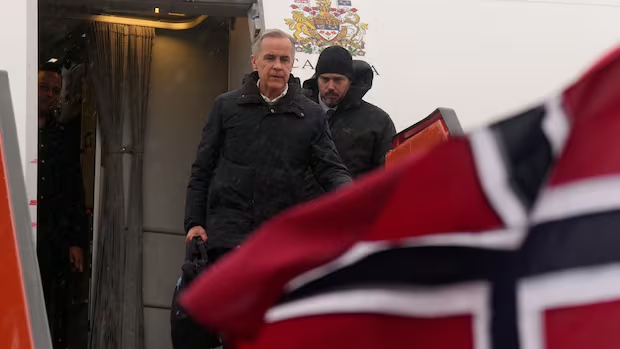
Prime Minister Mark Carney touched down in Norway early Friday where he will get important face time with the Nordic country’s leader and the German chancellor before taking in a major NATO wargaming exercise that includes Canadian troops.
Both countries are backing a bid by German submarine-maker TKMS to sell Canada 12 new submarines — a multi-billion dollar program that has been fast-tracked by the Liberal government.
Despite the high-stakes — militarily, economically and diplomatically — Carney said he doesn’t expect the submarine bid to be discussed among the three leaders.
“The short answer’s no,” he said, when asked about the possibility in Yellowknife prior to boarding a flight to Europe, “because we’re at a phase in that process where the final bids have been submitted.”
Both TKMS and the other bidder, South Korea’s Hanwha Ocean, handed in their proposals to the federal government’s defence investment agency on March 2. Over the next month, federal officials will be able to ask clarifying questions before the bidding is fully closed in early April.
Both companies have been told to expect a swift decision — perhaps as soon as late June.

The joint German and Norwegian pitch has been built around North Atlantic solidarity and longtime co-operation as NATO allies, as well as the economies of scale with all three nations running the same kind of submarines. TKMS is offering the Type 212CD, a newer version of the Type 212 boat already in service with several navies.
Micheal Byers, a political and defence expert at the University of British Columbia, said even if the specific subject of the submarine bid is off-limits, there’s always the subject of allied co-operation.
“I’m sure the Germans and the Norwegians are very glad that they’ll get to speak with him. Whether the prime minister is susceptible to that kind of friendly cajoling, I don’t know,” said Byers, who added that his perception is the prime minister is fairly clear-eyed and business-like.
“My sense is that he’s a pretty hard-headed guy and if he sees an advantage in going with the South Korean company, he’ll go with the South Korean company. This is not about sentimentality, this is a rational decision that needs to be made.”
All three leaders will travel north to Bardufoss, above the Arctic Circle, later on Friday, where more than 25,000 NATO soldiers, sailors and aircrew are participating in the alliance’s biannual exercise known as Cold Response.
The main exercise started on March 9 and runs until the 19th. It’s taking place on land, at sea and in the air and involves 14 countries.

Keir Giles, a defence expert at the U.K.-based Chatham House, said the participation of Canadian troops is important beyond the show of solidarity.
“Troops from Canada will be used to operating in these kinds of conditions” in the Arctic, said Giles. “And there’s a lot of valuable experience that they can share with troops that are deploying from farther south, for whom this may be entirely unfamiliar.”
Norwegian defence officials have played up the fact that this iteration of the long-standing war game, which practises reinforcing the country in the event of a major crisis, includes several hundred civilians playing various roles.
It’s an important addition, said Giles.
“War happens among people and that has to be factored into in the realistic assessment of how a war is going to progress,” Giles said.
“In Ukraine, it’s been clear what the impact on civilian populations is, and that, of course, needs to be modelled in any country that actually wants to protect its civilians against conflict.”
NATO nations have been struggling with ways to rally their population, and Giles said there are important lessons to be learned over the next several days.
“It’s not just keeping them alive, it’s also the resilience they provide,” he said. “It’s means of making sure that societies and economies can continue to function while you have an adversary which is doing its best to make sure that they don’t.”