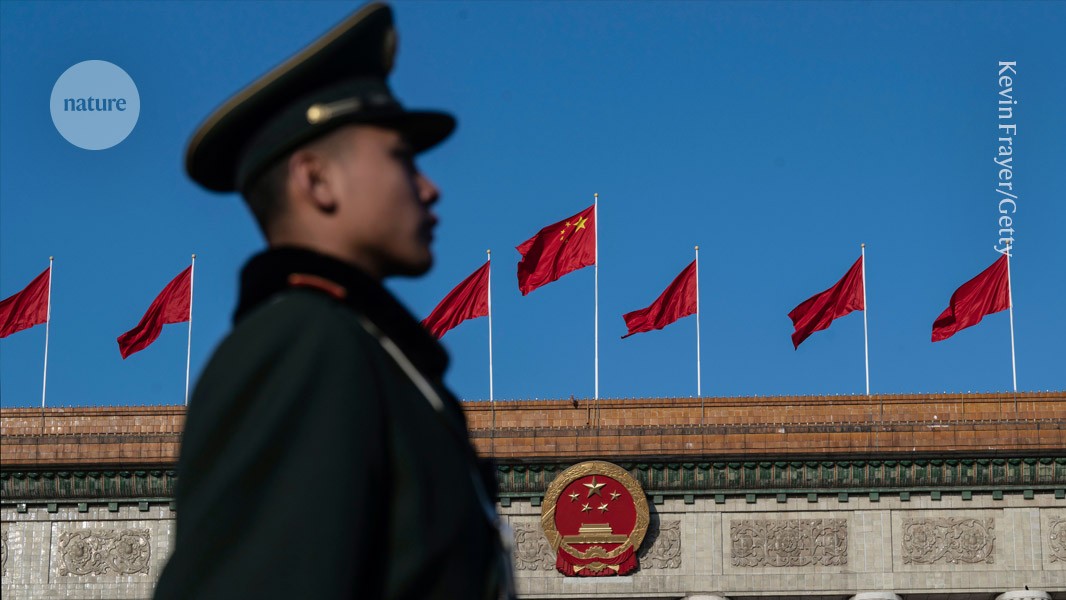
Credit: Kevin Frayer/Getty
China is pledging to use ‘extraordinary measures’ to support the country’s bid to become a global leader in artificial intelligence, quantum technology and other cutting-edge technological fields, according to its 15th five-year plan.
The plan (FYP) was passed by the top legislature in Beijing on Thursday and published on Friday. It will run from 2026 to 2030 and serves as China’s overarching blueprint.
Many researchers noted an air of confidence in the plan. “Five years ago, the sentiment of the Chinese science policymakers was still very much like, we don’t want to be too far behind the US, we are still doing the catching up,” says Meicen Sun, an information scientist at the University of Illinois Urbana-Champaign. “Now, there is this more palpable sentiment that there’s a real chance we can be a true leader,” she says.
The government has promised to boost its research and development (R&D) expenditure over the next five years. And the country’s science budget is also expected to increase to 426 billion yuan (US$62 billion) this year, a rise of 10% from 2025.
The Chinese government now considers science to be as important as other top-level national goals, such as boosting defence, economic growth and the country’s international influence, says Stefanie Kam, who researches Chinese politics at Nanyang Technological University in Singapore.
Technology strangleholds
The plan also doubles down on the government’s long-term goal of becoming more self-sufficient by overcoming technological bottlenecks that prevent China from making key technologies, such as advanced semiconductor chips.
It calls for breakthroughs along the ‘whole chain of development’ in six domains: integrated circuits, industrial machine tools (machines that make other machines), high-end instruments, basic software, advanced materials and biomanufacturing.
That essentially means that the country will step up its domestic capabilities in every aspect of those industries, says Steven Hai, a political economist focusing on technology innovation at Xi’an Jiaotong-Liverpool University in Suzhou, China.
Although China has tried to overcome technological choke points for many years, the mission has been brought to the fore in the 15th FYP, mainly owing to China–US competition for technological supremacy, says Zhou Weihuan, a legal scholar specializing in China at the University of New South Wales in Sydney, Australia.
The plan doesn’t go into detail about what the extraordinary measures will entail, but Sun suggests they will include provisions such as the ‘K visa’, which was rolled out last year to attract foreign scientists. “Extraordinary times call for extraordinary measures. This document is a prime embodiment of this,” she says.
The country will also fast-track R&D in areas such as biotechnology, neuroscience and deep-space exploration.
AI strategy
The plan doubles down on the use of artificial intelligence, applying the technology across society, in fields ranging from industrial development to social governance, as part of a national campaign called AI plus, which was announced last year.
AI research is now being treated as a crucial and strategic national resource that requires security along the whole supply chain, including chips, basic software and training to ensure mass adoption, Kam says.
In early 2025, Chinese tech start-up firm DeepSeek shocked the world by releasing two large language models (LLMs) that rivalled the performance of the dominant tools developed by US tech giants — but that were built at a fraction of the cost and computing power needed to train their US counterparts.
Sun says that the country’s AI advances have served as a confidence booster for its “attitudinal change” as to its standing in the global technological race. She expects China to not only develop AI as a technology, but also to “actively and pre-emptively” write the global rule books on AI governance and regulation.