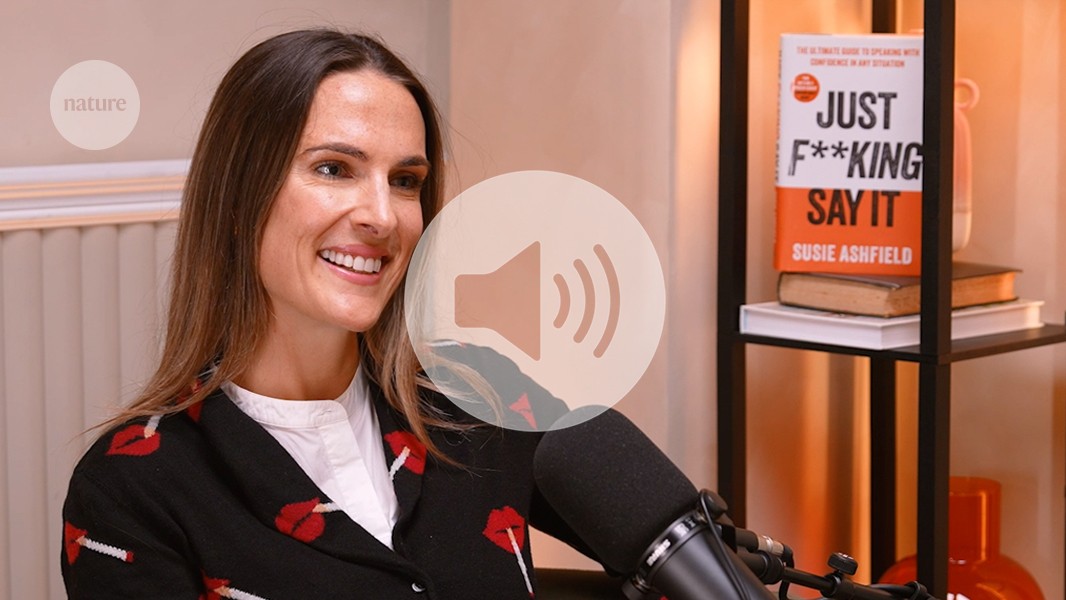
Holly Newson 00:00
Welcome to Working Scientist, a Nature Careers podcast. I’m Holly Newson, and in this series, you ’ll hear from authors who can help you in your career.
In this episode, I’m joined by Susie Ashfield, a speech and communication coach, and the author of Just F**king Say It, a book that helps you use your voice in the best possible way, whether that be for public speaking, a networking event, or asking for a pay rise.
So Susie, thank you for joining me. (Thank you for having me).
So, to kick off with…
This book, you have almost a mantra right at the start. To care less.
And when it comes to communication, and, you know, interacting with other people, I feel like that’s against most of our instincts.
We all care so much.
So why is that your approach?
Susie Ashfield 00:46
It’s exactly because of that. We are all desperately, desperately concerned about what other people think of us.
Now, ultimately, that’s a really good thing. We should (a little bit) care about how other people perceive us.
But when we get obsessed, when we really overthink how we walk into a room, what we’re saying, how we say it, we get in our own heads.
And we put levels of pressure on ourselves when we’re communicating that just shouldn’t be there.
And the output of that is that we overthink it. And we deliver something that’s garbled.
All because we are trying to meet this super high expectation that we’ve set in our own heads. And it just doesn’t really exist.
So that’s why the ethos is to just care less.
Let it go. See what happens. Enjoy it.
Holly Newson 01:35
And easy to say, probably hard to do. (Absolutely).
What are the foundations that you have to have in order to be able to get to that point where you care less?
Susie Ashfield 01:45
You have to know you know your stuff.
The example I can give you of that is: if you’ve ever been in that horrendous situation where people go, ‘Hello. We ’re sat around a room. Let’s go around the room and introduce ourselves.’
For some reason, for even the most experienced of speakers, this is the thing that strikes fear.
Holly Newson 02:03
So bad. (I’m really bad at that.) Me too.
Susie Ashfield 02:04
(Don ’t know why). No one likes it. And for whatever reason in our heads, we suddenly go, ‘what is my name?’
You know your name. I know my name, but that’s an exact example of the overthinking creeping going: do I know my name? I’m sure I know my name, but now I don ’t think I know my name anymore, and we have to sort of push back on that and go, it’s not just that I know my name. I know I know my name.
So it’s knowing you know your stuff.
Second of all, you have to try. So you have to put yourself out there a little bit.
The ethos of care less doesn’t mean I’m going to live a life of anarchy. It means I’m going to take this huge amount of pressure off myself, but I ’m going to put myself out there.
I am going to potentially make myself look just a little bit silly and see what happens.
And if you embrace that idea that, ‘okay, yeah, I might look a little bit silly, but let ’s see how this goes,’ you will find the ethos of caring less falls into place.
And just practicing. The more you prepare, the more you practice, the easier this kind of stuff gets.
Holly Newson 03:09
When you said that, it popped into my head that there are a lot of people who used to be cringe on the internet who are now very polished professionals when they put things out.
And it’s getting over that initial hurdle, whatever you’re doing of, like, maybe you ’re cringeing at yourself, or you ’re like, ‘Oh, that was not, you know, as good as I’d like it to be, but I did it anyway. ’
Susie Ashfield 03:30
Yeah, totally. There is a story in the book about one of my clients who wanted to do that.
They thought they could get…they were an independent management consultant.
They wanted to get ahead of their competitors, and they thought the best way to do this would be little videos on LinkedIn.
They’d seen me do it. They wanted to do it. And they wanted those videos to look good.
And so they took some coaching from me, and we get to the day of recording everything, set up, little studio like this.
Everything’s been paid for, and he just can’t do it, and it’s because that fear of looking silly is stopping him.
And so I think I said something to him along the lines of, ‘we’re just going to do the first one, and you are going to look like a complete prat. And we ’ll just accept that this is going to be cringey and horrible, and you’re going to hate it, but we ’ll record it, and then the next one will be better.’
So it ’s exactly that. It’s that, okay. ‘I’m going to be the clown here, and I don’t mind what the result is, because at least I’ve done it, and everyone else who sat there going, I couldn’t possibly make a fool of myself hasn’t.’
Holly Newson 04:28
Yes, yeah, definitely. And when I think about scientists in this context, I often think about something that scientists need a lot, which is funding.
So, if a scientist is going into a room to pitch for funding, what would be something that you think they need to know before they enter that room?
Susie Ashfield 04:49
I would tell them to ask themselves two questions. This is really important.
One. Why am I here?
Not having an existential crisis in the question. What is my objective?
And to remind yourself that perhaps for a scientist in a pitching round, it’s a slightly unusual situation.
Don’t lose sight of the fact you are there to ask for money. You are there to ask for investment.
That is ultimately the outcome you’re looking for. Hold on to that.
Question number two. In all of that, what is the one sentence your audience needs to hear?
Not ‘this is a demonstration of how much knowledge I have.’
Your audience already know that.
And I think this is potentially a bit of a common mistake I see from people in the science, medical or pharmaceutical fields.
Because their whole lives, they’ve had to spend a lot of time proving their credibility, proving their research, showing evidence.
That’s then how they communicate.
In a pitching setup: totally different.
You need to respond to the audience and say, ‘Okay, I’m here to ask for your money. And this is why investing in me or this product or this piece of research is going to be beneficial.’
So it’s that. What’s the one thing you want them to take away?
There’s a story in the book. It’s ultimately based on a true story, and it’s, again, a common problem.
‘I’ve got this piece of research. I’ve developed this tool, or this thing that is going to, let’s say it’s going to screen for breast cancer super-fast, super quickly. ’
It would feel natural for someone who’s done that research to go into that room and say, ‘hey, look, look at all the research. Look at all the technical things I’ve lined up to make this thing really very impressive.’
In actual fact, the one message they need to land is: this product saves lives.
You would be amazed at how many people miss the opportunity to land that message.
Because your investors might come from a science background.
Equally, they might not.
What you can guarantee is they come from an investment background. If they can see how what you’ve got saves lives, they are going to invest.
So I think particularly for people in that field, it is about taking a big step back and going ‘why am I here? What’s the one thing I want to get across? ’
(Is that the same for any pitching?)
I think actually, it applies to almost any piece of communication. (Okay)
Even coming on here today, as I was walking around Liverpool Street Station, I said to myself: ‘Right: why am I going on? And what’s the one message I want to land? ’
And it just two questions, even if you’ve had a rubbish day, will just kind of focus your mind.
What’s the one thing I want to get across here?
So I would say they apply to anything. We tend to fall into a bit of a trap, and it’s tied to what I was saying earlier.
Everyone sort of goes out there and tells people what they want to tell them.
Stop that. Take a big step back. And instead of telling people what you want to tell them, tell the audience what they need to hear.
And if you can do that, you will never need to come along and be one of my clients ever again.
But it is that point of going: ‘It’s not about me and how much I know and me proving myself and caring deeply about getting my message across. ’
It’s about them. What do they want?
Does that make sense?
Holly Newson 07:49
Yeah, that does make sense.
So how does storytelling come into this?
Is there anything that people can know about how to be better storytellers in order to get whoever ’s listening, whether that’s a conference audience or, you know, your team at work, to get them on board with your vision, or to convey information in the right way.
Susie Ashfield 08:09
Great question. I see storytelling everywhere at the moment, hashtag, storytelling,
It’s all over LinkedIn. It’s almost gotten point where I think we’ve slightly lost meaning of the word. (What does it mean?)
Who knows?
My interpretation is storytelling is just a fancy word for using case studies.
So if you use case studies, it doesn’t matter how much your audience understand about what you ’re saying, or how completely foreign they are to it.
If you use an example, aka a case study, aka a story, they will get it quickly.
So let’s come back to that example of, say, you’ve created something that detects cancer faster. And instead of saying: ‘Hello, I’ve connected 47 participants in a study of 18,000 people. We’ve discovered that…. ’
It’s about going in with something that really grabs people very quickly.
You could start with a date. TED talkers do that all the time.
‘On 4 May 2016 I discovered a lump in my left breast. Had that lump been discovered just four weeks earlier, my chances of survival would have gone up 80%. We’ve created something that ’s going to detect cancer in women of the age of 40 to 60, ten times faster. ’
And you see the case study I’ve used there, which I’ve completely made up on the spot, it’s completely hypothetical for anyone listening, it’s not only useful for you now to understand what I’ve said, whether you ’re a scientist or not a scientist. But it’s also just a lot more interesting.
I think it’s a lot more engaging than going: ‘Hello. My name is Susie Ashfield. I’ve been doing this for 20 years. Now let me list all of my qualifications before we get into the good stuff. ’
Start with a story and people want to engage with you. We are hard-wired to like storytelling and engaging with it.
We’ve been doing it really before we could even formally communicate.
So if there is something in us that deeply, deeply needs that storytelling stuff, deliver it.
Holly Newson 10:04
And if you’re not someone who, you know (very English reference), but like, who at the pub, you know they’re not the one that everyone is looking to to, like, tell that story. Like, everyone’s is not fixated on you, and you feel like, ‘Oh, maybe it’s just not me. ’
What would you say to them?
Susie Ashfield 10:22
I think that’s a very normal concern to have.
We all have that friend who is a brilliant storyteller, and they can make going to the shops for a packet of polo mints an epic tale.
If that’s not you, don’t worry.
All I would suggest you do is look at what you’ve got and think about hypothetical characters.
Behind numbers you have names.
Behind facts you have faces.
If you want to become a master storyteller, it’s just about changing where you put the focus, changing the lens from the facts, to the faces of the people you’re helping. A bit like creating an advert, or a bit like a newspaper article.
In fact, if you want to kind of add a third question, take a big step back and go, ‘Okay, how might a journalist find the human element here? ’
And if you can find that human element, you’re done. Even if you make it up. You can start by saying, ‘This is a hypothetical situation, but… ’
That’s a really good way of just using storytelling to get across even the most complicated of scientific information.
And I have to say, it is something…my clients, who I work with in this field, they tend to forget because they think it’s not important.
But when you are working with external audiences, even when you’re working with internal audiences, it’s a really nice way to grab people.
And it’s a really useful way to get across complicated information quickly.
Use it. Try it. All it needs to have is three parts: beginning, middle, end.
Holly Newson 11:44
So someone who is using storytelling and really making that effort to engage the audience, rather than just saying information, is always going to stand out.
That’s the person you ’re going to remember at the end of the day. So…very worthwhile
Susie Ashfield 11:56
Public speakers are made, not born. We meet people all the time.
They’re just naturally very good at this. ‘Oh, they were just born that way. ’
Those people are my clients. If someone looks like they’re a natural public speaker, if they look completely relaxed in front of the camera or conference, it’s because they ’ve done it a million times before.
Or they’ve practiced it until they feel really confident.
You know when Dolly Parton said ‘it takes a lot of money to look this cheap,’ it takes an awful lot of preparation and practice to look like a natural.
So remember, it is normal to be nervous. Everyone feels nervous. If you’re not feeling a little bit nervous, you are potentially either a toddler or a psychopath.
Those are the two categories of people who just do not feel imposter syndrome on any level.
So you should be feeling a little bit nervous. Nerves are a good thing.
Come back to what I said. Ask yourself: ‘why am I doing this? ’
Look how the guys at TED do it. Look how they take that key message, wrap a few interesting stories around it, attach a piece of research, a couple of statistics, no more than that, and suddenly they end up with 10-15 minutes of something that feels very natural, has very, very human elements, and it feels very normal, it feels very relatable. But it’s got that key message that lands with impact.
If you’re looking for an idea as to how you go into that room feeling as confident as possible: practice.
Practice out loud. You would be amazed how many people say, ‘I hate public speaking and I’ve got to do a presentation.’
I go ‘oh, how often you practising that presentation? ’
‘I haven’t practiced it. I prepared it, and I’ve been preparing it for the last 12 months. ’
But they haven ’t actually stood up and said those words out loud. Accept that you’ll be nervous. Practice it, do it and then do it again. That’s it.
Holly Newson 13:42
And at conferences, another thing that you often come across is networking.
And maybe you’ve gone there to network. And this book has honestly, some of the most practical advice for networking that I have ever read.
Like, it’s like, step-by-step. Like, not insulting anyone’s intelligence, but it’s a bit of a dummies guide but that, like, people need.
It should be, yeah, so you go to an event, you know, you’re there to maybe speak to people, but you’re actually in the room and you’re like, ‘Oh, now I’ve got to approach someone. ’
How can you get over that and comfortable feeling and actually go and start a conversation?
Holly Newson 14:17
If you are feeling a sense of, ‘Oh, no, I want to…I have to talk to people. And I don’t want to.’
Remember that as a very normal feeling. And what you are feeling is not necessarily that, ‘Oh, I have to say something.’
You ’re actually experiencing a fear of rejection. What if I walk up to that person, they just turn away out of outrage that I’ve started speaking to them.
What if I say something so completely unhinged they just don’t know what to do?
What if there’s an awkward silence?
Get to the crux of the worry. And when you’re there, realize that there is nothing real there.
If someone doesn’t want to engage with you, fine. Go and try someone else. But in an event that is labelled a networking event, people are expected to network.
So perhaps on the Tube, it is absolutely not normal to walk up some go, ‘hey, my name is Susie. I’m a public speaker.’
That ’s a bit unusual. But in something that is billed as a networking event, everyone has signed a silent contract in attending that event that says ‘I will walk up and start speaking to you. You may walk up and start speaking to me.’
If you’ve got a few pointers, little stories, in your back pocket about how you can push through the small talk and get to the bigger questions, even better.
Just a couple of little lines about, ‘oh the journey, oh the weather, oh, this happened on my way ’ to the thing that will be helpful to you and it will be helpful to them. But don’t be afraid to sort of comment on things that are happening around you, or ‘what do you think of the last speaker? ’
‘Hey, I’ve noticed this is a big theme. What are your thoughts on that? ’
Anything you like just to open up the other person, and then the easiest and most simple but effective trick of networking is to listen, ask the other person questions, listen to their answers, and now you are just having a conversation. Which you can do.
Holly Newson 16:05
Yeah, and what about when you need to go and talk to someone else? Is there any, are there any good pointers for how you do that without being rude or offending anyone?
Susie Ashfield 16:13
Yes, absolutely. I remember being at a networking event years ago, and I saw this happen beautifully, and I have never forgotten it.
The best way to get out of a conversation at a networking event is, ‘Please excuse me. I’ve just seen some people over there. I’ll come back. I really need to do some networking. ’
And it made me feel as though, ‘oh yes, they must network with the other people. But they were enjoying talking to me.’
And it’s so interesting watching people who are really able to work a room. They enter into conversations, and they exit those conversations really, really easily, and they never cause any offence again.
Because there’s an expectation if you’re at a networking event, you are there to network. But secondly, this idea of, ‘I’ve loved this. I ’ve just got to catch Fiona on a way out, so I’m just going to grab her. We’ll come back. ’
And then if you do come back, fantastic. You are now really working the room.
So that ‘excuse me while I go and network.’ One of the best ways of just politely moving on from that conversation. Being honest.
Holly Newson 17:11
And you also wrote that it can work quite well if you don’t come in with pursed lips, you have your mouth slightly open. Why? Is that?
Susie Ashfield 17:24
Very practical reason. If you suffer from a syndrome, which I experienced, called resting bitch face.
Didn’t ask you whether I was allowed to say the word fat. But there we are, you won’t look approachable. It’s a really strange thing.
So if ever I’m walking into a room, I just have my mouth slightly open, not closed, because if I have my mouth closed, I look miserable even if I’m not.
Even if I’m in a really cheerful mood, I’ve made myself look miserable. It’s a lot harder to approach someone who looks like they are suffering a dark cloud.
It’s a lot easier to approach somebody going, ‘Hi, look, I’m ready to be to be spoken to who I am drinking my hand I’m looking like, yes, you’re the person I want to speak to.’
So a soft, relaxed face really goes a long way.
Yeah, open body language counts for a lot.
Holly Newson 18:08
So let’s take us kind of into an environment with your colleagues. How do you just f**king say it if you’re in a really hierarchical environment. What do you do then?
Susie Ashfield 18:19
Well, I think it’s an interesting setup you’ve given me there. I suppose my question would be: ‘if you were a scientist: what’s stopping you? ’
Why have we suddenly said, ‘well, there’s a hierarchy. ’
Why does that suddenly say, ‘well, I couldn’t possibly say the thing I’m thinking of, because there’s a hierarchy.’
There’s a hierarchy everywhere.
Yeah. But if you say, ‘well, I’ve only been here two weeks, and I have to be here for 20 years before I can even think about putting an idea out’ you are going to find you trap yourself in this little box of ‘I can’t say anything unless I absolutely know it’s going to be correct, or brilliant, or useful. ’
If you do that thing of caring less and giving yourself to say, ‘okay, do you know what I’ve got this idea, there is a good chance this idea might be bad, or wrong, or just completely rubbish.’
Allowing yourself to go, ‘okay, this, this is a rough draft. Look. This is just something I’m thinking.’
Roll it into the room. See what happens. Because in our heads we’ve got this idea that someone ’s going to stand and go, ‘that’s a terrible idea. How dare you? ’
The worst thing that could happen in this country is someone goes interesting and then moves on.
If you’re not English and you listen to this, you’ve just been insulted. You’ve thrown something out there. You’ve gotten your voice into the space, and the next time, it feels a little bit easier.
That’s why the preparation and practice bit is so important.
What’s my statement? What’s the evidence or the example, I can attach to it, and then I’m going to wrap it up with the statement again.
You can acronym that, SES: statement, example, statement. Throw that out, and you’ve got something quite useful onto the table.
But don’t let this idea of hierarchy hold you back. It is very rarely the people at the top who are thinking about the hierarchy. It is always the people who are somewhere in the middle who are most worried about it, because they’re kind of moving through it, right?
Often I find with the people at the top, they’re looking down, and they’ve got this sensation of ‘the higher up you go, the further I have to fall.’
And the people who sort of, on day one obviously feel like they need to prove themselves.
But give yourself permission to get it wrong,
Holly Newson 20:23
And what if you’ve you know, you’ve shared some ideas with your boss. And your boss is just fundamentally not a very nice person. Or a very difficult person, difficult character.
What would be your advice on how to handle that relationship and communicate effectively?
Susie Ashfield 20:42
If you just have someone who is a bit hot-headed, a little bit bullish when they don’t necessarily need to be, ask yourself why that’s happening. Why are they taking this route?
Normally, and I’m sort of speculating a bit here because I you know we ’re not talking about a specific character, but normally, when someone is behaving like that, there is a reason for it.
And the reason for it is this: in the past, it’s worked.
If you have found that shouting ‘jump’ really loudly at someone results in them jumping, why would you not use that tactic again?
It’s worked in the past. Do you see what I mean?
So you just need to be the person who’s going to push back, be the adult in the room say, ‘well, actually, I’m going to finish this comment now. To come back to what I was saying earlier. ’
Don ’t take their bullish nature personally. That’s sort of what they want.
You need to stay rational. You need to stay calm. You need to get your point across, perhaps in a way that they want to hear that message.
I came across some characters recently who did have a boss who would very quickly change their mind about what they wanted. ‘I want it this way. ’
So they give it to them that way. And ‘no, no, now I want it this way. ’
And they take this pushback, this sudden change very, very personally. As though it was they had done something wrong.
They hadn’t done something wrong at all. They were just dealing with a character who moved at a million miles an hour, changed their mind every 15 seconds, and they just wanted information delivered in a certain way.
With characters like that, all you can do is expect the unexpected.
But remember, someone is behaving like a bully, because in the short term, it has worked for them.
In the long term, it is not going to hold out.
But you need to show them that that kind of reactive behaviour is not the way they’re going to get the best result from you.
Hold your ground. Stay calm. Be the adult in the room.
Holly Newson 22:35
So that example you gave of someone who changes their mind a lot, and you know, to try and expect the unexpected, is that sustainable to work in that environment?
For the person who is expecting the unexpected all the time,
Susie Ashfield 22:55
I think that depends very much on the individual. I think that’s down to you. Some people can deal with it. Some people understand that ‘okay, this is just how they communicate.’
And if on Monday they say they want a high-level overview. And then on Tuesday they say they want the details.
I can either learn how to be prepared for both, or I can just understand that this person is going to give feedback, they’re going to give feedback in a very strong way. And if I’m able to deal with that, fantastic.
I’ll be able to be flexible. I’ll be able to grow with them, but I will also be able to push back when it matters and say, ‘do you know what? I’m not going to jump the moment you say jump at me. ’
If that doesn’t work for you, that’s a very personal choice, and you have to decide when enough is enough.
Holly Newson 23:39
Moving along from the tricky characters. Say your boss is, you know, absolutely fine to work with. Great.
But you want a pay rise. What is your advice to someone before they enter that room and ask for that raise?
Susie Ashfield 23:56
Prepare for the conversation. Absolutely prepare for the conversation. You have been thinking about it for some time, I’m going to guess.
But now you need to prepare how you’re actually going to say it.
I would also prepare the other side if you can. So that they’re not caught on the back foot.
Put your case together. And just in the same way, if you had a product you wanted to pitch for business for, put your case together as to why you deserve that salary increase.
A lot of people don’t like to ask that question. And the reason is: they fear rejection. They fear if someone says, ‘No, I’m not going to give you a salary increase. That is directly linked to my credibility.’
That’s really not the case. If you can afford to give a salary increase, if one’s asked for, that will happen. And then sometimes it isn’t in the budget. That’s not necessarily a reflection of how you are as a professional.
So if you do receive pushback, that’s absolutely fine.
Be brave enough to have a conversation. Know how you ’re going to phrase it. Pull your case together clearly. Be really very binary, almost as though…
Here’s a little bit of a trick I use. Imagine you are thinking of a friend and you are helping them prepare a statement for why they deserve a pay rise.
And that just kind of takes the emotional side out of it. And you are now going to feel a lot more comfortable about asking what you want to ask for.
Then have the conversation.
The most important part of this is not that you get the money or that you don’t get the money. The most important part of this is knowing what you have to do in order to get that pay rise.
You want to either reach a compromise. You want to either reach a place of knowing what happens next.
But if you leave that conversation knowing exactly the hoops you need to go through, exactly what the stages are in order to get where you want to, that is a conversation well worth having, not to be avoided, and worth it every time.
You’re also going to indicate the other person. ‘Look, I’m determined this is what I want. I’ve got my eyes on something.’
And they’re going to start to be able to hopefully help you. If they value you, they’re going to help you reach that goal with you. It’s going to be a collaborative effort.
Holly Newson 26:00
Yeah, definitely.
And this conversation might be not the best thing if someone is just trying to get their foot through the door. They’ve not got the job that they want yet.
So what should someone do if they’re going for a job interview?
What is the best way to put their best foot forward?
Susie Ashfield 26:18
I think, for this field in particular, (and this is the message I was hoping to land as I was thinking about what to say for this podcast) there is something called the curse of knowledge.
And this comes back to what I was saying about: you as a scientist, you as someone who works in in this field, know a lot of stuff.
The temptation in that interview is to go, ‘hey, look how much stuff I know.’ And almost just kind of relay it into the interview.
The curse of knowledge is this cognitive bias. It ’s the idea that we assume everyone has the same level of knowledge that we do. That is unlikely to be true for your interviewer. Or maybe they even know more.
What you need to do is carefully prepare case studies. It’s the same old story. If they ask you for the time you led a team. If they ask you for time you had a breakthrough. If they ask you how do you deal with clients?
Have a series of stories lined up, a selection of case studies, almost a library, and a lesson from each one.
And if you feel like you are just matching the question to the case study intro, ‘and what I learned there was x, and the outcome of that was y.’
If you just have a selection of stories that you are ready to reel out to the interviewer, that is going to stop you from going into that ‘hey, here’s everything I know about the question you ’ve just asked. And we’re 10 minutes in, and remind me of the question again? ’
So stay on track with that selection of stories, and the one statement you want to get across. That’s my tip for interviews.
Holly Newson 27:43
If you’re really early career, say, maybe it’s even your first job. You maybe don’t have that many examples to draw from. Is there anything that is advisable in that case?
Susie Ashfield 27:53
Life is an example. Fine, if they ask for something specific and you don’t have it, absolutely fine. No one is expecting you to suddenly (actually, maybe that’s not true). People sort of say ‘we want ten years experience and we want to hire you ten weeks in.’
Even if that’s the case, even if you don’t have the right level of experience, you have experienced things.
So let me, let me think of an example. Perhaps you haven’t led a team on a science project, but perhaps you can think about what the word leadership means to you.
‘Do you know what? Actually, I was cycling home one day, and I saw somebody by the side of the road, and small group had formed. And we had to work together to get the ambulance that person before. And this is what I saw my role as being in that slightly strange but useful situation. It was my job to keep everyone calm. I was the one who called 999. And for me, that’s what leadership looks like.’
Doesn’t necessarily need to be linked to the field. If you don’t have any experience in that field yet.
Holly Newson 28:48
That’s such good advice. I’d never thought of….I had thought of life examples, but never something so specific. Like, I can even think of something where as a first aider, I was the one that stepped in. I never would have thought to use an example.
Susie Ashfield 29:01
You would have used communication, you would use leadership, you would have used listening. So we’re using these skills all the time.
Just keep collecting those stories. Curate them, hold on to them. Make a little library in your head.
Holly Newson 29:11
And one thing I didn’t expect to find in this book was advice on how to, in our busy brains, have good, original ideas.
So what do you have to share on that side of things, on how we can kind of free up our minds, our space, and have ideas that otherwise we might not have had?
Susie Ashfield 29:28
Brace yourself. Put your phone down.
I think you knew that.
And I think anyone listening to that question knew that as well.
It ’s tough, isn’t it? It is tough. And we’re getting more and more addicted to the little bricks we carry around in our hands.
Not far from where we’re sat right now, there is an amazing statue, the Five Tonne Venus.
She is five tonnes of pure woman reclining nude. It’s wonderful. I love this statue. It’s huge.
And whenever I’m around Liverpool Street, I go and take a look at her. And you just watch these people just ignore it.
And we walk past interesting things all the time. The Underground. Fascinating things are happening on the Underground all the time. And we choose to ignore it because a phone is easy.
It creates the creativity for us. It does our thinking for us. And if we’re tired, and if we’re busy, and if we ’re overwhelmed, how nice it is to have that screen just absorb all of that for us.
So we need to be quite regimented in bringing back creativity.
Think about things that inspire you. Trailers to movies. You don ’t have to read a whole book. Just dip into little bits of it. Pictures. Your surroundings. Break out of the environment you’re used to. If you’re stuck in the same little four walls every day trying to come up with new ideas, it’s not going to happen.
Treat yourself to a lunch, or a walk, and just put your phone down. Listen to some music. Work out what stimulates and fires those creative thoughts, and you will find they start to come back to you.
But creativity is a muscle that we need to keep flexing.
The more we flex it, the easier it becomes to use. The easier it is to come up with different ways of thinking and brand new ideas.
Put your phone down, change your environment, do something different.
Holly Newson 31:20
Yeah, I think it’s that, that space, that breaking out of the, what your brain expects to happen next. It expects you to pick up your phone, you know, you’re, you’re on whatever app is your preferred method of, you know, passing time.
And then you’re either, if you’re on a journey, you’ve, you’ve got to, you ’re from A to B. And you’re there, and you haven’t thought really about anything.
Susie Ashfield 31:40
Yeah, where did that time go? I ’ve got an app blocker now, because it was just draining and draining and draining. And it is quite good. Thoughts are coming back. Freedom of thought.
Oh, wow, yeah, I remember nostalgia and thinking about this and thinking about that, and not just being fed stuff, to be honest, I don’t even want to see anyway. Break yourself free.
Holly Newson 32:01
And Socrates makes an appearance in your book.
Susie Ashfield 32:05
Does he? I’m glad one of us has read it!
Holly Newson 32:09
So whether or not you can remember this part of the book, we’ll find out. What can we all learn from Socrates? If you need to it’s on page 19.
Susie Ashfield 32:18
Shall we take a look? With a brand new copy as well? I can sign this for you if you if you like. But it will devalue the books.
I’ll warn you of that.
It’s the idea that if you are worried about something, and I think as human beings, we’re worried about stuff all the time. What am I worried about? What am I actually worried about? How likely is that to happen?
So I’ll give you an example.
It is really normal to be nervous. And you can spend weeks being nervous. I have clients who take betablockers to lower their heart rate before they go on stage.
I don’t recommend that.
I have clients who throw up before they do presentations or important meetings because they are so nervous.
Start to sit with those really uncomfortable feelings.
And what Socrates says is, use a cognitive approach to drill into the fear, not run away from it. Really ask yourself, ‘what am I actually frightened of? ’
An example answer to that might be something as simple as, ‘okay, well, I know what I’m saying, but what if I go bright red? ’
Fine. What ’s the fear behind going bright red?
‘What if I go bright red and people see that I’ve gone bright red? ’
Fine. What ’s the problem there?
‘What if I go bright red? People see that I go bright red and they judge me. They decide that because I’ve gone bright red I’m nervous, and therefore I’ve lost all professional credibility in front of them. And what if they start talking about me behind my back?’
‘And what if, what if I lose my job? ’
And the moment you’ve really put a pin in that thought and laid it out, you go, that is completely irrational. If this is what I ’m frightened of, now that I know this is what I ’m frightened of, it doesn’t really make sense.
Or if you are a client, you’re telling me that, and you feel in the moment that it does make sense, and there is a very high chance of that happening. I’ll accept that, because I can’t tell you you ’re not frightened of something.
But I will ask you how much evidence you have behind it.
So I might say to you, ‘okay, Holly, how many times has that happened before? ’
And you’ll say, going bright red. ‘oh, all the time. ’
And I go, ‘okay, you ’re going to go back red. How much evidence have you got to suggest that people can see it? Has anyone ever mentioned it to you?’
‘Once, when I was a child? ’
(Great). ‘And in that time since then? ’
Not often? Okay, great.
And now that final question. How many times have you ever received any kind of evidence: written feedback, but written feedback, verbal feedback, from someone saying, ‘I thought you’re a great person, but you went bright red in that presenation. And now, as a result of that, I just don’t trust you as a professional anymore.’
And the moment you sort of start to say it and make me go, I’m worrying about something that’s irrational. My anxious brain is overthinking every single thought in my head, and I’m worried about something that is not going to happen. And it’s that method that Socrates said of: Just come on. Logic. One step after the other.
This is how I confront the fear, and it’s the same way actually they deal with people who are frightened of flying or anxious without exams.
It’s that same process of just logical questioning to get to the root of the fear and then seeing what’s really underneath it. How much can you challenge that?
Holly Newson 35:24
Yeah, and I feel like that connects really nicely back to caring less. Because if you have that fear and that anxiety, it’s really difficult to care less. So sitting with it and unpacking it helps you at least get towards that stage.
(Yeah), I think, which is much needed.
I don’t know. I think, like you said, no one is a natural speaker. It’s about doing it over and over again and confronting that fear, whatever it might be.
Susie Ashfield 35:51
It’s normal to be nervous. You know, if you ’re going to the airport, if you’re going to catch a plane.
If you put your passport in your top pocket, you know it ’s in your top pocket, but your brain keeps telling you, ‘where’s my passport? Where’s my passport, where’s my… ’
And you end up checking your pocket ten times in between leaving your house and going to the airport.
Now the upshot of that is that you will remember your passport.
The downside is that you are overthinking something that you already have evidence for. That’s sort of how anxiety works. It is really normal that your brain sort of overthinks these things in order for you to arrive at the airport with your passport.
So it’s natural, but often unhelpful.
Holly Newson 36:30
And so is there any one last takeaway, anything that we haven’t touched on, that you would love people to know about Just F**king Say It, your book.
Susie Ashfield 36:39
Just F**king Say It was written for a number of reasons.
But I think the title is really important.
I got pushback on the title, but I fought for it, and the reason is this.
At the end of the day, when I have given my client all of the advice I can give them, that is the last piece of advice I have left.
Just do it. Just do it. Just do it and see what happens.
And if you fail, if it goes wrong, (there’s no such thing as wrong) but if it goes wrong, if it doesn’t land how you want it to land, the consequence of that is very rarely anything worse than having to do it again next week.
The more you do it, the easier it gets.
But everything in the book will only work for the people who are willing to give it a go in its smallest possible format.
There’s a whole chapter in there, for example, on saying no.
People want to get better at saying no.
‘I need to say no to that person who’s asked me for a pay rise because we don ’t have that in the pot yet. But I know I am a people pleaser. I know I hate saying no.’
If you can ’t say no to the big things. Yet, the next time you walk into a cafe and they say no to the napkin, say no to the sugar with that, no thank you.
Just start finding small ways of trying this stuff out before you build up to the big stuff.
So the last point of the book is the title Just F**king Say It.
Holly Newson 38:00
I think it’s, I think it’s great advice to just you. You ultimately have to try things. And if that trying thing is saying something that feels uncomfortable, got to give it a go.
Susie Ashfield 38:09
Absolutely. And also, I like the idea of people walking into very quiet library and going, have you got a copy of Just F**king Say It. So that was, that was another thought I had.
But mostly it’s the first one.
Holly Newson 38:20
Well, Susie, thank you so much for joining me and such a joint chat, and I really appreciate it.
Susie Ashfield 38:25
This was so much fun. Thank you. Bye.