The Taiwan Ministry of National Defense said on Sunday that Chinese military aircraft are once again flying near the island, ending a two-week pause that began shortly before the war in Iran.
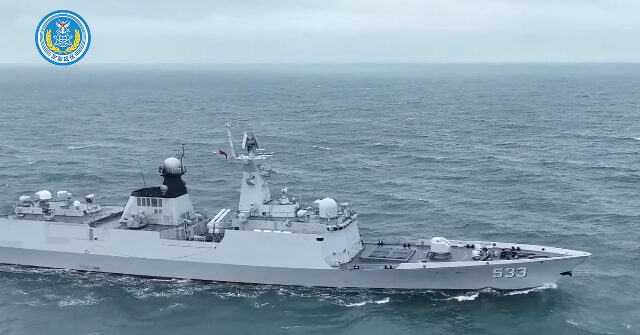
Taiwan detected 26 Chinese military planes on Saturday, 16 of them penetrating various regions of Taiwan’s Air Defense Identification Zone (ADIZ), the buffer zone that surrounds a country’s national airspace, the Associated Press reported. Several Chinese surface vessels were also spotted around the ADIZ.
Chinese air traffic fell off dramatically on February 27, the day before the beginning of Operation Epic Fury. No planes from the People’s Liberation Army (PLA) were detected inside Taiwan’s ADIZ until March 11, with the exception of two warplanes spotted on March 6.
Chinese flights resumed gradually between Wednesday and Friday, and appeared to return to their usual level on Sunday.
China’s flights around Taiwan serve as an intimidating reminder of the PLA’s presence, and also keep pressure on Taiwan’s much smaller air force, which is frequently called upon to scramble jets in response to Chinese incursions – a tactic known as “grey zone warfare.”
Ben Lewis, founder of a platform called PLATracker that monitors Chinese military movement, told CNN last week that the pause was “frankly unlike anything we’ve seen in recent history, in terms of PLA activity around Taiwan.”
“Since Taiwan’s defense ministry began releasing this data in 2020 the trend has been up, up, up – and now this lull, which maybe has ended today, maybe not, represents a very significant change in the pattern,” Lewis said last Thursday, the day PLA jets began returning to the skies around Taiwan – and the day a U.S. Navy surveillance plane flew through the Taiwan Strait.
Some analysts noted that China’s “Two Sessions,” the annual meetings of its rubber-stamp legislature and a top consultative body, roughly coincided with the decline of aerial activity around Taiwan.
The near halt to flights this year was a much steeper decline than is normally associated with the Two Sessions. Only severe weather has accounted for an equally sharp drop in PLA air activity around Taiwan during the past five years.
Institute for National Defense and Security Research senior fellow Su Tzu-yin told the Taipei Times that China might have taken a two-week break in its harassment flights simply to “weaken Taiwanese support for increasing national defense spending,” or to convince the United States that Taiwan requires less military support.
Another theory was that China dialed back its harassment of Taiwan to smooth the way for trade negotiations and President Donald Trump’s scheduled visit to Beijing, while the most obvious explanation seemed to be that China was worried about losing its supply of oil from Iran and the Strait of Hormuz due to Operation Epic Fury, so it might have seemed prudent to conserve jet fuel.
Left-wing outlet the New York Times (NYT) cited experts who doubted the ominous theory that China scaled down its harassment flights because it was preparing its air and naval forces for a serious attack on Taiwan, or perhaps another military action in the South China Sea.
Taiwanese Defense Minister Wellington Koo cautioned reporters not to read too much into the fluctuation of Chinese air activity around Taiwan. Koo said it was important to “look at a range of indicators,” such as the continued presence of Chinese ships in the area, even when PLA aircraft were grounded.