Listen to this article
Estimated 5 minutes
The audio version of this article is generated by AI-based technology. Mispronunciations can occur. We are working with our partners to continually review and improve the results.
After Iranian Shahed drones hit the Mina Al-Ahamadi oil refinery in Kuwait on Friday, Ukrainian President Volodymyr Zelenskyy confirmed that Kyiv has sent more than 200 military specialists to the Middle East to help defend critical infrastructure from the same type of threat Ukraine has been facing for years.
Zelenskyy said 228 Ukrainian drone specialists have deployed to five countries — Qatar, the United Arab Emirates, Saudi Arabia, Kuwait and Jordan.
After the U.S. and Israel started launching airstrikes against Iran on Feb. 28, Gulf Arab states have been targeted with more than 2,000 drones and missiles.
Those countries, which have suffered attacks on energy infrastructure, hotels and diplomatic missions, are also keen to purchase thousands of Ukraine’s interceptor drones, and Kyiv says that “serious agreements and deals” are being worked out.
“For the last week, we had four different requests for interceptors from the Middle East,” said Andrii Sych, co-founder of the Kyiv-based UV military cluster, a manufacturer that also collaborates with other drone companies.
“So I can say the demand is quite high.”

He told CBC News one of the inquiries came from the United Arab Emirates, but the manufacturer hasn’t officially sold any interceptors yet because it needs an export licence from Kyiv and permission to sell defence technology abroad.
Ukraine has unrivalled experience when it comes to downing Iranian drones, which were first used by Russia in the fall of 2022.
Since then, manufacturers across the country have been on the forefront of developing drone interceptors — innovation that was driven by daily deadly attacks and technology that has been tested extensively in battle.
Sych, who used to work as an engineer testing apps that are used on mobile devices, was diverted to drone development after the start of the war.
He was originally working on interceptors to take down Russian reconnaissance drones, but said the company pivoted to focusing on the larger, winged Shahed-style drones because Ukraine was experiencing what he called “a crisis in air defence solutions.”

‘A bullet with wings’
At an undisclosed location in the Kyiv region, where a tattered Russian flag has been laid out as a doormat, Sych and Danylo Kholiavko, the founder of UV military cluster, demonstrate how one of the manufacturer’s interceptor models works.
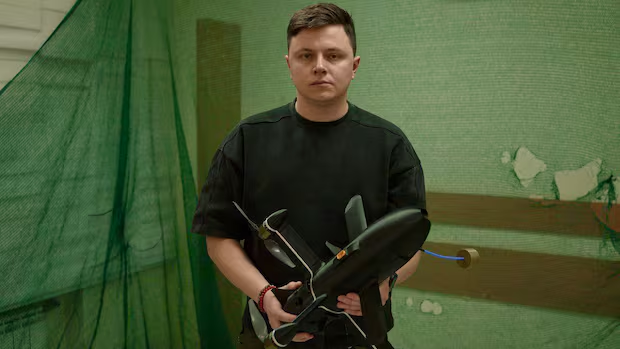
The frame of the body is made by a 3D printer and its shape, which Sych describes as looking like a “bullet with wings,” was inspired by racing drones that were used by Red Bull.
Kholiavko shows a model that can travel more than 300 kilometres per hour and contains a thermal camera to detect the Shaheds, which are frequently launched at night.
When it is deployed, the drone is equipped with explosives. It can be remotely detonated or it can explode on contact after crashing into the drone it’s targeting.

Private Ukrainian companies are getting calls from countries across the Middle East, including Qatar, Saudi Arabia and the U.A.E., asking for interceptor drones. The low-cost weapons are needed to counter Iran’s Shahed drones as the U.S. and Israel-Iran war escalates.
Depending on the specific model, the interceptor itself would cost around $2,000 US, but Kholiavko said there would be additional expenses for the ground station, which contains radar, and the crew controlling it.
“We have three years of experience intercepting [Shahed] drones and we know how complex it is,” said Kholiavko.
“The first six months were very difficult and we didn’t intercept any drones.”
He said that changed after they worked on tactics and co-ordination with the crew on the ground.

Evolving technolgy
Sych told CBC News that when it comes to interceptors, there are essentially three modes of operation.
Some are controlled the entire time by a pilot on the ground wearing goggles that display a feed from the drone’s camera. Other models are equipped with software that allows the drone to track and strike a target automatically after it is launched by a pilot.
A third version, which Sych said he hasn’t personally seen deployed, is completely autonomous. After a target is identified, it will launch on its own.
“The most important thing in the whole process is people and their training,” he said.
“You can have the most advanced automatic UAV and still have zero interceptions in real life.”
UV military cluster says it is able to produce about 7,000 interceptors a month.
Earlier this week, while he was in London to meet with the U.K. Prime Minister Keir Starmer, Zelenskyy said that when you take into account all of Ukraine’s drone manufacturers, it can produce about 2,000 interceptors every day.
He said the country requires about half of them for its own defence needs, but it could sell the rest if those countries agree to help Ukraine.
Kyiv already is jointly producing drones with Germany, Britain, Denmark and the Netherlands, and will begin an agreement soon with Norway.