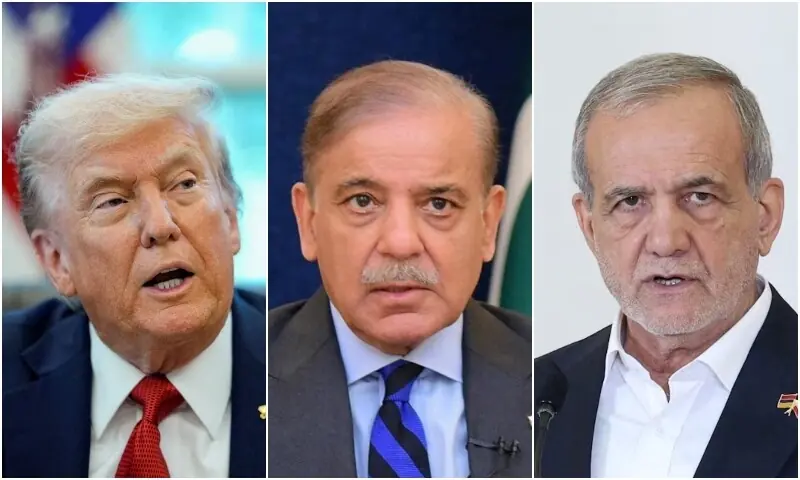
With the US-Israel war on Iran in its fourth week, Pakistan has stepped onto the diplomatic stage amid high-stakes wrangling to end the hostilities.
Pakistan has repeatedly emphasised that it wants an end to the ongoing hostilities in the Middle East. And with the situation fluctuating by the hour, Islamabad has emerged as a potential venue for talks between the two sides. Here’s what we know so far.
Rumours abound
Since the conflict began on Feb 28, Pakistan’s civilian and military leadership has been engaging with the leaders of regional and friendly countries and calling for a de-escalation of hostilities.
Over the past week, several global publications, including Reuters and Axios, claimed that Islamabad had actively offered itself as a facilitator for engagement between the US and Iran.
Some reports hinted that a meeting could be held if things proceeded smoothly, with Axios and The Guardian claiming that mediators were considering Islamabad as a potential venue for talks.
Amid the speculation, the Foreign Office on Tuesday had urged local media to await official announcements when asked about these reports.
“Pakistan, consistent with its longstanding policy, remains committed to the resolution of the ongoing conflict in the Middle East/Persian Gulf through diplomatic means and engagements,” FO Spokesperson Tahir Andrabi said in response to queries about the reports.
“Diplomacy and negotiations often require that certain matters be advanced with discretion. The media is therefore encouraged to refrain from speculation and to await official announcements regarding decisions and outcomes,” he had said.
Shehbaz formally pitches Islamabad as potential venue
However, shortly thereafter, Prime Minister Shehbaz Sharif formally pitched Islamabad as a potential venue for negotiations between Iranian and US officials.
“Subject to concurrence by the US and Iran, Pakistan stands ready and honoured to be the host to facilitate meaningful and conclusive talks for a comprehensive settlement of the ongoing conflict,” he wrote on X, tagging US President Donald Trump, Iranian Foreign Minister Abbas Araghchi and US Special Envoy Steve Witkoff.
While there was no official word on whether the offer was Pakistan’s own initiative, sources privy to discussions said that the request that Islamabad host talks between the two warring sides had actually come from Washington.
It is worth mentioning that US President Donald Trump had shared PM Shehbaz’s post on his own Truth Social platform.
US sends ‘peace plan’; White House tells media to refrain from speculation
On Wednesday, US media reported that Washington had sent a peace plan to Iran, with the New York Times and Reuters naming Pakistan as the messenger.
A senior Iranian official who spoke to Reuters did not disclose details of the proposal passed on by Pakistan, or whether it was the same as a 15-point US proposal reported by news outlets.
The source claimed that “either Turkiye or Pakistan was under consideration as the venue for such talks”.
Rafael Grossi, head of the International Atomic Energy Agency (IAEA) — which has been closely monitoring the war as Israel and Iran target each other’s nuclear structures — also added to the speculations.
“I think there could be talks this weekend in Islamabad, Pakistan,” he told Italian newspaper Corriere della Sera in an interview.
However, when asked if he would go to Islamabad, the IAEA chief replied, “We don’t know yet, but we’re available. The agency is an impartial and peaceful interlocutor.”
Up until then, there was no official confirmation of Islamabad relaying Washington’s peace proposal.
Meanwhile, White House Press Secretary Karoline was also asked about “face-to-face” talks between the US and Iran, potentially in Pakistan.
“I’ve seen a lot of speculation and reporting about potential talks that could happen later this week. Nothing should be deemed official until it is announced formally by the White House. I would not get ahead of our skis on reporting about any talks this week, until you hear directly from us,” she said.
She also cast doubt on the draft of the 15-point plan being cited in media reports, saying: “The White House never confirmed that full plan. There are elements of truth to it, but some of the stories I read are not entirely factual.”
Later, Iran’s Foreign Minister Abbas Araghchi made the distinction between direct and indirect engagement clear, saying that an exchange of messages through “mediators does not mean negotiations with the US”.
No talks were being held with Washington, he said, adding that the US had failed to achieve its key war objectives against Iran, including securing a quick military victory and bringing about regime change in Tehran.
Dar says Pakistan facilitating ‘indirect US-talks’ but mum on hosting
On Thursday, Deputy PM Ishaq Dar took to X to confirm that Pakistan was facilitating “indirect US-Iran talks”.
“There has been unnecessary speculation in the media regarding peace talks to end the ongoing conflict in the Middle East. In reality, US-Iran indirect talks are taking place through messages being relayed by Pakistan.
“In this context, the United States has shared 15 points, being deliberated upon by Iran”, contrary to earlier reports regarding the plan being rejected.
“Pakistan remains fully committed to promoting peace and continues to make every effort to ensure stability in the region and beyond,” he said.
However, he did not make any mention of whether this diplomacy would result in Pakistan hosting the two sides.
FO says ‘developments’ will be announced as and when they happen
The topic was also in the limelight in the weekly media briefing held by the Foreign Office (FO) at around the same time on Thursday.
Responding to queries, FO Spokesperson Tahir Andrabi urged the media to refrain from speculation about US-Iran talks, particularly any venue or date for any possible dialogue.
“This is not an event,” he remarked, stressing the need to distinguish between a “process and an event”.
“Developments in the process will be announced as and when they have […] When the process has some concrete information, we will share with you,” he added.
Additional input from Baqir Sajjad Syed.
Header image: A combination photo of US President Donald Trump, Prime Minister Shehbaz Sharif and Iranian President Masoud Pezeshkian. — Reuters/File