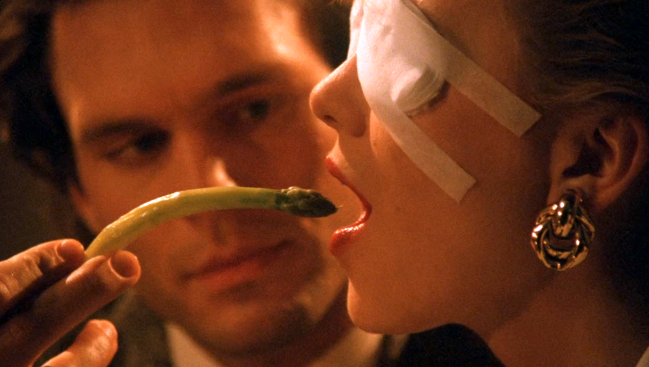
On Friday nights, IndieWire After Dark honors fringe cinema in the streaming age with midnight movies from any moment in film history.
First, the BAIT: a weird genre pick, and why we’re exploring its specific niche right now. Then, the BITE: a spoiler-filled answer to the all-important question, “Is this old cult film actually worth recommending?”
The Bait: Honey?! I Made David Watch “Death Spa”!
I knew I’d made a mistake the moment our chief film critic David Ehrlich emailed me back.
On Monday afternoon, I sent out my usual call for IndieWire After Dark volunteers. It’s a routine, low-stakes invitation that goes to all website staffers who might want to watch something weird and then write about it with me that week.


By Tuesday, when the phenomenally grotesque ’80s slasher I have programmed for tonight did not immediately elicit a response, I followed up. Specifically, with this meme of Octavia Spencer from Blumhouse’s major motion picture classic, “Ma.”
“Don’t make me drink aloooone.” The catchy words of the menacing jingle were still working their way through my head when I heard the reply.
“I’m down!,” David wrote, mere seconds before my stomach dropped.
It’s not that I don’t want David to contribute to After Dark, quite the opposite! Before joining IndieWire in 2023, I’d wanted to work with David for as long as I’d read movie reviews. Even now, after three years as colleagues, I’m man enough to admit I’m still intimidated by how clearly he sees cinema. His writing has an architectural quality to it that never ceases to amaze me, and as a critic, David doesn’t just watch stories; he situates them. He knows when a film is important and why, but more importantly, he sees how each and every attempt fits into a much larger timeline for both people and artistry.
That’s why I panicked. Because I had just assigned David(!)… “Death Spa“(!!)

Michael Fischa’s 1988 slasher, also known as “Witch Bitch,” centers a hi-tech L.A. health club where a jealous ghost murders the hell out of some beautiful people. “You’ll sweat blood,” the tagline promises — leaving, “You’ll piss yourself laughing,” mostly implied.
The ludicrous script, co-written by James Bartruff and Mitch Paradise, ping-pongs between a gym-sex melodrama and a painfully ’80s “Final Destination” precursor with mesmerizing creativity. It is not, by any metric, an “important” film. It is, however, extremely my sport.
I first saw “Death Spa” during one of those stretches in my life defined by minimal responsibility and maximum film consumption. So, either college or the pandemic. I can’t be sure which. Before I was a professional critic, I was a self-taught midnight and horror movie lover who to this day spends a lot of time alone. Studying computer science in undergrad, I gravitated toward slashers in part because they gave me a structure to hold onto. Tropes, sequels, and even shameless copycats gave me a way to compare craft without getting overwhelmed by just how much movies can mean to me personally.

All things told, I’m a little too sensitive for the movies I think David tends to love most. I’ve seen “Saw” in a packed theater and had a great time, but when it comes to the heart of something like “Wall-E,” I’m cooked. Martin McDonagh’s “The Banshees of Inisherin,” for example, devastates me so completely that I absolutely must watch it alone. (You can see me scream, but I blubber in private, thanks!)
Conversely, something like “Death Spa” doesn’t demand anything of anyone at anytime. It’s sweaty so-bad-it’s-good cinema at its finest: chaotic, colorful, unpredictable, and totally disinterested in you’re taking it seriously. The kills are inventive in a way that makes the movie feel almost competitive with itself, easily outpacing its closest cousin, “Killer Workout” (1987). And in terms of sheer commitment, it goes everywhere and tries everything this particularly nonsensical corner of bygone nightmares has to offer. That’s why I love it.

Two years ago, David and I both appreciated Coralie Fargeat’s “The Substance.” I consider that proof our tastes aren’t incompatible so much as ill-acquainted, and strong evidence that a carefully selected shiny pink unitard can unite us. Maybe we arrive at admiration from different places. David seems to prefer stylish excess and gore only when it builds to something meaningful and emotionally precise. But while I like that too, I also revel in films that seem to practically demand punishment for their woeful audacity.
The same instinct that made me defend the completely ridiculous ending of “Alien: Romulus,” which David despised as best I know, is also the one that makes me cherish something like “Death Spa.” In athletic terms? If David invited me to the track to do the 100-meter hurdles, I would show up in the parking lot ready to speed-eat a pack of cigarettes. Both are admirable pursuits. They’re just not judged on the same scale.

That difference in opinion is part of what makes this job feel worthwhile, especially these days. We’re living in a moment where disagreement can feel existential and taste has a tendency to calcify into identity too quickly. I don’t expect “Death Spa” to convert David into a shock jock. I don’t even expect him to like it. But I do think there’s something valuable about stepping into someone else’s version of fun. About watching a movie that isn’t trying to be great, but is trying to do something, anything, to entertain weirdos like you. Er… me?
I’m a marathon runner, and there’s a common t-shirt I see on the trail here that says, “My sport is your sport’s punishment.” That’s what this week’s After Dark feels like. I know enough about David’s preferences to know this movie might not be for him. But as someone who reads his work, learns from it, and genuinely admires the way he champions film, I like inviting him to see how the midnight half lives (or, in this arena, dies). —AF
The Bite: 24 Hour Fitness Film Criticism
OK, real talk: I wrote most of this on the second floor of a Chipotle before I read Ali’s obscenely kind and thoughtful portion of the piece, which paints me as the Frank Gehry of film criticism or some such, so please keep that in mind as you enjoy my singular commentary on my new favorite movie about why you should never work out in public. Ahem:
The best thing about my job is that I get to watch a lot of movies. The worst thing about my job — and I’ve sent many rudely unanswered emails about this very subject to every major Hollywood studio — is that very few of those movies are set in a demonically possessed, super high-tech 1980s health spa that feels like a live-action version of the Midgar gym where Cloud has to do all of those janky-ass squats in “Final Fantasy VII.” Indeed, exactly zero of the films I’ve reviewed over the last 10 years fit that specific criteria, despite the fact that colorful spandex, evil computers, and terrible screenwriting are more popular in this business than ever.
Needless to say, I was intrigued when my colleague Alison Foreman asked if I wanted to watch something called “Death Spa.” It almost sounded too good to be true, and when the film opened with a Wellesian crane shot of Los Angeles’ Starbody Health Spa, I feared that I had been sold a false bill of goods. No disrespect to Alison, but I had no interest in watching a movie about an ordinary unhaunted health spa — I wanted something that felt even half as bone-chilling and fucked up as it does to Google how much it would cost to join the Equinox that’s down the street from IndieWire HQ.
Oh ye of little faith! Just as I was about to abandon the movie in exchange for the more reliable horrors of Bravo’s “Summer House,” CRASH! A bolt of lightning smashed into the gym, its signage suddenly read “d ea th Spa,” and the camera descended into a fitness club that appeared to be co-owned by the Marquis de Sade and the set designer from “Saved by the Bell” (assuming those weren’t the same people). At long last, I knew that my prayers had been answered.

If Tubi didn’t already exist, “Death Spa” is the kind of thing that would inspire somebody to invent it. Giallo fans might take offense if I described the general vibe of the film as “‘Suspiria’ if it were co-written by somebody named Mitch Paradise,” but that doesn’t necessarily make it wrong. Directed by Michael Fischa, the movie was apparently inspired by the rapid over-expansion of L.A.’s gym culture, which is of course a perfectly natural backdrop for a story about a shapeshifting hacker ghoul.
And what does “Death Spa” have to say about America’s performative relationship with fitness? Plenty! Indeed, few movies have ever been more damning or prescient in their condemnation of the health industrial complex, which hides all manner of sins under the guise of physical improvement. Do the many people we meet and come to love over the course of the film — beloved characters like Flabby British Nerd, Chemically Blinded Blonde, and Marvin — frequent the Starbody Health Spa in order to work on themselves? No, they go there to wear tight clothes in public, shower together naked, and then enjoy a protein shake from the girl whose hand definitely isn’t going to get destroyed by Chekhov’s smoothie machine in the movie’s third act.
None of those things sound bad on their own, of course. They sound rather good, actually. (Maybe not the hand thing). In fact, if you’ll excuse me I’m going to pay a quick visit to whatever bank has been built over the cursed land where the club owner’s suicidal wife Catherine burned herself to death in the hopes that some of the vibes might still be in the air.

But before I do that, I want to take a moment to point out the obvious: Everyone at Starbody Health Spa is and has always been so focused on themselves and their own hard, sweaty, glistening abs that they didn’t even realize that Catherine was hurting after the loss of her child. They were so busy flexing their muscles that they lost all feeling in their hearts. And so, while I have some lingering questions about the logistics of how Catherine inhabited the body of her ex-brother-in-law (the late Merritt Butrick) as part of her plan to kill her husband so that he can join her forever in Hell, I can’t help but see the situation from her perspective.
Did these people deserve to have their faces melted off (“it nearly dissolved the girl like an Alka-Seltzer”) for the crime of doing bicep curls to some of the coolest MIDI synth tracks never used in a JRPG? Only God can say. Was I cackling with glee when the ghost pulled off a proto-“Final Destination” by unscrewing the spa’s diving board? Possibly. Do I think anyone who rebuffs a beautiful woman by telling her “I’m Beta, you’re VHS” deserve to spontaneously explode as part of a senseless ploy to beef up the body count? 100 percent, and I wish that fate hadn’t befallen another character instead. Also, shout out to that line for aging into one of modern cinema’s most incredible self-owns.

I think what I’m trying to say is that “Death Spa” is a chilling window into a world where people didn’t feel like they could work out alone. As someone who was born with the physique of a film critic, I’m a big believer that working out should be done often, intensely, and with profound amounts of shame in the privacy of your own home, where exercise is stripped of its performative element, and “Death Spa” is a fun, gruesome, and glorious reminder that an Apple Fitness account and some dumbbells are all you really need to get in shape.
Have I gotten in shape? No. But that’s only because the gym where I get all of my fat-melting cocaine burned down in a tragic self-immolation accident 40 years ago. In conclusion: “Death Spa” is a much smarter and more rewarding film than most of what comes out these days, and Ali — whose passion for, knowledge of, and rare insight into all things horror has been a consistent joy of mine for as long as she’s been writing for this site — is a legend for introducing me to it. —DE
“Death Spa” (1988) is now streaming free on Tubi.
Read more installments of After Dark, IndieWire’s midnight movie rewatch club: