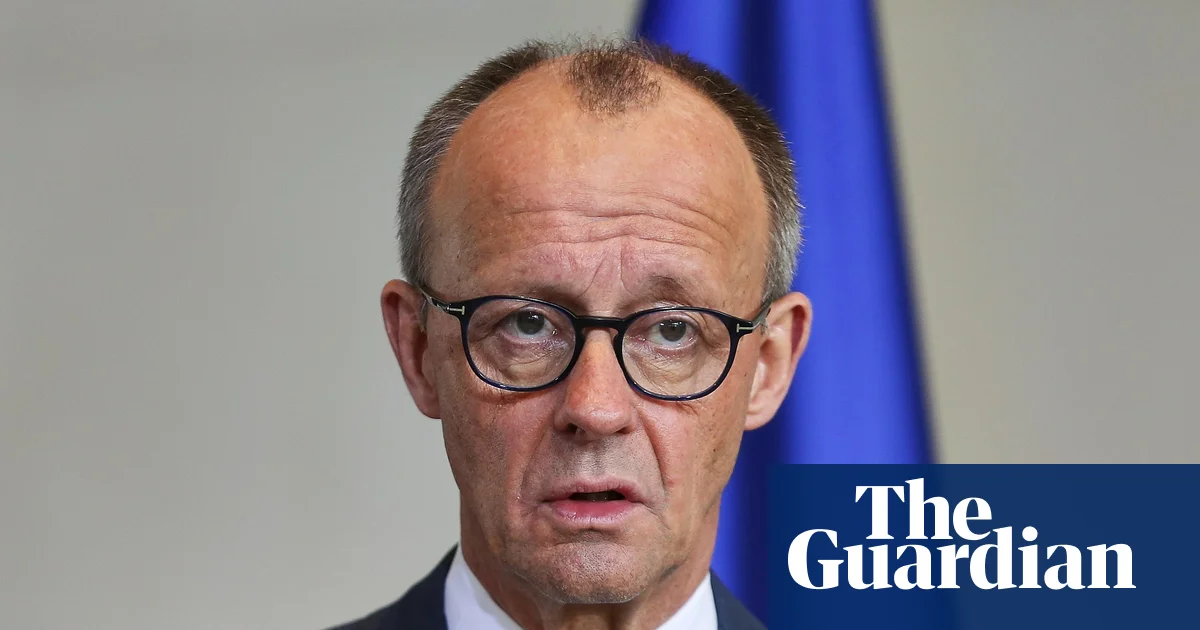
Friedrich Merz has drawn condemnation from NGOs and members of his own government after he called for the vast majority of Syrians living in Germany to “go back to their homeland.”
The German chancellor, who was elected last year after promising a tough line on immigration in a bid to beat the far right, made the remarks during a visit to Berlin on Monday by the interim Syrian president Ahmed al-Sharaa.
Explaining that Berlin’s priority in terms of removals was to send back Syrians who had committed crimes, Merz said he and al-Sharaa would in the longer-term work toward broad-scale returns from Germany, home to the biggest Syrian diaspora in the EU.
“In the longer perspective of the next three years, that … was the wish of President al-Sharaa: [that] about 80% of the Syrians currently living in Germany should go back to their homeland,” Merz said, citing the necessity to rebuild the war-ravaged country.
Al-Sharaa, a former Islamist rebel leader, did not confirm the goal of returning 80% of the more than 900,000 Syrian citizens registered in Germany by 2029, and the figure seemed to take political officials in Berlin by surprise.
Anke Rehlinger, deputy leader of the co-ruling Social Democrats (SPD), tacitly accused Merz of playing into the hands of the anti-migration, anti-Islam Alternative für Deutschland (AfD) by setting a target for repatriations for 2029, when Germany’s next general election is expected.
“It’s not a wise move on the part of the chancellor to put forward specific figures within specific timeframes, because that raises expectations he may not be able to meet,” she told newspaper group Funke.
Rehlinger voiced understanding for al-Sharaa’s call for Syrians to help their country’s reconstruction. “However, many Syrians are now our fellow citizens because they have integrated here, work in occupations in which there are shortages, care for elderly people or drive buses, and have often even become German citizens,” she said.
About 244,000 Syrian citizens received a German passport between 2016 and 2024, the largest group among those newly naturalised.
Criticism also came from within Merz’s conservative CDU party, with its foreign policy spokesperson Roderich Kiesewetter calling the figures the chancellor cited “problematic in several respects”.
He stressed that the AfD could capitalise on any unkept promises and also noted the role played by skilled Syrian workers in the German economy. “If they return, we face a challenge,” Kiesewetter told business newspaper Handelsblatt.
The German Hospital Society, representing the sector’s interests, underlined the “considerable importance” of Syrian doctors, with 5,745 working in German clinics – the largest group of foreign physicians. Another 2,000 Syrians work as carers.
“If these skilled workers were to leave the country again, it would have a significant impact on healthcare,” said its deputy chair Henriette Neumeyer.
Franziska Brantner, co-leader of the opposition Greens, called Merz’s repatriation goal “reckless”. “For many people, returning to Syria is simply not an option at all”, said Brantner, given security risks and lack of faith among many Syrians in the political transition. Fellow Greens MP Luise Amtsberg denounced Merz’s remarks as “shameful”.
Given Syria’s ongoing instability and the continued threats faced by minority groups there, immigration advocacy group Pro Asyl called for an immediate end to deportations to Syria and a policy “guided not by short-term deterrence in migration policy, but by human rights, protection and long-term stability”.
Merz took office last May in a coalition with the centre-left SPD, vowing to break with the more welcoming border policy endorsed by fellow Christian Democrat Angela Merkel.
Merkel, who governed Germany for 16 years until 2021, allowed about 1.3 million people fleeing war and oppression from across the Middle East and Afghanistan into Germany in 2015-16.
That initially popular move eventually led to a backlash that has provided political fodder for the AfD, now the country’s largest opposition party.
Merz acknowledged that many of the Syrians who arrived in Europe’s top economy under Merkel had made a vital contribution to German society.
But he said that most wanted to return now that the regime of Bashar al-Assad was gone.
Official statistics show more than 3,700 Syrians have voluntarily returned from Germany as of November 2025. Experts noted that forced deportations usually face lengthy legal challenges.
In the face of criticism, Merz appeared on Tuesday to backtrack from the specific target.
“The figure of 80% returnees within three years was cited by the Syrian president,” Merz was quoted by Bild newspaper as saying. “We have taken note of this figure, but we are aware of the scale of the task.”