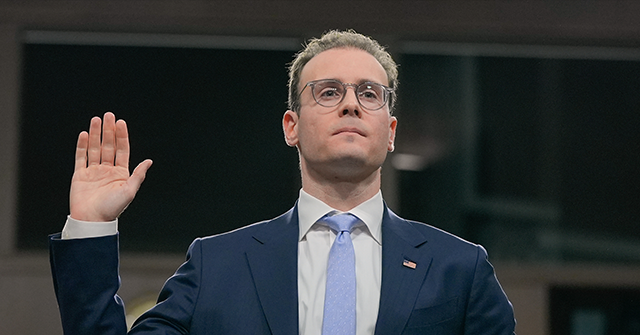
During my November congressional testimony before the Senate Agriculture Committee, I pledged to work tirelessly as Chairman of the Commodity Futures Trading Commission (CFTC) to maintain the agency’s status as a world-class financial markets regulator. I committed to protect our farmers and ranchers, roll back outdated rules and regulations, and deliver on President Trump’s promise to make America the crypto capital of the world.
I’m pleased to report that in the 100 days since being sworn in, I’ve made significant progress on those goals. The CFTC is moving rapidly to deliver a new Golden Age for America’s financial markets.
Many Americans have never heard of the CFTC, but the agency is one of the world’s most important financial regulators. The agency, which regulates futures, options, and swaps, oversees more than $500 trillion in notional value of financial activity in the U.S. every year. These products are used by farmers who hedge their risk from drought and rising input costs and by airlines that need stable prices for jet fuel. At a more practical level, the CFTC helps ensure that Americans have steady prices for things like groceries, gas, and other everyday products. The agency has recently seen an increased interest in prediction markets and products involving crypto assets and AI data center compute.
My approach since being confirmed to lead the agency has been simple: how can we continue to deliver robust markets for all Americans as we embark into a new frontier of finance? I have begun by undoing some of the actions and policies of the Biden administration. The agency’s so-called Climate Risk Unit has been dismantled, and I’ve rescinded several other climate-related initiatives that don’t make sense for our agency or market participants. The CFTC is a serious financial regulator, not an agency used to pursue political pet projects.
The Biden-era approach of regulation through enforcement has also come to an end. Instead of working with innovators and job makers, the prior administration pursued legal action against them and refused to set clear rules, which forced the world’s most cutting-edge technology companies to flee offshore, killing American jobs and businesses in the process. Thankfully, federal courts have rejected many of these claims, but we’re still working to undo the damage.
In addition to righting the wrongs of the previous administration, the agency has been moving full speed ahead to deliver on the president’s priorities. To start, I’ve launched an Innovation Advisory Committee comprising academics, financial industry incumbents, and new entrants, and revitalized the Agricultural Advisory Committee to make sure that farmers, credit providers, and agricultural market participants have a seat at the table. The origins of our markets are in the trading of agricultural commodities.
The CFTC was created to enable these markets to be deep, liquid, and fair, because our nation’s farmers and ranchers need access to strong risk management tools. Importantly, the agency is looking to implement changes to the Commitment of Traders (COT) report and publish it on a more frequent basis, a long-time request from agricultural businesses. Under my leadership, we’re returning confidence back to our growers and producers.
Another key priority is to lower the compliance burdens and energy costs for small businesses. To help, the agency is working to finalize de minimis threshold exemptions to provide regulatory relief to energy, agriculture, and critical mineral producers that have been blocked from fully accessing commodity swaps markets. This action will provide access to more market participants, which will work to stabilize and contribute to lower commodity prices in the long term.
As new asset classes emerge and with the possibility of Congress passing crypto asset market structure legislation soon, the CFTC is ready to take responsibility for a $3 trillion crypto asset market that is growing larger by the day.
In January, we partnered with the Securities and Exchange Commission (SEC) on Project Crypto, creating a joint effort between the SEC and the CFTC to harmonize federal oversight of crypto asset markets.
In March, the agency took several steps to improve the regulatory environment: providing no-action relief to a digital wallet software developer, publishing the first crypto asset classification system, referred to as a taxonomy, that makes clear the differences between digital securities and digital commodities, delivering further clarity concerning tokenized collateral, and launching an Innovation Task Force—dedicated to advancing clear rules of the road for American innovators building novel products within U.S. derivatives markets.
The same regulatory clarity being delivered to the crypto industry is being developed for prediction markets, which can serve as powerful tools for information discovery and are regulated by the CFTC under the Commodity Exchange Act. Not only did Commission staff issue a Prediction Markets Advisory, but the agency recently published a notice soliciting early public input before considering new regulations for prediction markets.
I have been humbled to be a part of the Trump administration’s effort to break from the restrictive regulatory practices of the past and create a derivatives market that works for everyone.
Our derivatives markets are among the most sophisticated and liquid in the world, and as the financial markets continue to fully digitize and move onchain, regulators must be disciplined enough to administer the minimum effective dose of regulation, otherwise innovation moves elsewhere, and our nation suffers the consequences.
If the past is prologue, the next 100 days—and the years beyond—will build on this transformative foundation as the CFTC remains the gold standard for smart, effective oversight of financial markets.
Michael S. Selig was sworn into office as the 16th Chairman of the Commodity Futures Trading Commission on December 22, 2025, after being nominated by President Donald J. Trump.