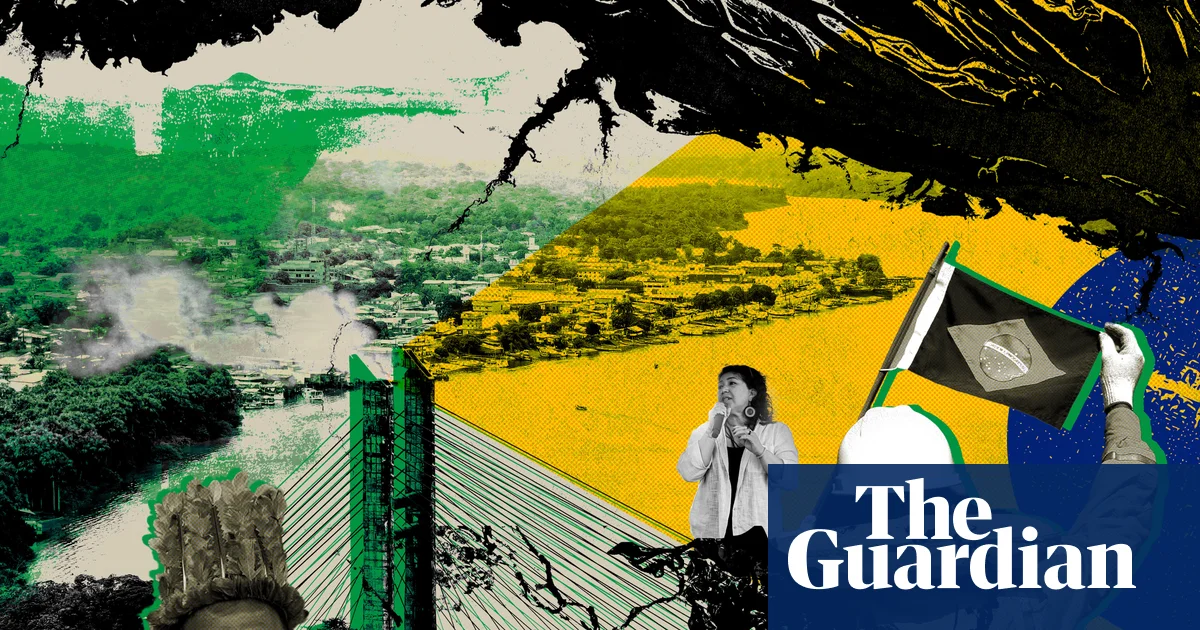
Covering a densely forested area larger than Wales, the municipality and city of Oiapoque, in the state of Amapá, is an isolated yet renowned part of Brazil, thanks to a popular national saying. “From Oiapoque to Chuí” highlights the country’s northernmost and southernmost points, respectively, illustrating its vastness.
Although well known, it is a remote area with about 30,000 inhabitants where less than 2% of the houses have access to proper sewage treatment. One-third of its residents are Indigenous people from four ethnic groups living in 68 hamlets across three Indigenous lands, 66 of which have electricity for less than 12 hours a day.
Yet now there is hope for significant development, although this is coupled with great fear.
At the northern edge of Brazil’s coastline, Oiapoque has been transformed into an operational base for Atlantic Ocean ultra-deepwater drilling by state-controlled company Petrobras – one of the probable new energy frontiers of Brazil.
Spanning four other countries, the Equatorial Margin in Brazil stretches for 2,200km (1,370 miles) along the coast of six states, including 19 “blocks” in the Amazon River mouth basin, whose exploration rights have been acquired by several companies. Petrobras holds a 100% stake in six blocks and has begun exploring the first in a research capacity.
Amid a climate and an energy crisis, many see it as a paradox for Brazil to position itself as a global leader in the energy transition while aspiring to become the world’s fifth-largest oil producer by 2030.
Oil has already been Brazil’s main export product for two consecutive years, surpassing soya beans.
“This paradox is present in any country that takes seriously the transition away from fossil fuels, as the global economy is organised around them,” says Miriam Garcia, senior climate policy manager at World Resources Institute (WRI) Brasil. “We still need to increase energy efficiency and eliminate energy poverty by providing universal access to affordable renewable energy.”
The first block in which Petrobras began exploratory drilling on 20 October 2025 was FZA-M-59, previously under BP’s control. Building a safety structure in Oiapoque, located 175km (110 miles) away, was one of the requirements set by Ibama, the federal environmental regulator, to grant the research licence.
“It’s like a fire extinguisher: it has to be nearby,” says Rodrigo Agostinho, president of Ibama. “An accident risk is not only related to Petrobras, as there is already very strong neighbouring oil activity.”
The concerns of nature campaigners and environmental authorities were given credence on 4 January, 76 days after drilling began, when the first incident occurred. Petrobras reported a leak of 113 barrels (18 cubic metres) of drilling fluid.
According to the company, “the fluid meets permitted toxicity limits and is biodegradable, with no damage to the environment or to people”. Yet Ibama expressed “serious concern” and fined the company 2.5m Brazilian reais (£360,000).
A technical report, now under seal, said the chemical contains enough toxic substances to affect marine animals’ basic functions until the chemicals are completely degraded. Other key organisms may have been eliminated in the affected area, which changes the dynamics of the food chain.
Petrobras halted operations for more than 30 days, reported the causes and was authorised by the National Petroleum Agency (ANP) to resume after replacing all sealing elements and training the workers involved.
In Oiapoque, the population is divided. If the Equatorial Margin’s potential is confirmed, production would begin between 2032 and 2035. This prospect is drawing in new residents who are interested in developing safety infrastructure, improving air transport, and expecting projections of 54,000 direct and indirect jobs, along with a 60% increase in Amapá’s GDP.
Petrobras says it will prioritise local labour, as it did in the Urucu field, with the workforce largely made up of people from the Amazon region.
For the time being, the outlook seems realistic. A rescue exercise conducted in August generated 50m Brazilian reais of economic activity in goods and services, equivalent to 10% of Oiapoque’s GDP. Food and rent prices have risen; 800 students are waiting for vacancies in the municipal school system; formal and makeshift buildings are going up in seven new neighbourhoods in deforested areas.
But development is threatened by the city’s history of political instability and recurrent cases of corruption. The mayor and deputy mayor had their mandates annulled for vote-buying, with extraordinary elections scheduled for 12 April.
Environmental consequences have also begun. “At first, it was the daily low-flying aircraft and helicopter flights. Birds fled far away, no one knows where,” says Edmilson dos Santos Oliveira, general coordinator of the Council of Chiefs of the Indigenous Peoples of Oiapoque. “We have survived for thousands of years by taking [our livelihood] from nature. If they pollute our rivers, what will become of us?”
The Equatorial Margin is known for its strong, complex ocean currents. It hosts one of the most biodiverse marine ecosystems on the planet, home to a rare type of mangrove and a coral reef system that are regulators of global temperatures.
A study in Nature Sustainability stated that containing an oil accident in this region would be more difficult and time-consuming than the BP oil spill in the Gulf of Mexico. Models show that it would threaten species such as the jaguar, as well as economic activities such as açaí harvesting, tourism and fishing.
“There are no public policies for the research phase, and the damage is already irreversible now,” says Luene Karipuna, executive coordinator for the Articulation of Indigenous Peoples and Organisations of Amapá and Northern Pará. “We are not against development, but we are not included in the impact assessment. It is as if there were no Indigenous peoples and lands in the region. We want to be heard.”
Petrobras says it strictly complies with the requirements of the competent authorities and that consultation with communities is not required for this activity.
Campaigners say Brazil lacks a mandatory framework of safeguards for each stage of projects, and existing environmental legislation has been weakened.
“In these large-scale ventures, by the time public consultations take place, an absurd amount of time, money and political capital has already been invested,” says Caroline Rocha, executive director at Latin American climate lawyers initiative for mobilising action (Laclima).
Felício Pontes Jr, a federal regional prosecutor, says other large developments, such as road paving, the opening of waterways, hydroelectric dams and oilfields, have followed similar dynamics in the Amazon for decades.
“What all these projects have in common is the rendering invisible of affected communities, a practice adopted during the military dictatorship and replicated into the 21st century,” he says.
Recent history speaks for itself. Communities around the Belo Monte dam continue to lack access to electricity and food, and fishers receive insurance payments far below their previous earnings. The federal public prosecutor’s office in Pará has filed lawsuits to seek compensation for unforeseen impacts at Belo Monte and in Oiapoque.
Another example of a new oil exploration frontier lies in the dense Amazon rainforest. In the Urucu field, the country’s largest onshore oil and gas project, the average production is 105,000 barrels of oil equivalent a day. Nearly 100 wells were drilled 40 years ago, and Petrobras plans to drill 22 new wells, starting two in 2026, with a $500m investment by 2030.
According to the company, the available fossil gas supplies 65% of electricity consumption in Manaus and five other municipalities in Amazonas state, while all the states in the north and part of the north-east of the country depend on liquefied petroleum gas. But the affected cities of Carauari and Manaus continue to face basic shortages despite the royalties and taxes they receive.
“We face high levels of insecurity, drug traffickers and violence. The Indigenous work plan is not complied with, and what returns to the community is insufficient,” says Mariazinha Baré, general coordinator of the Articulation of Indigenous Organisations and Peoples of Amazonas. “Those who benefit are the state and the mega-corporations.”
In Brazil, oil and gas income is distributed through royalties and special participation based on proximity to production fields. This 1980’s model, deemed “obsolete and disconnected” in a recent judgement by the federal court of accounts, results in “excessive concentration of resources”.
“A true geographical lottery, leading some beneficiaries to reach wealth indicators (GDP per capita) that would place them, if they were countries, among the 10 richest nations in the world,” said the judgement.
Promises to improve living standards with resources from the “pre-salt” – deep-water reserves discovered 20 years ago in the Atlantic – remain far from being fulfilled, with allegations of a lack of governance and transparency.
Brazil’s sovereign fund, created in 2008, was abolished in 2018 to pay public debts. The federal social fund, created in 2010 and also financed by pre-salt revenues, will publish its first annual report in June, in response to a new law passed in 2025.
Two weeks after closing the Cop30 UN climate summit, President Luiz Inácio Lula da Silva ordered his staff to present by 6 February guidelines for creating an energy transition fund, financed by revenues from oil and gas production, for a “just and planned transition, aimed at gradually reducing the country’s dependence on fossil fuels”. The document has yet to be published.
In 2024, the money also began to be used to address the climate crisis, with 20bn Brazilian reais allocated to repair losses and damages in southern Brazil’s floods.
According to research by the Institute for Socioeconomic Studies (Inesc), at least 45bn Brazilian reais is tied up in judicial disputes over revenue sharing, or stranded for other reasons. In addition, barriers prevent the use of royalty revenue to reduce inequalities. Increases in primary expenditure are limited by fiscal rules, and about 30% of the government’s flexible spending is earmarked for parliamentary amendments.
“This creates a legal constraint that prevents oil revenues from being directed towards social and climate policies,” says Alessandra Cardoso, policy adviser at Inesc. “Social redemption through oil revenues is a mirage.”