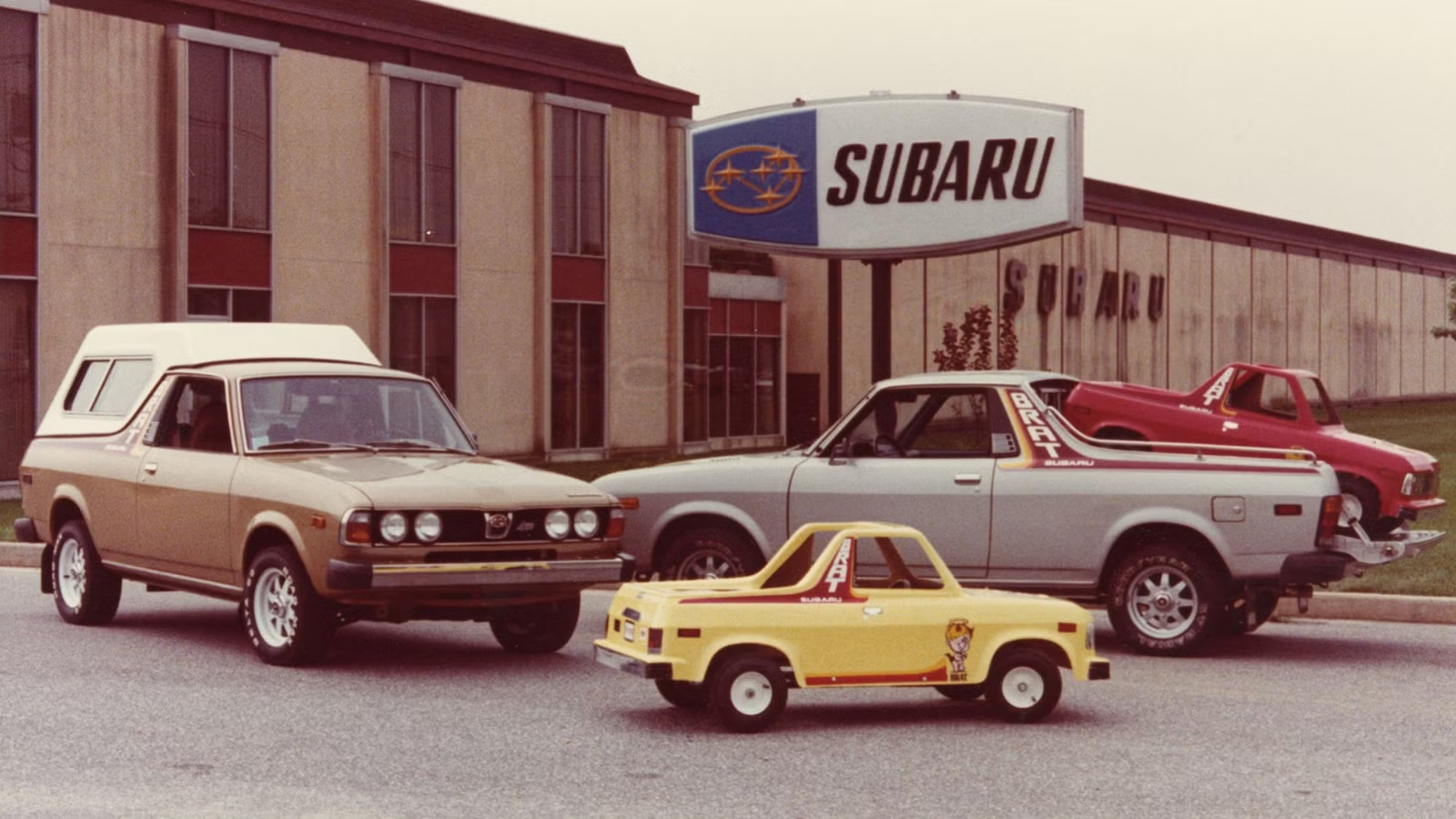
From 1978 to 1987, Subaru sold a fun little pickup truck that was quirky right down to its name, BRAT. And while the name may conjure up images of Bart Simpson or Dennis the Menace, it was just an acronym for Bi-drive Recreational All-terrain Transporter. Subaru marketed it as a “Fun in the Sun” vehicle with “On-Demand” 4WD and a pair of rear-facing jump seats in the bed.
If you think a pair of seats in the bed is strange, wait until you pop the hood and see the spare tire sitting on top of the flat-four engine. But the compact truck was relatively inexpensive and efficient, and people loved it. Subaru sold about 100,000 of them in North America while they were in production. Even President Ronald Regan owned a Subaru BRAT. And now would be the perfect time for Subaru to bring it back.
Of course, a 2026 BRAT would be quite different. Don’t hold your breath for those jump seats. The 1970s were a different era. Heck, we could throw metal-tipped lawn darts at each other back in those days. But if the spirit of the Subaru BRAT could be revived, it would probably sell quite well. Below are four reasons why this is the perfect time for the Subaru BRAT to re-enter the American market.
4
Booming compact pickup market
Ford and Hyundai made them popular again
The compact pickup truck market is booming again. The Hyundai Santa Cruz and Ford Maverick were introduced within months of each other back in 2021. They have proven quite popular, and they just keep getting more popular each year.
In 2025, Ford sold a record 155,051 Maverick pickups. Subaru sold roughly the same number of Outbacks last year, and the Outback is its third-most-popular model, just behind the Forester and the top-selling Crosstrek. Subaru would love to have a popular model like the Maverick join its lineup.
Pickup trucks are getting bigger, more complex, and more expensive. Americans still buy them, but as Maverick sales prove, there is a significant market for smaller, more fuel-efficient trucks. These smaller trucks handle like cars and, as such, are easier to maneuver and park. Most truck owners don’t need to tow a Caterpillar D4 Dozer around every day, so a small truck bed and modest towing ability are plenty.
Other automakers see this opportunity and are already developing compact trucks to rival the Maverick and Santa Cruz. Toyota has already confirmed that they are working on a compact truck that will slot below the Tacoma in its current truck lineup.
Quiz
The Subaru BRAT
Think you know the scrappy little truck that charmed farmers, surfers, and even a U.S. president — put your BRAT knowledge to the test!
OriginsDesignHistorySalesLegacy
What does the acronym BRAT stand for in the Subaru BRAT’s official name?
That’s right! BRAT stands for Bi-drive Recreational All-terrain Transporter. Subaru crafted this name to highlight the vehicle’s dual-drive capability and its versatility for outdoor adventures.
Not quite — BRAT stands for Bi-drive Recreational All-terrain Transporter. Subaru chose this name to emphasize the vehicle’s part-time four-wheel-drive system and its appeal to outdoor enthusiasts.
In what year did Subaru introduce the BRAT to the American market?
Correct! The Subaru BRAT made its American debut in 1977. It was part of Subaru’s strategy to offer something unique in a market that was increasingly interested in small, fuel-efficient vehicles following the 1970s oil crisis.
Not quite — the BRAT arrived in the American market in 1977. Its timing was shrewd, capitalizing on American consumers’ growing interest in fuel-efficient vehicles after the oil crisis of the mid-1970s.
What unusual feature was built into the BRAT’s cargo bed specifically to help Subaru avoid U.S. import tariffs on trucks?
Exactly right! Subaru installed rear-facing jump seats in the cargo bed so the BRAT could be classified as a passenger vehicle rather than a truck, cleverly sidestepping the 25% ‘Chicken Tax’ tariff on imported trucks. It was a creative bit of regulatory judo.
The correct answer is the rear-facing jump seats bolted into the cargo bed. By adding these seats, Subaru reclassified the BRAT as a passenger vehicle, legally avoiding the steep 25% Chicken Tax tariff that applied to imported light trucks.
Which U.S. president was famously photographed owning and driving a Subaru BRAT on his ranch?
Spot on! Ronald Reagan owned a Subaru BRAT and was photographed driving it at his Rancho del Cielo property in California. The association with Reagan gave the BRAT a significant publicity boost and an all-American, rugged image.
The president in question was Ronald Reagan, who drove a BRAT on his Rancho del Cielo ranch in California. The images of Reagan behind the wheel were excellent free advertising for Subaru and helped cement the BRAT’s rugged, outdoorsy reputation.
What type of drivetrain system did the original Subaru BRAT use, which was considered innovative for a small pickup of that era?
Correct! The BRAT used Subaru’s signature permanent all-wheel drive system with a symmetrical layout, which was quite advanced for a small pickup at the time. This gave it superior traction compared to traditional rear-wheel-drive competitors without requiring a separate transfer case.
Actually, the BRAT used Subaru’s permanent all-wheel drive with a symmetrical drivetrain layout — a hallmark of the brand. Unlike typical part-time 4WD trucks of the era, the BRAT delivered power to all four wheels continuously, giving it an edge in traction on varied terrain.
The BRAT was built on the platform shared with which Subaru model that was already selling well in the United States?
That’s right! The BRAT was developed using the platform of the Subaru Leone, which was already a familiar and proven vehicle in the U.S. market. Sharing components with the Leone helped Subaru keep the BRAT’s production costs down while leveraging existing engineering.
The correct answer is the Subaru Leone. The BRAT’s development was rooted in the Leone’s platform, allowing Subaru to share mechanical components and reduce engineering costs. The Leone was already established in the U.S. when the BRAT launched in 1977.
In what year did Subaru discontinue the BRAT in the United States market?
Correct! U.S. sales of the BRAT ended after the 1987 model year. By that point, the small truck segment had become increasingly competitive, and Subaru chose not to continue updating the aging design to meet newer safety and emissions standards.
The BRAT was actually discontinued in the U.S. after the 1987 model year. The compact truck market had grown fiercely competitive by the mid-1980s, and Subaru ultimately decided not to invest in modernizing the BRAT’s aging platform for the American market.
Which Subaru executive is widely credited with pushing the development of the BRAT and championing its introduction to the American market?
That’s right! Malcolm Bricklin, the colorful entrepreneur who originally brought Subaru to North America, was a key champion of the BRAT concept for the U.S. market. Bricklin had a talent for spotting unconventional vehicles with niche appeal, as he also demonstrated with the Bricklin SV-1 sports car.
The answer is Malcolm Bricklin, the entrepreneur who first introduced Subaru vehicles to North America and was instrumental in pushing the BRAT for American audiences. Bricklin had a knack for unconventional vehicles — he also created the gull-winged Bricklin SV-1 sports car in the early 1970s.
Your Score
/ 8
Thanks for playing!
3
Toyota and Subaru partnership
Toyota could save Subaru millions by helping bring the BRAT to market
Speaking of Toyota, they already own a roughly 20 percent stake in Subaru. This relationship has already birthed icons like the Subaru BRZ and Toyota 86. This “shared DNA” strategy saves billions in R&D, and it’s the exact blueprint needed to bring a modern BRAT to life. Subaru wouldn’t have to go it alone; they could easily adapt the rugged, unibody platform Toyota is currently developing for its own upcoming compact pickup.
By leveraging Toyota’s chassis and hybrid expertise, Subaru could focus on what they do best. That would be Symmetrical All-Wheel Drive and an outdoor, on-the-go aesthetic. Imagine a modern BRAT with the fuel efficiency of a Prius, the utility of a Maverick, and the off-road soul of a Crosstrek.
If a buyer wanted to trade a giant gas-guzzler for an agile, lifestyle-oriented rig, a Toyota-backed Subaru truck is an almost guaranteed hit.

Amid Subaru’s sales slump, one model is setting new sales records
One bright spot is carrying the brand through a tough stretch.
2
America needs efficient and affordable vehicles
New truck prices are higher than ever and gas prices are soaring
Cars and trucks have gotten very expensive, and the price of gasoline is going through the roof. For the average worker, the sticker shock is real.
A standard Chevrolet Silverado 1500 can easily eclipse $70,000, while a Ford F-250 Platinum, outfitted with a high-output 6.7L diesel engine, regularly flirts with a staggering six-figure price tag. These are incredible machines, but for many, they have simply priced themselves out of reach.
The pain doesn’t stop in the dealership finance office either. With fuel prices remaining volatile, the reality of filling a 34-gallon Super Duty tank with diesel at $5.30+ per gallon is a financial gut punch. Americans need a break, and that’s exactly where a modern Subaru BRAT could save the day.
A revived BRAT wouldn’t be a gas-guzzling behemoth; it would likely arrive as a high-efficiency hybrid or a fully electric truck. By targeting a price bracket between $30,000 and $40,000, Subaru could offer a rugged, nimble alternative that handles the “real world” perfectly. For the vast majority of drivers, a 1,500-lbs. payload and a weekend’s worth of camping gear are all the utility they truly need.

- What’s Included
-
M12 impact driver, hammer drill, 3/8-inch ratchet, charger, two batteries
- Cordless?
-
Yes
If you’re looking for a great DIY starter kit from Milwaukee, this M12 3-tool combo kit is it. With an impact driver, hammer drill, and 3/8-inch ratchet, along with a 4Ah and 2Ah battery, this kit is a great starting point for projects both at home and on your vehicle.
1
Retro is always cool
Many automakers are reviving classic nameplates to draw in nostalgic buyers
People love modern versions of classic vehicles. You only have to look at the massive success of the resurrected Ford Bronco or the modernized Land Rover Defender to see that drivers are starving for vehicles with a soul. Even Porsche, while pushing the boundaries of performance, remains religiously faithful to the iconic silhouette of the 911.
People don’t just want transportation; they want a connection to the classics. This cultural shift has birthed events like RADwood, a global celebration of 1980s and 1990s car culture that treats the quirky vehicles of the past with the same reverence usually reserved for million-dollar exotics.
At the heart of that “Rad” era sits the Subaru BRAT, a vehicle so unique that its cult following has only grown stronger over the decades.
The time is right

In 1978, Subaru introduced the BRAT because it spotted the growing demand for smaller, compact trucks. That same trend exists in 2026.
By blending 21st-century safety and efficiency with the BRAT’s unmistakable heritage, Subaru could capture the hearts of Gen Xers and Zoomers alike. In a sea of anonymous, oversized trucks and SUVs, a retro-inspired BRAT would be a breath of fresh air, proving that you don’t need a massive footprint to leave a giant impression.