Comic book adaptations became the defining force of pop culture in the 2010s, but there was still trepidation about touching a masterpiece as influential as Alan Moore’s legendary graphic novel Watchmen. Named by TIME as one of the greatest novels of the 20th century, Watchmen inverted the superhero narrative by intertwining the history of caped crusaders with American history, resulting in a nightmarish present where vigilante justice was dominant, the nation was on the brink of war with the Soviet Union, and Richard Nixon was about to enter his third term as President. Instead of trying to make a period piece that reflected the exact reality that the original classic had been released in, Damon Lindelof created a spiritual successor with HBO’s Watchmen, which served as a continuation of the canon established back in 1985. The result is the most daring science fiction show that HBO has ever released, which swept the Emmy Awards in a first for comic book adaptations.
The biggest issue with 2009’s Watchmen film, directed by Zack Snyder, was that it was so enamored with the style of the superheroes themselves that it didn’t contain the venomous criticism that Moore had for what they represented. Since Moore had used Watchmen to take a stand against nuclear armament, authoritarianism, and police brutality, Lindelof updated the HBO show to reflect the issues of the current era, including America’s history of political corruption and white supremacy. While it ends up tying into the original text in a way that is as surprising as it is fulfilling, Watchmen also serves as a declarative statement that has sadly become even more relevant in the years since it first premiered.
HBO’s ‘Watchmen’ Isn’t a Typical Comic Book Adaptation
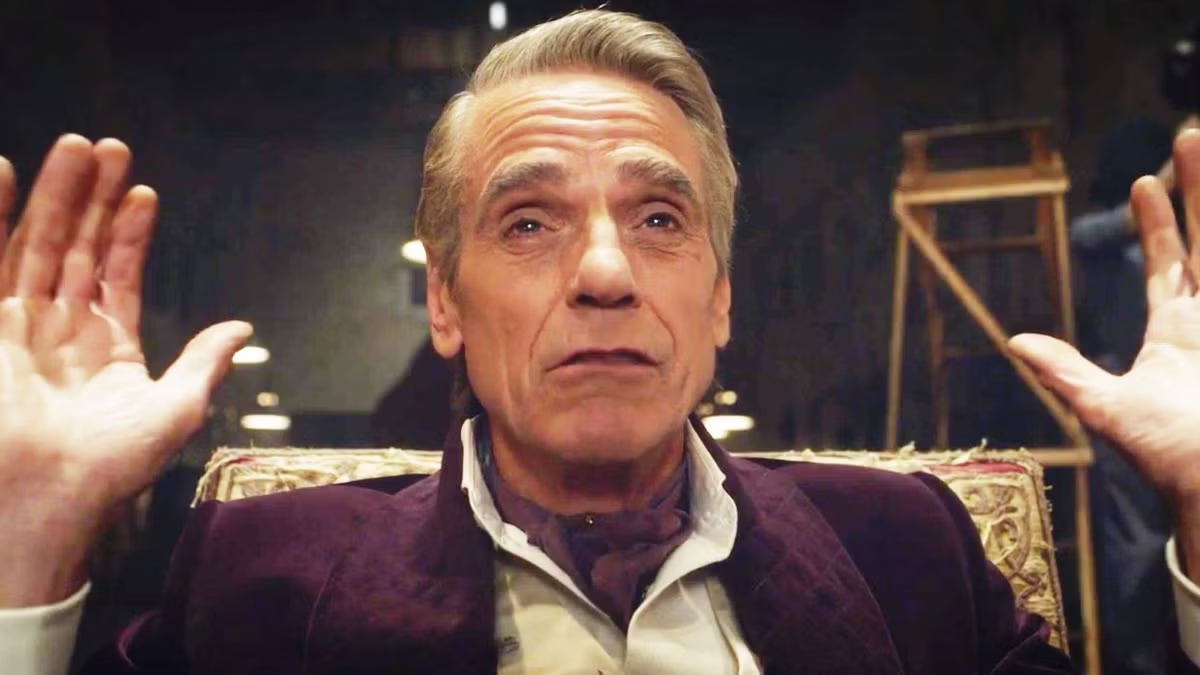
Instead of baiting the viewer with nostalgia, Watchmen starts by introducing new characters that fit into a modern world left devastated by the events of the original story, in which Adrian Veidt (Jeremy Irons), the superhero known as “Ozymandias,” unleashed a devastating squid attack on New York City to prevent a nuclear war. The new protagonist, Angela Abar (Regina King), is a member of the police force who masks her identity because of a coordinated effort in which white supremacists attacked several officers in their homes. Angela is aware of the events that occurred in the original Watchmen, but has gone on to live her own life with her husband, Cal (Yahya Abdul-Mateen II). It’s through Angela’s investigation into her own heritage that Watchmen is able to question where Moore’s characters ended up, and how they factor into a new society that has become even more stratified.
HBO’s 10/10 Sci-Fi Miniseries Proved Yahya Abdul-Mateen II Was Phenomenal Long Before ‘Wonder Man’
Damon Lindelof’s HBO series earned the Marvel star an Emmy.
What’s even more impressive than the maneuvering of comic book mythology is that Watchmen is legitimately informative about U.S. history; the show draws attention to the 1921 Tulsa Race Massacre, in which “Black Wall Street” was burned down by a racist mob that destroyed a significant chunk of history. This is something that is rarely mentioned in the American education system, particularly in Southern states that have a severely slanted curriculum when it comes to the nation’s past. The event itself isn’t just explored in Watchmen in visceral, disturbing detail, but purposefully woven into the plot and how it relates to one of the most famous and mysterious characters in canon. Since superhero films often begin with a moment of tragedy that the characters are forced to overcome, Watchmen is able to channel real anxieties about the American present to answer one of the biggest lingering questions that Moore never had the opportunity to.
‘Watchmen’ Is an Adaptation That Makes Thoughtful Updates to the Source Material
Hooded Justice is a character who is credited in Watchmen as being the first modern superhero, but his identity is kept under wraps until “This Extraordinary Being,” one of the greatest episodes in the history of HBO. “This Extraordinary Being” understands something fundamental about superheroes because of the notion of a secret identity, as it offers them the protection of living a different life. The reveal that Hooded Justice is actually Angela’s grandfather, Will (Jovan Adepo), twists the story by showing that the character only put on a mask to cover up his race. On a greater level, superheroes, the most defining figures within contemporary pop culture, are revealed to have emerged as a means to fight racism without risk of consequence, and serve as another example of Black achievements being lost to time. It’s a powerful statement that works especially well because of the amazing use of black-and-white within the episode to show the fluctuation of time.
Watchmen comes full circle in its ending by finding a creative way to explore Dr. Manhattan, a character whose relationship with time makes him difficult to depict traditionally. HBO’s Watchmen improves upon the original text’s biggest flaw by offering something tangible for Dr. Manhattan to relate to in the real world, which justifies his decision to continuously involve himself in human affairs. It’s not only a thematically ambitious series, but a visually striking, exciting work of propulsive genre filmmaking that packs more thrills into nine episodes than most shows that ran for multiple seasons. Watchmen is the type of adaptation that the industry needs more of; it’s reverential of the original text and why it was so popular, but channels contemporary insights into a narrative that speaks to the current generation.