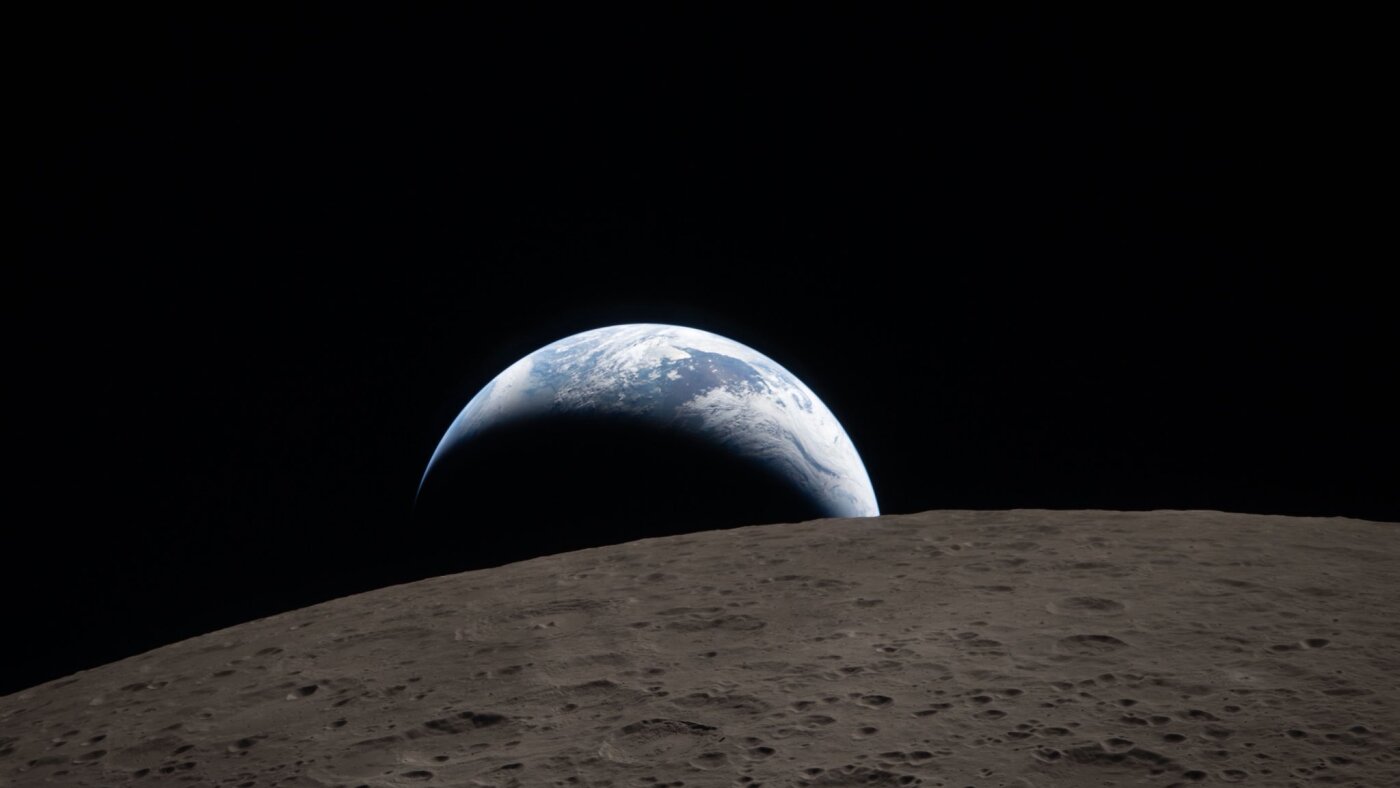
Earthset captured through the Orion spacecraft window at 6:41 p.m. ET on April 6 during the Artemis II crew’s flyby of the moon. A muted blue Earth with bright white clouds sets behind the cratered lunar surface. The dark portion of Earth is experiencing nighttime. In the foreground, Ohm crater has terraced edges and a flat floor interrupted by central peaks. Central peaks form in complex craters when the lunar surface, liquefied on impact, splashes upward during the crater’s formation.
NASA
hide caption
toggle caption
NASA
The Artemis II astronauts are making their way back to Earth after the lunar flyby.
The crew became the first astronauts in over 50 years to fly around the far side of the moon. They also experienced a solar eclipse.
During the mission’s loop around the moon, the crew took geological observations of places of interest on the lunar surface with their own eyes and snapping thousands of photos of the surface.
The crew will return to Earth on Friday and splash down off the coast of California. NASA says a landing on the lunar surface won’t happen until 2028, at the earliest.
Here is what they captured.

April 6: Captured by the Artemis II crew during their lunar flyby, this image shows the moon fully eclipsing the sun. From the crew’s perspective, the moon appears large enough to completely block the sun, creating nearly 54 minutes of totality and extending the view far beyond what is possible from Earth. The corona forms a glowing halo around the dark lunar disk, revealing details of the sun’s outer atmosphere typically hidden by its brightness. Also visible are stars, typically too faint to see when imaging the moon, but with the moon in darkness, stars are readily imaged. This unique vantage point provides both a striking visual and a valuable opportunity for astronauts to document and describe the corona during humanity’s return to deep space. The faint glow of the nearside of the moon is visible in this image, having been illuminated by light reflected off the Earth.
NASA
hide caption
toggle caption
NASA

April 6: This is a portion of the moon coming into view along the terminator — the boundary between lunar day and night — where low-angle sunlight casts long, dramatic shadows across the surface. This grazing light accentuates the moon’s rugged topography, revealing craters, ridges and basin structures in striking detail. Features along the terminator, such as Jule Crater, Birkhoff Crater, Stebbins Crater and surrounding highlands, stand out.
NASA
hide caption
toggle caption
NASA

April 6: A close-up view from the Orion spacecraft during the Artemis II crew’s lunar flyby captures a total solar eclipse, with only part of the moon visible in the frame as it fully obscures the sun. Although the full lunar disk extends beyond the image, the sun’s faint corona remains visible as a soft halo of light around the moon’s edge. From this deep-space vantage point, the moon appeared large enough to sustain nearly 54 minutes of totality, far longer than total solar eclipses typically seen from Earth.
NASA
hide caption
toggle caption
NASA

April 6: Captured from the Orion spacecraft near the end of the Artemis II lunar flyby, this image shows the sun beginning to peek out from behind the moon as the eclipse transitions out of totality. Only a portion of the moon is visible in the frame, its curved edge revealing a bright sliver of sunlight returning after nearly an hour of darkness.
NASA
hide caption
toggle caption
NASA

April 6: This image shows the moon, the near side (the hemisphere we see from Earth) visible at the right side of the disk, identifiable by the dark splotches. At lower left is Orientale basin, a nearly 600-mile-wide crater that straddles the moon’s near and far sides. Everything to the left of the crater is the far side.
NASA via AP/NASA
hide caption
toggle caption
NASA via AP/NASA

April 6: The moon is seen in the window of the Orion spacecraft, in a photo taken by the Artemis II crew, at the end of Day 5 of the journey to the moon.
NASA via AP/NASA
hide caption
toggle caption
NASA via AP/NASA

April 6: The Orion spacecraft, Earth and the moon are seen from a camera as the Artemis II crew and spacecraft travel farther into space.
NASA via AP/NASA
hide caption
toggle caption
NASA via AP/NASA

April 6: Artemis II pilot and NASA astronaut Victor Glover peers out one of the Orion spacecraft’s windows looking back at Earth ahead of the crew’s lunar flyby.
NASA via AP/NASA
hide caption
toggle caption
NASA via AP/NASA

April 4: Artemis II astronauts (from left) Reid Wiseman, Jeremy Hansen, Christina Koch and Victor Glover gather for an interview en route to the moon.
NASA via AP/NASA
hide caption
toggle caption
NASA via AP/NASA

April 4: Astronaut Christina Koch preps for lunar flyby activities after completing aerobic exercise on the flywheel device.
NASA via AP/NASA
hide caption
toggle caption
NASA via AP/NASA

April 3: An image of Earth taken by astronaut Reid Wiseman inside the Orion capsule.
NASA via AP/NASA
hide caption
toggle caption
NASA via AP/NASA

April 3: The exterior of the Orion spacecraft Integrity is seen during the Artemis II mission en route to the moon.
NASA via AP/NASA
hide caption
toggle caption
NASA via AP/NASA

April 3: The Earth seen from a window on the Orion spacecraft Integrity during the Artemis II mission en route to the moon.
NASA via AP/NASA
hide caption
toggle caption
NASA via AP/NASA

April 3: NASA astronaut Christina Koch is illuminated by a screen inside the darkened Orion spacecraft on the third day of the agency’s Artemis II mission. To the right of the image’s center, Canadian Space Agency astronaut Jeremy Hansen is seen in profile peering out one of Orion’s windows. Lights are turned off to avoid glare on the windows.
NASA via AP/Getty Images North America
hide caption
toggle caption
NASA via AP/Getty Images North America
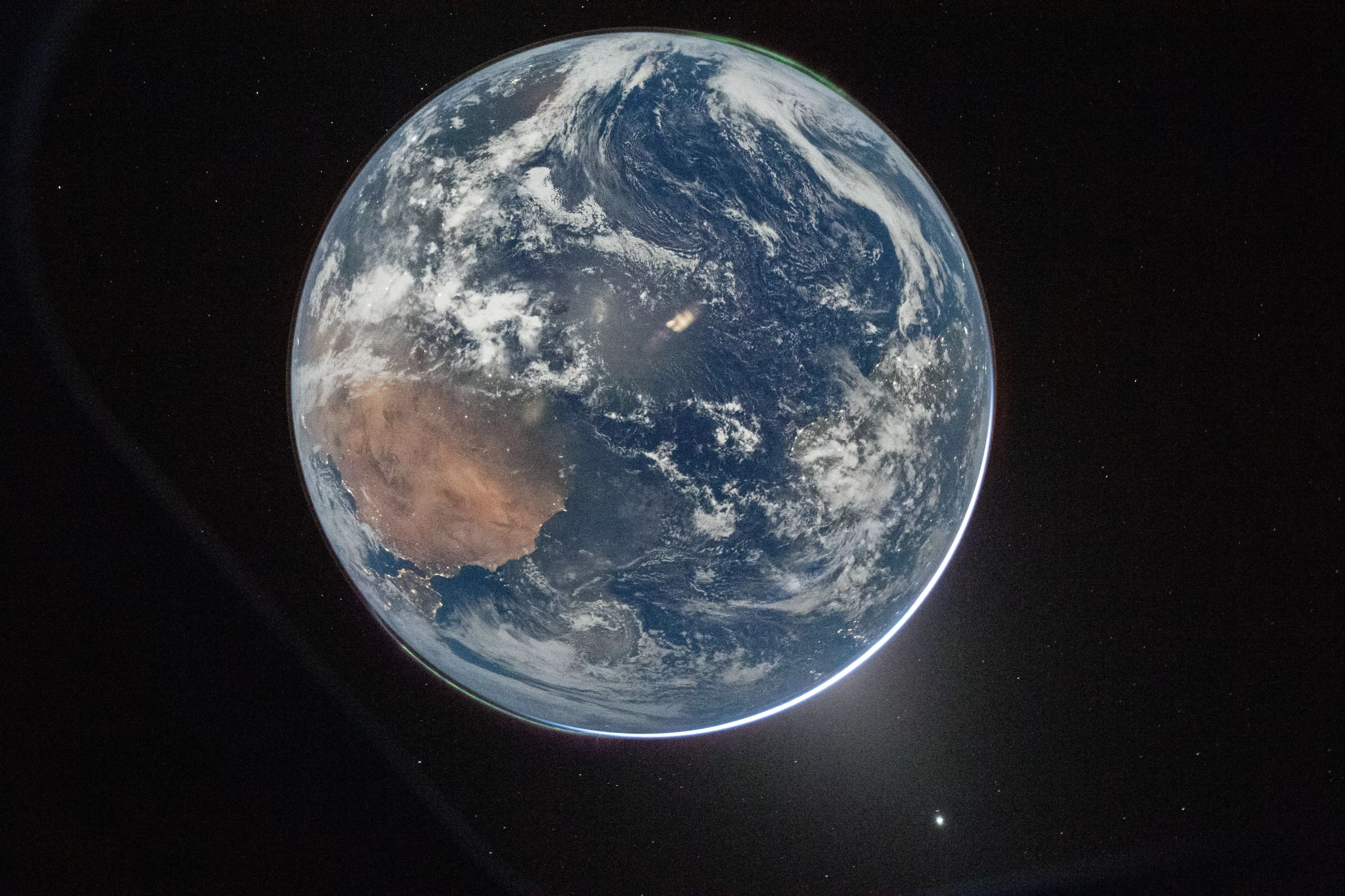
April 2: A view of Earth taken by Wiseman from of the Orion spacecraft’s window after completing the translunar injection burn.
NASA via AP/NASA
hide caption
toggle caption
NASA via AP/NASA

April 2: Mission specialist Christina Koch peers out one of the Orion spacecraft’s main cabin windows, looking back at Earth, as the crew travels toward the moon.
NASA via AP/NASA
hide caption
toggle caption
NASA via AP/NASA

April 2: A view of Earth from the Orion spacecraft as it orbits above the planet during the Artemis II test flight.
NASA via AP/NASA
hide caption
toggle caption
NASA via AP/NASA