There’s something very satisfying about a show that knows exactly what it’s doing from the start. You don’t have to worry about a weak season or a disappointing ending, which happens more often than you think. But I love when I can just settle in and trust that the story is going somewhere, and more importantly, that it will get there properly. That kind of consistency is rare, especially with long-running shows.
Most series start strong and then lose focus along the way. However, the HBO shows on this list stand out. They don’t feel like they are figuring things out as they go. They build slowly, they follow through on their ideas, and they actually respect the time you invest in them. By the end, it feels like you have just watched something good. Let’s get into the list.
‘Deadwood’ (2004–2006)
What makes Deadwood stand out is how fully it commits to its story from the very beginning. It does not try to ease you into things or simplify anything. Instead, it drops you straight into a rough, growing town where power is still being shaped and nothing is stable. The tone of the show stays consistent throughout, which is a big reason why it never loses its grip.
The story follows figures like Seth Bullock (Timothy Olyphant) and Al Swearengen (Ian McShane), whose interests often clash as the town develops. Their interactions drive much of the tension, though the show also gives attention to the wider community. Over time, their personal relationships shift, and alliances change. Even the town slowly takes a different form. The writing, however, is complete because everything builds just naturally. Their conflicts are never forced, and the characters are allowed to grow without sudden changes in the storyline.
‘Six Feet Under’ (2001–2005)

Six Feet Under takes a very different approach, though it is just as consistent in what it sets out to do. The show talks about everyday life, but it does so through the lens of a family that runs a funeral home. From the start, it deals with heavy themes, though it presents them in a very different way that is more honest and overwhelming.
The Fisher family, including Nate (Peter Krause) and David (Michael C. Hall), steer through personal struggles while managing the business their father left behind. Each episode often begins with a death, which then connects to the emotional state of the characters. As time passes, the show builds a deeper understanding of grief, relationships, and change. The standout point of the show is how carefully it develops its characters. Their character arc is very real, their growth feels earned, and the story moves forward without losing focus.
‘Rome’ (2005–2007)

Historical shows often feel distant, but Rome keeps everything grounded in people and their choices. It does not just focus on major events. Instead, it shows how those events affect individuals who are trying to survive, gain power, or simply hold on to what they have. That balance is what keeps the show engaging from start to finish.
The story moves through the fall of the Roman Republic, following figures like Julius Caesar (Ciarán Hinds) and Mark Antony (James Purefoy), while also staying close to soldiers like Lucius Vorenus (Kevin McKidd) and Titus Pullo (Ray Stevenson). Their paths cross in ways that connect personal lives to political shifts. As power changes hands, loyalties are tested, and their consequences feel realistic. The writing stays consistent because it never loses focus on how big events shape individual lives.
‘The Leftovers’ (2014–2017)

Some shows give you clear answers, but The Leftovers works in the opposite way. It slowly builds its story around uncertainty and sticks to that idea from the very beginning to the end; nothing changes. Instead of trying to explain everything, it highlights how people react when they are left without answers. That approach gives the series a strong sense of direction, even when everything just feels unpredictable.
The series begins after a sudden event where a portion of the world’s population disappears without explanation. Kevin Garvey (Justin Theroux) tries to maintain order in his town, while Nora Durst (Carrie Coon) deals with personal loss in her own way. As the story moves forward, different characters search for meaning, each in their own way. What keeps the show consistent is its focus on the emotional truth of every individual and those gray areas that do not need explanations.
‘Succession’ (2018–2023)
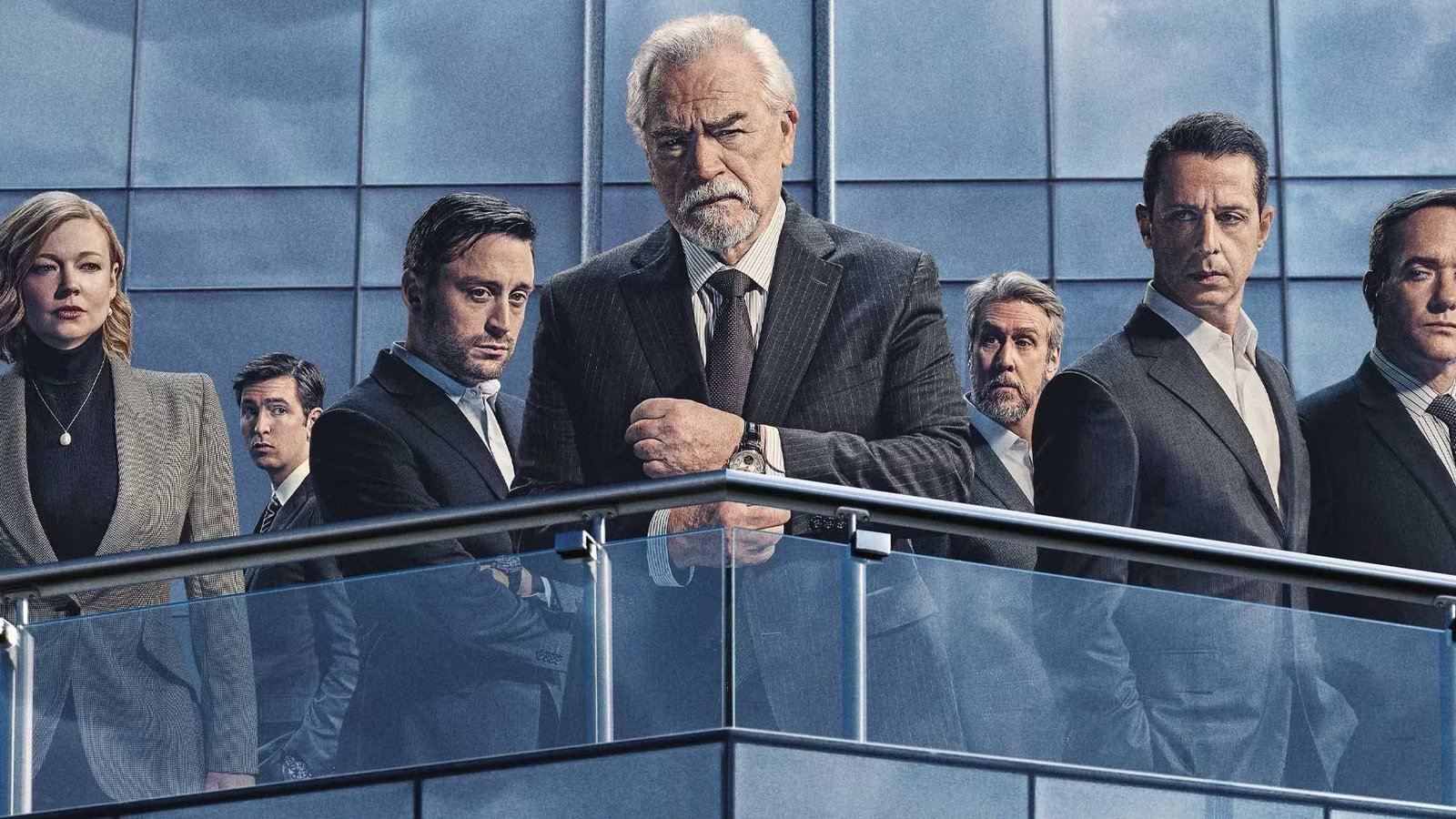
Power struggles can easily become repetitive, but Succession keeps things sharp by constantly shifting the balance between its characters. The show starts with a clear idea, which is a family that is fighting over control of a media empire, and then it keeps finding new ways to explore that conflict without losing its focus in the middle. Every season builds on what came before, so nothing feels reset or ignored.
Logan Roy (Brian Cox) sits at the center of it all, while his children — Kendall (Jeremy Strong), Shiv (Sarah Snook), and Roman (Kieran Culkin) — circle around him, each of them trying to secure their position. Alliances form and break, though the emotional damage always carries forward. The writing works because every move has a consequence, and even those consequences stay with the characters instead of randomly vanishing after a few episodes. By the end, the story feels complete because it follows its own logic all the way through without taking easy shortcuts.
‘The Sopranos’ (1999–2007)

It is easy for long-running shows to lose direction, but The Sopranos never really does. From the beginning, it knows what it wants to explore, and then it stays committed to that idea even as the story expands. The show mixes crime, family life, and personal struggle in a way that is consistent across all seasons.
Tony Soprano (James Gandolfini) balances his role as a mob boss with his personal life, including his sessions with Dr. Melfi (Lorraine Bracco). What makes the writing stand out is how it allows contradictions to exist without trying to resolve them neatly. Tony can be both controlled and impulsive, caring and destructive. He has all these realistic shades. As the story moves forward, relationships shift, though the core themes remain steady. And because of that, the show feels complete.
‘The Wire’ (2002–2008)

The Wire is one of the best shows that stays amazing and consistent throughout, while also expanding its scope. Each season looks at a different part of the same system within the city of Baltimore, and it does not feel redundant at all, though everything connects in a way that was planned from the start. The show does not rush its storytelling, and it does not simplify complex issues.
Characters like Jimmy McNulty (Dominic West), Omar Little (Michael K. Williams), and Stringer Bell (Idris Elba) are part of a much larger picture that includes law enforcement, politics, education, and the media. As the focus shifts from one area to another, the story keeps building on previous events. Nothing is ignored, and nothing feels added just “for effect.” I felt the show to be very complete, especially in its storyline and character development. It does not change its tone or direction to chase attention, which is why it holds together so well from beginning to end.