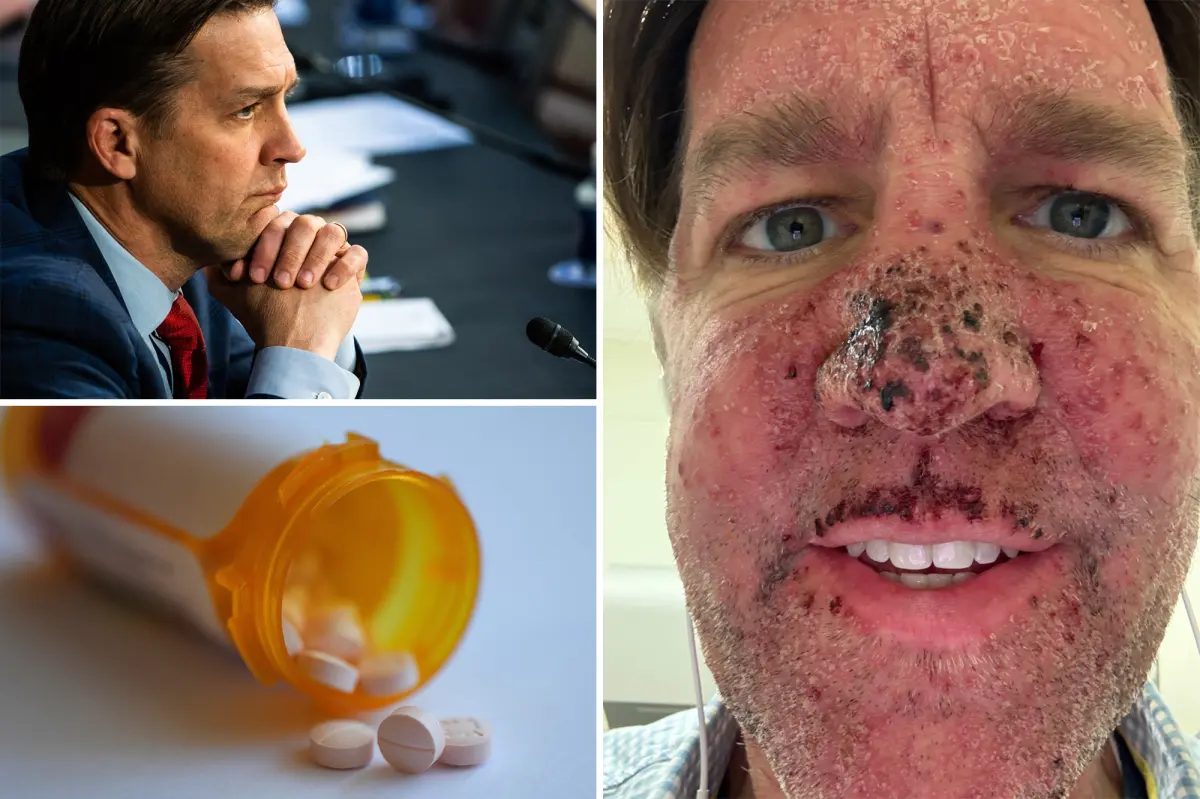
Former GOP Sen. Ben Sasse is opening up about living with what he describes as a “definite death sentence.”
The 54-year-old father of three was diagnosed with Stage 4 pancreatic cancer last year, an aggressive disease he’s fighting with an experimental drug that has left his skin bloody and “bubbling.”
“Here’s a hard fact: Ben Sasse’s torso is chock-full of tumors,” the ex-Nebraska lawmaker recalled a doctor telling him after a full-body scan, in an interview with The New York Times published Thursday.
Considered one of the hardest cancers to detect and treat, pancreatic cancer is also incredibly lethal. In December, doctors told him he had three to four months to live.
“I’m at Day 99 or something since then, and I’m doing a heck of a lot better than I was doing at Christmas,” Sasse said.
But it hasn’t been easy.
Sasse is enrolled in a clinical trial for daraxonrasib, a targeted therapy designed to slow pancreatic cancer by blocking the mutant proteins that drive the disease in most patients.
“I take it orally, but it’s a nasty drug,” he told the Times. “It causes crazy stuff like my body can’t grow skin and so I bleed all out of a whole bunch of parts of me that shouldn’t be bleeding.”
Sasse, who represented Nebraska in the Senate from 2015 to 2023, said his skin and face feel “nuclear.”
Recently, a pharmacist who was taken aback by his appearance asked if doctors had done something “electrical” to him.
“I don’t even know what that is, but either acid or electric shocks produce a face that looks this hideous,” Sasse said with a laugh.
In January 2023, Sasse left the Senate to become the president of the University of Florida. He stepped down at the end of July 2024 after his wife, Melissa, was diagnosed with epilepsy.
Sasse sought medical attention last year after experiencing intense back pain, which he later learned was caused by pancreatic tumors pressing against his spinal column.
The disease occurs when cells in the pancreas — a gland tucked behind the stomach that regulates blood sugar and produces digestive enzymes — begin to mutate and multiply uncontrollably, forming a tumor, according to the Cleveland Clinic.
Early-stage pancreatic tumors often don’t appear on imaging tests, which is why many people, including Sasse, don’t discover the disease until it has already spread.
After his diagnosis, doctors put him on 55 milligrams of morphine, which he said made him feel “high as a kite” but helped ease his suffering.
In the months since, Sasse said daraxonrasib has shrunk the tumors enough that he was able to lower his morphine dose, reducing the nausea and fatigue that came with the stronger medication.
Now, he takes about 30 milligrams a day and said his pain is down roughly 80% from where it started — even as he still deals with a bloody face and “strong waves of desire to puke.”
Sasse said the tumor volume in his torso is down 76%, though he does not expect the drug to lead to a miraculous recovery.
Even as his pancreatic tumors improve, he explained, the disease had already spread so widely that doctors are unlikely to ever fully catch up.
“There’s too much Whac-A-Mole,” Sasse told the Times.
Even so, the medical community is closely watching daraxonrasib.
Pancreatic cancer is resistant to many standard cancer treatments, making it notoriously difficult to treat. As a result, it is highly fatal, ranking as the third leading cause of cancer deaths in the US.
Between 2015 and 2021, just 13.3% of people diagnosed with pancreatic cancer were still alive five years later, according to the National Cancer Institute.
Revolution Medicines is hopeful that its drug might be able to help shift that tide.
In early trials for advanced pancreatic cancer, about one-third of patients taking daraxonrasib saw their tumors shrink, and most had their cancer stay stable or improve.
Patients lived a median of 13 to 16 months, longer than the seven to eight months usually expected with standard chemotherapy.
When daraxonrasib was combined with standard chemo, more than half of patients had their tumors shrink, and 90% had their disease under control.
Early results also suggest that patients taking daraxonrasib as their first treatment may respond even better, though long-term outcomes and side effects are still being studied.
Based on those findings, the FDA in October gave daraxonrasib one of the first vouchers in a new fast-track program aimed at getting promising drugs to patients faster than ever.
“There are certain diseases where getting access to promising drugs may mean the difference between life and death, and pancreatic cancer is an example of this,” said Dr. Christopher Lieu, a professor of medical oncology at the University of Colorado Anschutz.
“There are not enough treatment options, and our patients don’t have the luxury of waiting years for any regulatory agency to review data,” he explained in an interview with the school’s Department of Medicine.
“The idea that the FDA has a pathway for accelerated review is important and exciting, but it’s a new program, so I think there’s still a lot we’ll have to learn from it.”
In 2026, an estimated 67,530 Americans will be diagnosed with pancreatic cancer, and 52,740 are expected to die from the disease.
For Sasse, the thought of leaving his wife and children behind brings a heavy weight.
But he said he has found some serenity — in his Christian faith and in the idea of death itself.
“I’ve continued to feel a peace about the fact that death is something that we should hate,” he told The Times.
“We should call it a wicked thief. And yet, it’s pretty good that you pass through the veil of tears one time and then there will be no more tears, there will be no more cancer.”