U.S. stocks reversed early losses and oil fell back below $100 a barrel after Israeli Prime Minister Benjamin Netanyahu said he was negotiating a peace deal with Lebanon and NATO Secretary-General Mark Rutte said countries were stepping up to reopen the Strait of Hormuz.
By late in the afternoon, the Dow Jones Industrial Average was up about 300 points, or 0.6%, and the S&P 500 and the Nasdaq $NDAQ were also both up about 0.6%. Brent crude oil futures were still up slightly on the day but back to $96 a barrel, while West Texas Intermediate oil futures were at $98 a barrel.
The encouraging signs for the ceasefire followed outcry over Israeli strikes on Beirut and other Lebanese population centers. The Guardian reported these strikes had claimed more than 200 lives within the first 24 hours of the ceasefire. This raised fears the truce could collapse almost immediately. According to The Guardian, Netanyahu framed any prospective dialogue around two conditions: Hezbollah laying down its arms and Lebanon entering a peace relationship with Israel. He made no pledge to suspend the ongoing strikes.
Tehran threatened to shut down the Strait of Hormuz again if the Israeli strikes continued, The Guardian reported, with Pezeshkian declaring that any diplomatic process was pointless so long as bombs kept falling on Lebanon. Iran’s deputy foreign minister, Saeed Khatibzadeh, indicated that Islamabad had pressed Tehran to hold back from a stronger response He argued that de-escalation served the goal of a wider settlement.
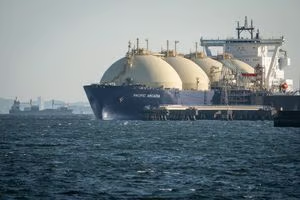
The ceasefire was brokered by Pakistan and announced by President Donald Trump late Tuesday. It had initially sent oil prices sharply lower. The conflict began on Feb. 28 when the U.S. and Israel attacked Iran. Tehran retaliated by targeting commercial vessels in the Strait of Hormuz, a chokepoint that handles roughly a fifth of the world’s oil supply. The disruption has been described as the largest global oil supply shock in history. Analysts estimate a deficit of about nine million barrels a day even after emergency stockpile releases and pipeline rerouting.
U.S.-Iran talks are scheduled to begin in Islamabad, Pakistan, though Iran’s president had placed those negotiations in doubt pending a halt to Israeli strikes in Lebanon. The Guardian reported that roughly 1,400 vessels were still idling in the Gulf, and that in the first 24 hours after the ceasefire took effect, only 11 ships cleared the strait — a fraction amounting to under ten percent of normal throughput.