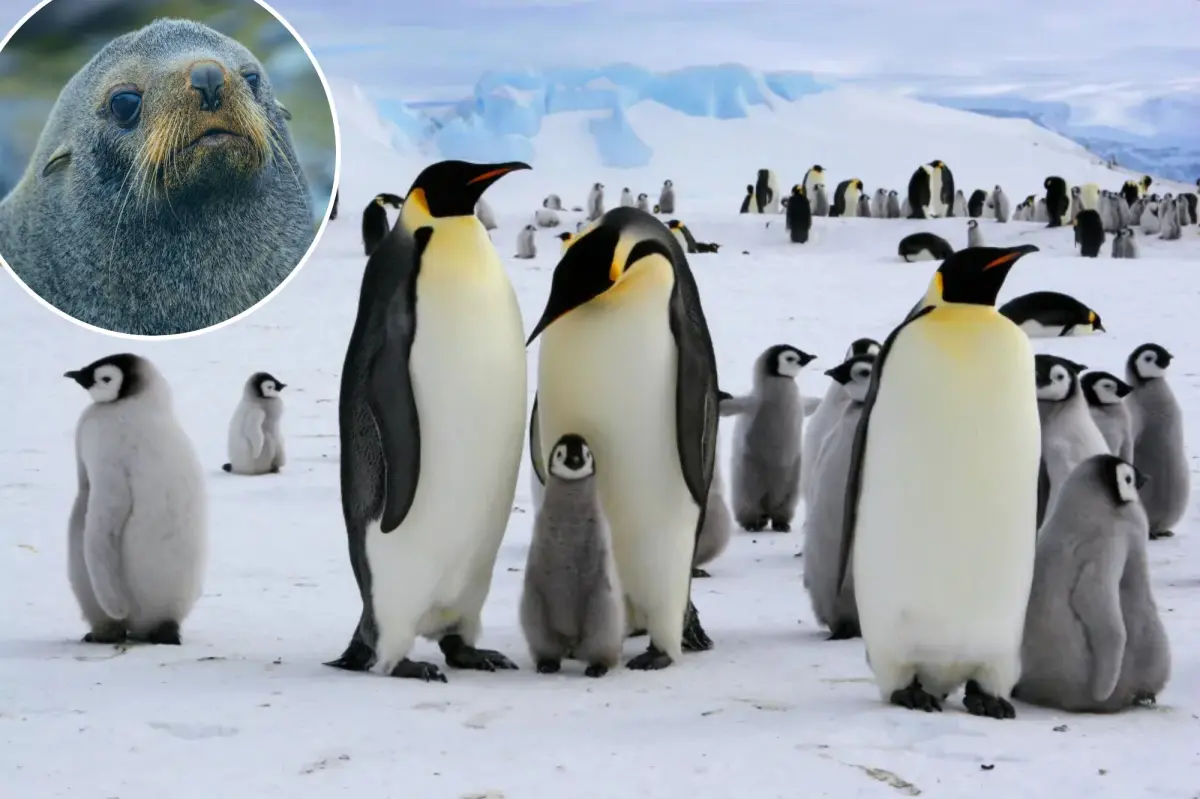
These birds are on a wing and a prayer.
Emperor penguins, indigenous to Antarctica, are now at a frighteningly high risk of death by drowning due to drastic climate change.
The prognosis for the black-and-white avians — the largest of their species, growing up to 4 feet in height — has moved from “Near Threatened” to “Endangered” on the International Union for Conservation of Nature’s (IUCN) red list.
It’s an alarming upgrade, for both penguins and people, based on projections that its population will drop 50% by the 2080s, per a new report.
“The decline of the emperor penguin…[is] a wake-up call on the realities of climate change,” Grethel Aguilar, IUCN Director General, said in a statement, noting that the Antarctic fur seal has, too, become an endangered species.
Echoing the doc’s distress, Martin Harper, CEO of BirdLife International, deemed the emperor penguin’s grim status a “stark warning,” saying, “Penguins are already among the most threatened birds on Earth. Climate change is accelerating the extinction crisis before our eyes.”
While staunch skeptics insist that global warming and climate change doomsayers are merely blowing hot air, confident that long-term shifts in temperatures and weather patterns “will not lead to humanity’s demise,” ecology experts for the IUCN say the plight of the emperor penguin serves as a weathervane for potential dangers ahead.
“Antarctica’s role as our planet’s ‘frozen guardian’ is irreplaceable,” said Aguilar, “offering untold benefits to humans, stabilizing the climate and providing refuge to unique wildlife.”
But as it’s rapidly melting away, emperor penguins are wasting away to watery graves.
The birds require fast ice — sea-ice that’s “fastened” to either the coastline, ocean floor or grounded icebergs — as habitat for their chicks and during their moulting season, when they’re not waterproof, per the authorities.
But the early break-up and loss of sea ice, due to global warming, has contributed to the loss of approximately 10% of the population between 2009 and 2018 alone, equating to more than 20,000 adult penguins.
Breeding colonies, buxom with baby penguins, or chicks, have also met untimely demises to drowning, en masse, as sea-ice structures are liquifying before the little ones are able to swim.
It’s an unkind end — and mankind is to blame, said Philip Trathan, a member of the IUCN SSC Penguin Specialist Group.
“Human-induced climate change poses the most significant threat to emperor penguins,” confirmed the specialist. “Early sea-ice break-up in spring is already affecting colonies around the Antarctic, and further changes in sea-ice will continue to affect their breeding, feeding and moulting habitat.”
“Emperor penguins are a sentinel species that tell us about our changing world and how well we are controlling greenhouse gas emissions that lead to climate change,” added Tratuan, a contributor on the emperor penguin red list assessment.
Being in the red, for both the emperor penguin and the Antarctic fur seal — a species that’s decreased from an estimated 2.1 million in 1999 to 944,000 in 2025 due to rising ocean temps — can have damaging impacts Earth’s biospheres, cautioned Kathleen Flower, Vice President of Biodiversity Science at Conservation International.
“These listings are not only sobering for two iconic animals; they reflect what is happening to penguins and seals globally,” said Flower.
“Their decline underscores how quickly ecosystems are being degraded and how the compounding impacts of warming accelerate food scarcity, emerging disease, and habitat loss,” she continued. “The result is rapidly increasing extinction risk for many species.”
“The Red List is an essential tool, but it must be adequately resourced and strengthened with climate‑informed science to identify risks and help reduce climate‑driven extinctions.”