When it comes to the neo-Western, the subgenre strays a bit from the beaten path that is the Old West. Typically taking place in the modern American West (or at least in the mid-to-late 20th century), the neo-Western often meditates on how civilization has swept in and changed what once made the frontier so wild and legendary. But when creating a collection of which neo-Westerns deserve the highest praise, we came up with five pictures that every self-respecting fan of the genre ought to include.
Of course, taste is certainly a factor worth noting here. Some of these contemporary-set Westerns are darker than others, but each speaks to very real thematic experiences that many have across the modern American landscape. From Oscar-winning productions and modern classics to old-school takes and even a comic book-inspired picture, the neo-Western is rife with thrilling material worth adding to your genre collection. So, before the sun sets in the West, grab these genre-defining neo-Westerns.
‘No Country for Old Men’ (2007)
Based on the popular novel by Cormac McCarthy, No Country for Old Men is probably the first movie that comes to mind when you hear the term “neo-Western.” Set in the 1980s alongside the U.S.-Mexico border, the Coen Brothers‘ Academy Award-winning achievement is best known for its bleak Texan aesthetic, Javier Bardem‘s chilling performance as hitman Anton Chigurh, and that powerful final scene that brings the entire picture full circle. It’s a truly remarkable take on the 20th century West set a hundred years after the “Wild West” days of the 1880s. Despite that, it carries the spirit of the Old West with ease.
With a remarkable cast that also includes Josh Brolin and Tommy Lee Jones, No Country is a bit of a downer, but there are plenty of reasons why it’s considered the best Western (not just neo-Western) of the 21st century. Not only does it powerfully bring McCarthy’s unorthodox prose to life, but the Coens exceed their previous works entirely here by committing fully to the broken down, beat-up, and overall untamed world that is West Texas. Although it’s set in the ’80s, it really feels as if (aside from a few elements) it could be set in modern day. When it comes to the neo-Western, starting with No Country for Old Men is the way to go.
‘Hell or High Water’ (2016)

Speaking of West Texas, Hell or High Water propels us a few decades into the 2010s with a unique take on a bank robbery picture that evokes the spirit of Old West outlaws and lawmen. Penned by Taylor Sheridan as the second entry in his thematic American Frontier trilogy, the film follows brothers Toby (Chris Pine) and Tanner Howard (Ben Foster) as they rob a series of local banks across West Texas, all while being pursued by an unlikely pair of Texas Rangers, played by Jeff Bridges and Gil Birmingham. It’s easily among the greatest neo-Westerns of the last 25 years.
Directed by David Mackenzie, Hell or High Water is everything you could ask for in a picture about modern outlaws who ramble across the modern American West. It’s arguably the most thrilling a neo-Western can be as the tension between the sympathetic bank robbers and the badges that pursue them continues to grow. The main cast is phenomenal too, with Foster being a particular highlight that steals the entire show (on top of all that cold, hard cash) fiercely every moment he’s on-screen. If you’re looking for a good time that echoes the best parts of the traditional Western while being set firmly in the modern day, this one’s for you.
‘An Unfinished Life’ (2005)

Of all the neo-Westerns out there that deserve the highest praise, An Unfinished Life is undoubtedly the most underrated. Based on the novel of the same name by Mark Spragg (who co-wrote the screenplay alongside his wife, Virginia Korus Spragg), the Lasse Hallström-directed neo-Western drama centers on Robert Redford‘s rough-around-the-edges Wyoming rancher and widower, Einar Gilkyson, as he comes to understand his daughter-in-law (Jennifer Lopez) and get to know the granddaughter (Becca Gardner) he didn’t know he had. It’s heartwarming (and heart-wrenching) in all the best ways, and offers a different, perhaps refreshing, take on the modern West.
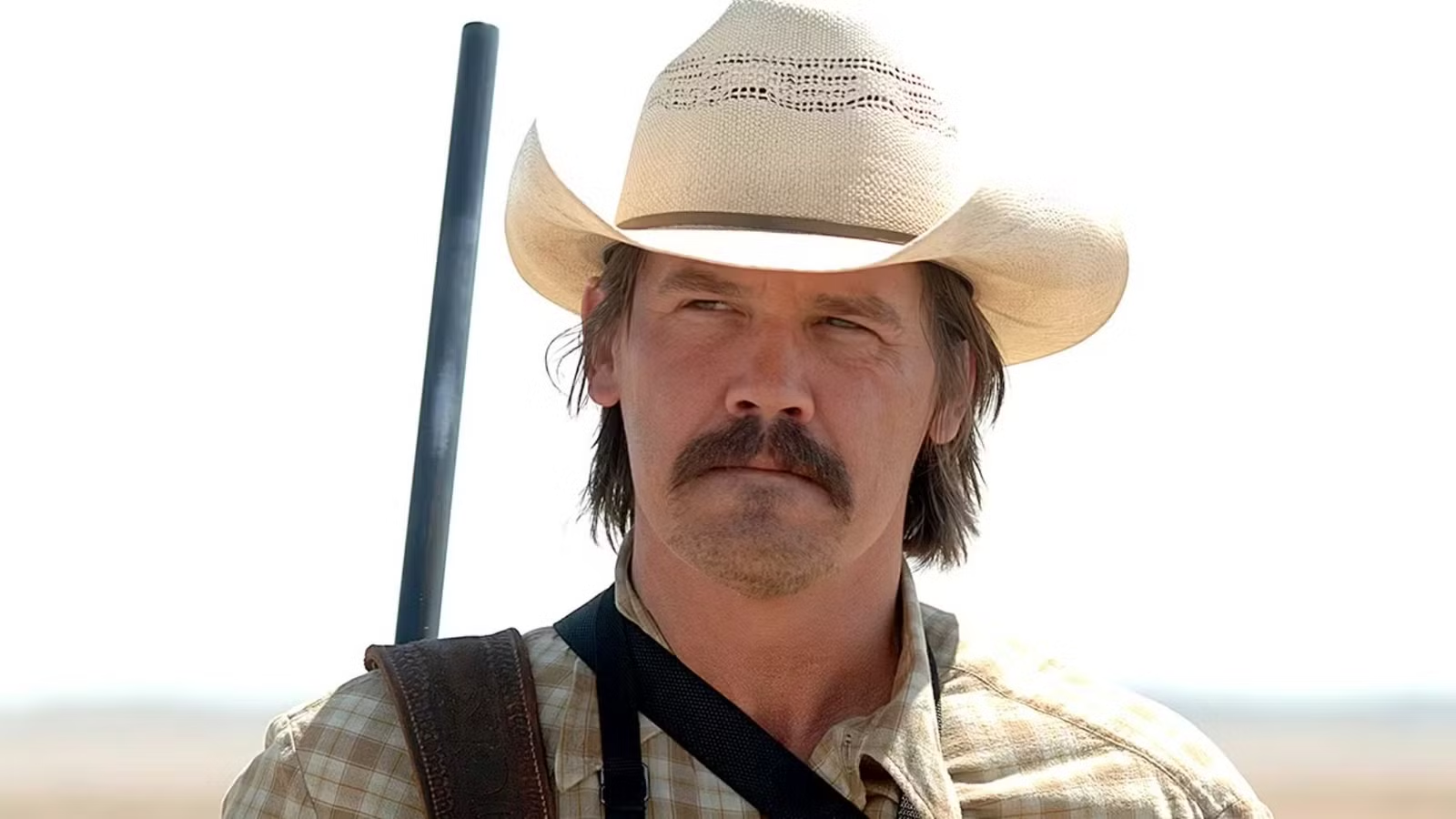
Although Einar himself is somewhat cynical, An Unfinished Life, which also features Morgan Freeman and Josh Lucas, is a more romantic look at the genre that highlights all the best parts of the modern, small-town West. It doesn’t pull its punches when it comes to the personal tragedy that exists in the real world, but it reminds us that there is still beauty, love, and companionship to be found in life, even after enduring the darkest nights of the soul. What more could we expect from a picture that stars the man who made A River Runs Through It? It’s certainly counted among many of the solid neo-Westerns that time has forgotten.
‘Logan’ (2017)
Okay, maybe it’s a bit of an oddball pick to choose a movie that is so blatantly a superhero flick, but Logan is a cut above the rest. From director James Mangold, a man no stranger to the genre himself, this futuristic neo-Western follows the title hero (Hugh Jackman) as he escorts his estranged daughter Laura (Dafne Keen) from the U.S.-Mexico border to a mythical safe haven for mutantkind called “Eden,” just shy of the U.S.-Canada border in North Dakota. As the pair travel alongside a mentally-declining Charles Xavier (Patrick Stewart), their pilgrimage across the American West is one of violence and bloodshed, something Logan hopes that Laura can one day move past.
Although technically a dystopian comic book movie, Logan is not only a neo-Western thematically, but in practice as well. If we simply substitute Logan’s career as Wolverine for being a gunslinger and the X-Men comics Laura collects for pulpy dime novels, the film’s place in the genre becomes quite obvious. Additionally, using Shane, one of the greatest Western masterpieces of all time, as the backdrop for the film’s gut-wrenching final moment is a cheap shot that Mangold performs quite flawlessly. Yes, Logan is a neo-Western, and it’s one of the very best.
‘Lonely Are the Brave’ (1962)

Long before the neo-Western was a terribly common subgenre, Lonely Are the Brave set the standard for what a contemporary-set Western could (and should) be. When cowboy Jack Burns (Kirk Douglas) purposely gets himself incarcerated to help a friend on the inside, he becomes a fugitive upon breaking out. With the law on his tail, Burns flies into the wilderness as if it’s the Old West, and he were an outlaw whose face is plastered across wanted posters. But this is the 20th century, and the “Old West” that Burns idolizes is no longer there to welcome him with open arms.
While it may feel a bit more like a traditional Western to us given its black-and-white aesthetic and how much life (and technology) has changed since the early ’60s, Lonely Are the Brave is a fabulous neo-Western that reminded us that the mythic West is no more, no matter how much we wish it were. Although based on the novel The Brave Cowboy by Edward Abbey, director David Miller makes this tale his own, with Douglas reminding the audience just why he was considered a knockout Western star. As a picture that laments the Old West as it once was, it has become one of the most forgotten Western classics out there.

Lonely Are the Brave
- Release Date
-
May 24, 1962
- Runtime
-
107 minutes
-

Kirk Douglas
John W. “Jack” Burns
-

Gena Rowlands
Jerry Bondi
-
Walter Matthau
Sheriff Morey Johnson
-