
About 40% of the world’s land surface is classed as drylands1 — deserts and water-scarce grasslands, shrublands and savannahs. Life can be tough for the more than two billion people that live there. In Chinguetti, Mauritania, Saharan dunes push into streets and courtyards, burying homes and forcing residents to move to other towns. In Mongolia, a lack of rainfall is placing immense pressure on herders and ecosystems, and sending dust and sandstorms across the border into China and South Korea2.
What China’s Great Green Wall can teach the world
Arid regions are spreading, owing to global warming. By 2100, half of Earth’s land area is expected to be dryland3, with five billion inhabitants1. And human activities such as agriculture are exacerbating problems by removing protective vegetation, compacting and degrading soil and reducing the land’s capacity to retain water.
To meet this challenge, many countries have set up large programmes to combat desertification. One of the largest is China’s Three-North Shelterbelt programme, also known as the Great Green Wall of China. Begun in 1978 and scheduled to run until 2050, the project involves creating a huge patchwork of forests and planted areas across northern China, spanning 40% of the country, to stabilize the movement of sand4 (see ‘A country-wide endeavour’). The intent is to shield farms, villages, roads and railways from the encroaching Gobi and Taklamakan deserts.

Source: https://go.nature.com/41SWANZ
Forest cover in the region has nearly tripled, from about 5% in 1978 to just under 14% in 2023. The area affected by soil erosion has declined by two-thirds. The intensity and frequency of dust storms have fallen5, improving air quality in downwind cities such as Beijing.
It’s not always easy. In the driest zones, trees continually die and the area needs replanting. In some places, planting of a single species has left forests vulnerable to disease. In 2024, about 27% of China’s territory was still classed as desert — a decline of only 1.5% since 2014.
Beyond China, green-wall projects across Africa, India and the Gulf states have struggled to reap benefits. For example, Africa’s Great Green Wall, a continent-spanning reforestation initiative led by the African Union, managed to restore only four million hectares of degraded land6 between 2007 and 2020 — putting it way off its target of rehabilitating 100 million hectares by 2030.
Over the past few decades, we have tracked desertification and efforts to combat it across China, Africa and beyond. In our view, countries across the world could benefit from adopting aspects of China’s strategy to keep more of the desert at bay.
Why green walls fail
Most green-wall projects start with a simple vision: plant more trees to contain drifting sand. Yet, early greening is hard to sustain, because young trees succumb easily to drought, grazing and neglect7.
Across the Sahel, for example, reported two-year survival rates for trees range from 60% to 10–40%8. In Senegal, only one or two of several dozen reforestation sites contain a greater density of woody plants than would be expected naturally8. In China, reports indicate that about 67% of the area planted in the past four decades remains green.
Plantings wither for several reasons. Trees need water and years of aftercare, but short funding cycles for projects don’t provide the long-term money needed. Often, little consideration is given to which species might thrive where, how water limits might affect growth and how projects might influence local livelihoods. Farmers and herders are typically given few incentives to nurture trees that might be seen as competing with their livestock for scarce resources.

For decades, China has used straw-chequerboard techniques, in which straw is partially buried, to control sand and let plants grow.Credit: Jiaojun Zhu
Reliable funding is rare. For example, Africa’s Great Green Wall depends heavily on money from international donors, much of which fails to reach the project at the local level8.
And a lack of coordination can hamper long-term strategy. In India, for instance, responsibilities for desert restoration are spread across the government departments for forestry, irrigation, agriculture, rural development and energy. This fragmentation blurs accountability for restoration outcomes and makes it difficult to make sure that choices about planting align with water budgets, grazing controls and long-term aftercare9.
Four lessons from China can help other nations to overcome these problems.
Change measures of success
For many green-wall projects, the goal is to restore as much land as possible to a desired ecological baseline. Often, donors ask for reports on easily measured activities, such as the number of tree nurseries established or training sessions held7,8. But more important is how desert restoration benefits people and the environment.
Initially, China aimed to green its dry landscapes quickly, mainly through planting fast-growing monocultures of trees. But the project has evolved (see ‘Changing strategies for greening in China’), and formally refocused in 2021 on how to use greening to help the country reach its goals around development and livelihoods.

Sources: https://go.nature.com/4VNDSB6 & https://go.nature.com/4SYKIXL
Now, rather than asking how many trees have been planted, green-wall planners in China ask: have dust storms reaching cities dropped in intensity? Are dunes still advancing towards roads and pipelines? Have sources of household income in target regions diversified and stabilized?
Tree planting is now more selective, targeted to support existing and new infrastructure, energy systems and livelihoods. Rather than taking a one-size-fits-all approach, the aim is for interventions to be tailored to local and environmental needs.
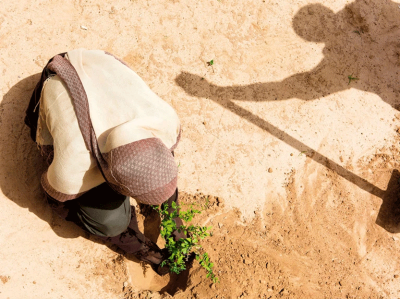
Is Africa’s Great Green Wall project withering?
In the Xinjiang region, the Taklamakan Desert Highway shows the promise of targeted greening. This crucial transport and oilfield corridor is protected by a roughly 440-kilometre stretch of stress-tolerant shrubs — a shelterbelt — which slows winds and protects the region from burial by sand and dust. The shrubs were initially maintained using diesel-fuelled drip irrigation systems that distributed locally available saline groundwater, rather than scarce fresh water. Built in 2000, the shelterbelt made clear the costs of greening in extreme drylands: expensive maintenance, diesel-related emissions and damage in some sections caused by continued dune movement10. Those lessons helped to drive upgrades, such as solar-powered irrigation. By 2022, the last diesel wells had been converted, with reports subsequently describing the route as China’s first “zero-carbon desert highway” (see go.nature.com/4tosddx).
Since the late 2010s, large solar and wind farms have also been constructed at desert margins in China, where high levels of sunshine and wind generate energy. The solar panels and turbines provide anchors for vegetation, protect farmland and act as hubs for rural industries, including renewable energy production as well as agriculture on land beneath panels. This approach can give locals incentives to protect and care for the new infrastructure and vegetation by providing them with jobs, land-lease income and grazing opportunities for their livestock. But care is needed: in parts of China, restoration has relied on top-down grazing restrictions to protect plants, and some people have lost their livelihoods. This causes uneven effects on pastoral mobility and incomes, with social costs outweighing ecological benefits11.

Straw chequerboards are placed strategically around features such as desert lakes and roads.Credit: Xin Gao
China’s targeted strategy can travel, but its models cannot be copied like for like. Each region will need to define its own goals, taking into account local environments. In the Sahel, for example, where tree survival rates are low, greening programmes might need to prioritize recovery of shrub- and grass-dominated vegetation, rather than continuous tree belts, to ensure that animals can graze. And in the Gulf states, where ambitions are large but aridity is extreme and water is costly, projects should factor in the cost of water per unit of dust reduction or cooling benefit, to ensure long-term viability.
Make use of China’s expertise
China has long used rigorous experimentation to design interventions that work. Other regions can piggyback on these decades of research to make fast gains.
For more than 50 years, China has used low-cost straw-chequerboard techniques to control sand across many thousands of hectares. Straw grids are partly buried to roughen the surface of the sand. This slows near-ground winds and pins mobile sand in place, buying time for shrubs and grasses to regenerate12. In regions with tight budgets, straw chequerboards could be deployed near villages, roads, canals and field edges, using local straw.
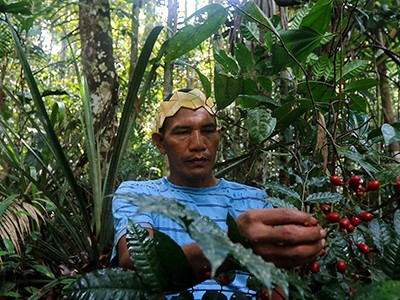
Why repairing forests is not just about planting trees
China is coupling renewables infrastructure directly with ecological restoration, by building huge stretches of photovoltaic arrays (linked collections of solar panels). One such base in Inner Mongolia’s Kubuqi Desert, for instance, generates 4.1 billion kilowatt-hours of electricity per year — enough to power a mid-sized European city. It is expected to restore about 6,700 hectares of desert and reduce annual sediment flow into the nearby Yellow River by about 2 million tonnes (see go.nature.com/4sokuez).

