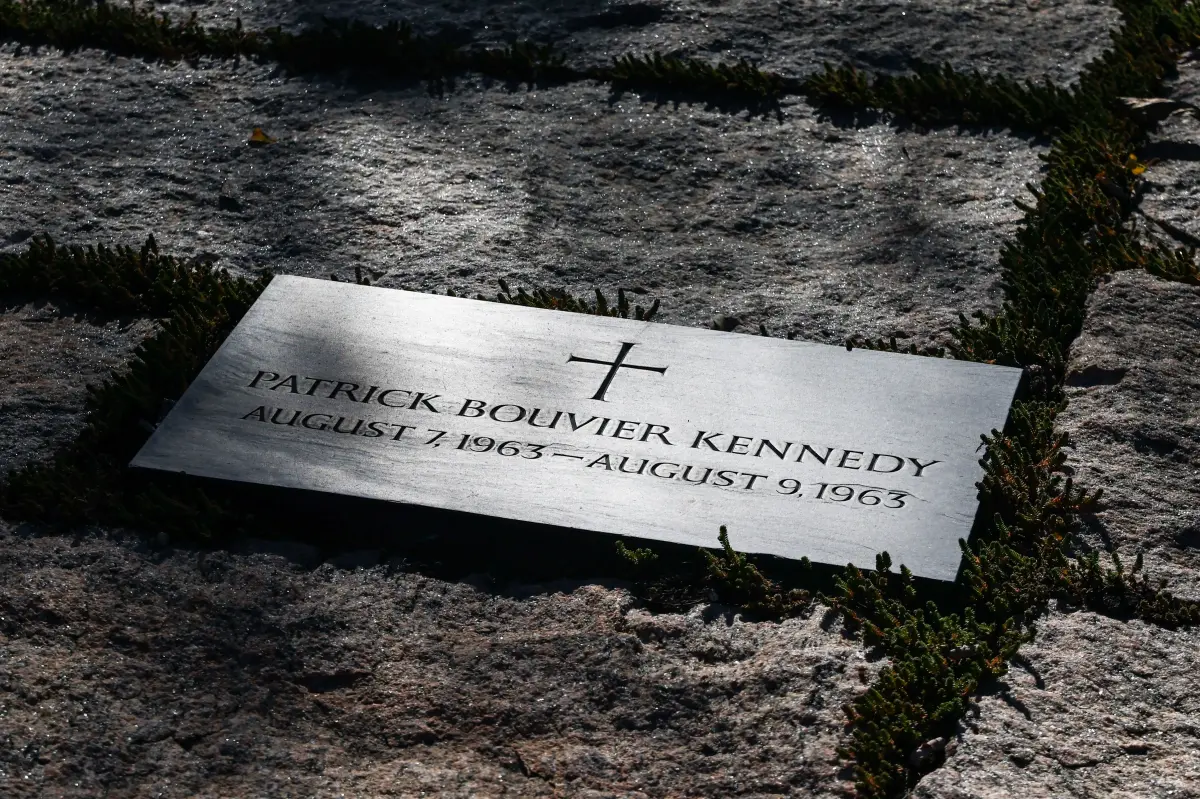
On August 7, 1963, First Lady Jacqueline Kennedy Onassis delivered her youngest child via an emergency caesarean section at an Air Force Base Hospital in Massachusetts.
Baby Patrick was five and a half weeks premature, and doctors immediately knew there were problems with his labored breathing.
“The infant had a translucent grapelike coloring, warning of an insufficient flow of oxygen to nourish the body,” writes Steven Levingston in “Twilight of Camelot: The Short Life and Long Legacy of Patrick Bouvier Kennedy” (Gallery Books; out now).
Patrick developed symptoms of hyaline membrane disease (HMD), later called infant respiratory distress syndrome (IRDS), and didn’t survive, but his death would push doctors to come up with better treatment options
“His case motivated neonatology researchers to push the boundaries of innovation,” Levingston writes.
The President had been aboard Air Force One when Patrick was born. He arrived soon after, the baby was quickly baptized, and, hours later, rushed to Boston’s Children’s Hospital, where he was placed in a hyperbaric chamber filled with oxygen.
Jackie was too weak from surgery to visit her son, so the President spent hours at the hospital.
In the early hours of August 9, doctors summoned the President, who had taken a break in the hospital basement, and told him he needed to come back immediately.
At a few minutes past 4 a.m., Patrick’s overtaxed lungs gave out, and his heart stopped.
“He died inside a colossal steel contraption while his father peered in at him through a porthole,” writes Levingston.
“‘He put up quite a fight,’” Jack murmured. ‘He was a beautiful baby.’
Press secretary Pierre Salinger remembers that the President, “walked away from us and through a door into the hospital boiler room.’ Out of sight, ‘he wept for ten minutes.’”
Jackie later told historian and Kennedy special assistant Arthur Schlesinger that Jack collapsed in grief, the first time they saw each other after Patrick’s death. She was “stunned” by his emotions, having “never seen anything like that in him.”
The couple had already weathered several losses.
Before giving birth to Caroline in 1957 and John Jr. in 1960, Jackie had multiple miscarriages. In 1956, she’d given birth to a stillborn daughter while Jack was on a cruise in the South of France — supposedly a “bacchanale,” with young women “getting on and off the boat at its ports of call.”
When Jack was informed that Jackie had given birth to a daughter, whom they had planned to name Arabella, he initially refused to come home. It was only when a friend advised the then-senator that it would hurt his chances to run for president if he didn’t that he reluctantly returned to the States and his grieving wife.
Some in the fecund Kennedy family blamed Jackie’s difficulties on her heavy smoking habit, but her husband may have contributed to his wife’s challenging pregnancies.
When he was a senior at Harvard, he contracted “a venereal disease that presented the symptoms of chlamydia which persisted for years,” writes Levingston. “Today, chlamydia in pregnant women is known to cause premature labor, low birth weight, and fetal development outside the uterus, resulting in miscarriage.”
The President channeled his grief over Patrick’s death into action.
In October of 1963, he signed a two-bill package totaling $594 million ($6.1 billion in today’s dollars) that set aside research into maternal and child health, improved prenatal care in impoverished areas and establishing research centers.
“In 1963, hyaline membrane disease was killing an average of 25,000 babies a year in the United States,” writes Levingston. “The chance of survival at that time was about 50 percent for a baby, like Patrick, born six weeks early with a lung ailment.”
By the 1990s, thanks to government-funded research, the respiratory disease had largely been eliminated as a primary cause of death for premature babies.
Dr. Robert DeLemos, who helped deliver Patrick, was devastated by the baby’s death and dedicated the rest of his life to finding a solution. He worked to develop a ventilator — the Baby Bird — specifically for infants’ needs. It would give children like Patrick a nearly 99% chance of survival.
“Over the years, Patrick’s story informed DeLemos’ teaching,” Levingston writes. “The loss of the President’s baby had a powerful impact on him, one he never forgot.”
The author notes that the loss also brought John and Jackie closer together. Just over three months after his passing, a grief-stricken Jackie uncharacteristically agreed to accompany her husband on a campaign tour to Texas.
It would be on that tour, on November 22, 1963, that JFK would be shot and killed, sitting next to his wife.
He was transported to Parkland Memorial Hospital in a desperate attempt to save his life.
After he was declared dead, Jackie remembered that her husband had slipped a St. Christopher medal into Patrick’s casket and wanted to do something like that.
Jackie slid off her wedding ring and, while alone with Jack’s body, tried to slide it on to her husband’s pinky. It stopped at the knuckle, but an orderly stepped in with some hand cream she managed to get it on.
The First Lady kissed the President’s hand and bid