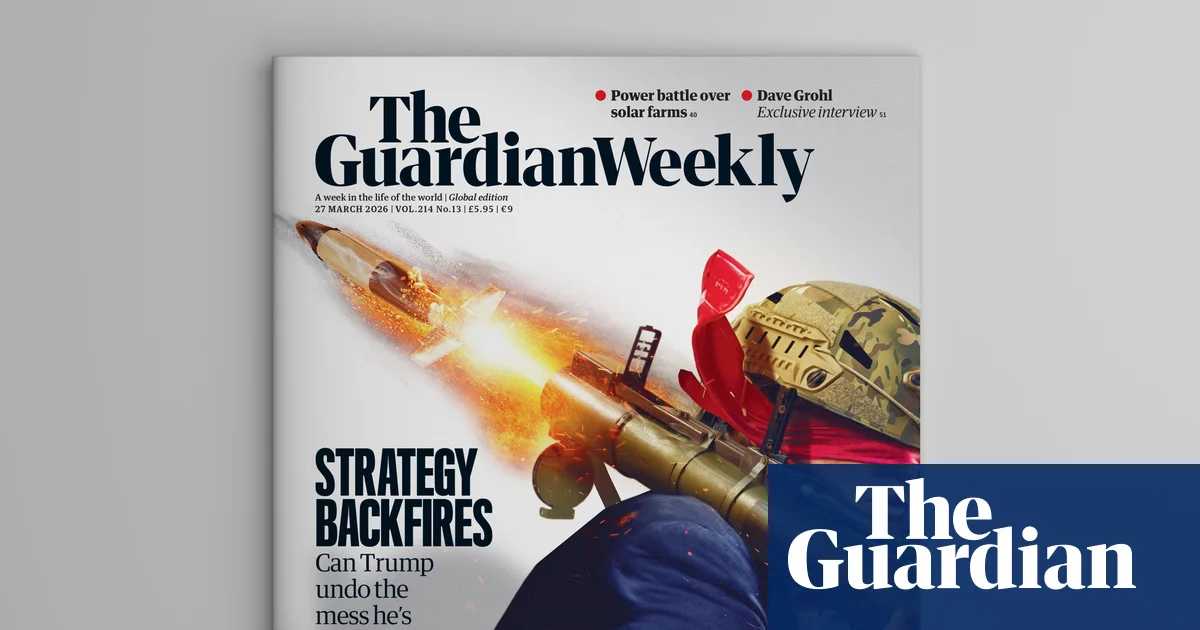
Brinkmanship, the ability to take countries to the edge of conflict, was a staple of cold war diplomacy. The remnants of that finely balanced standoff, bound by a rules-based order and spheres of influence, has given way to a world in freefall; to an ever-widening war in the Gulf where the aims are as unclear as the endpoint.
It is approaching a month since the US and Israel launched their attacks on Iran, arguing they were acting to remove the country’s nuclear threat, destroy its ballistic missile capability and free the populace of a tyrannical theocratic regime. Yet it seems it is these civilians and neighbouring Gulf countries who are bearing the brunt of the campaign while the Iranian regime’s willingness to escalate the war seems undimmed.
In another extended big story, Patrick Wintour recounts the week in which the world tipped into freefall. Richard Partington explains how a prolonged conflict is likely to have long-term effects, from oil prices to inflation to growth. From south Lebanon, William Christou talks to health workers caught in the crossfire of Israeli airstrikes.
Meanwhile, Emma Graham-Harrison reports from Jerusalem, where the Israeli PM, Benjamin Netanyahu, hopes that destroying an “axis of evil” will rehabilitate his image. Finally, Simon Tisdall asks, when US president Donald Trump does try to stop the war, will anyone listen?
You can keep up with the latest news, commentary and analysis on this ever-evolving story here.
Get the Guardian Weekly delivered to your home address
Five essential reads in this week’s edition
Spotlight | The ‘anyone but’ election
Pippa Crerar looks ahead to local elections in the UK, where voters seem more concerned with who they want to keep out of political office than who they vote in
Science | Not-so silent nights
Can a “vacuum cleaner turned the other way” become a popular solution to snoring disorders? Natasha May explores the rise of Cpap machines
Feature | Gamifying government
Steeped in gaming and rightwing culture, Elon Musk’s Doge team set out to defeat the enemy of the United States: its people, write Ben Tarnoff and Quinn Slobodian
Opinion | Collateral damage
Attacks on synagogues and Jewish shops in the UK, Europe and the US don’t hurt Benjamin Netanyahu, says Jonathan Freedland, they just hurt ordinary Jews
Culture | Rock return
“Validation was an insatiable monster”: Dave Grohl talks to Ben Beaumont-Thomas about Foo Fighters, life after his infidelity and grief for bandmate Taylor Hawkins
What else we’ve been reading
In 30 thrilling minutes on Sunday evening, the British trio of Keely Hodgkinson, Georgia Hunter Bell and Molly Caudery each won gold at the world indoor athletics championships in Poland (in the 800m, 1500m and pole vault respectively). Sean Ingle spoke to the husband and wife coaching team Trevor Painter and Jenny Meadows, who have guided Hodgkinson and Hunter Bell to the very top of their disciplines. Their approach, writes Ingle, combines “art, science and [an] arm around the shoulder”. Clare Horton, assistant editor
Having spent the last week or so hill walking in the Scottish Hebridean islands, I was naturally drawn to this piece on routes exploring the Beinn Eighe national nature reserve in Scotland’s rugged north-west, an achingly beautiful landscape of jagged rock peaks and deserted moorlands. Graham Snowdon, editor
Other highlights from the Guardian website
Audio | Off Duty: The Crime – Full Story podcast
Video | Abel leaves LA: self-deportation from Trump’s America
Gallery | Teenage kicks: Camden’s Museum of Youth Culture
Get in touch
We’d love to hear your thoughts on the magazine: for submissions to our letters page, please email weekly.letters@theguardian.com. For anything else, it’s editorial.feedback@theguardian.com
Follow us
Get the Guardian Weekly magazine delivered to your home address